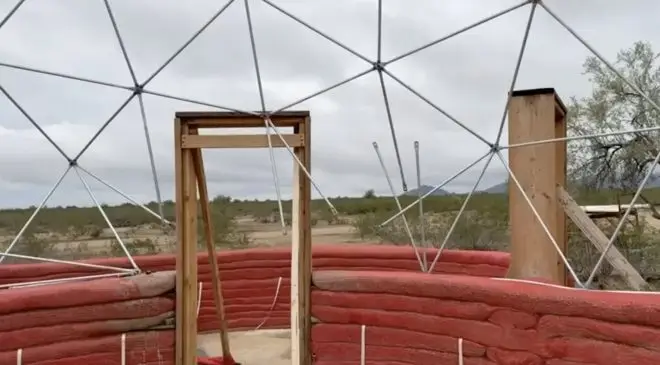
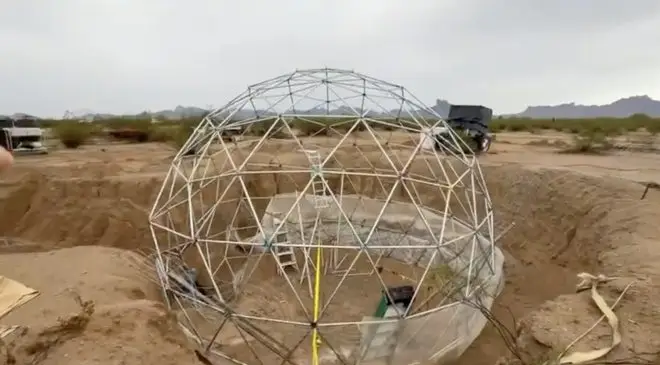
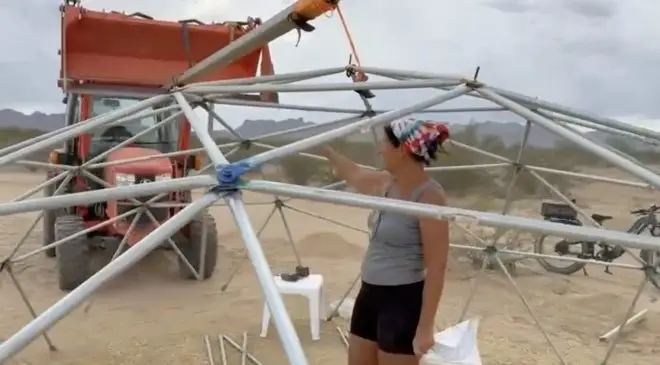
In this episode of Occupy the Land, we advance two key self-sufficiency projects on the Arizona desert homestead. For the root cellar, Ernie produces EMT conduit struts with the stamp press for the 20ft geodesic sphere, explaining the fabrication process, hole punching, color-coding, and assembly planning. Simultaneously, Donna and Ernie finish securing the chicken coop with a full hardware cloth floor (trenched and packed to block tunneling predators like ground squirrels), wood shavings bedding, and ventilation setup as the chicks (now ~3-4 weeks old) transition into their larger run. Practical, parallel progress on food production and storage! Peace.
Transcript:
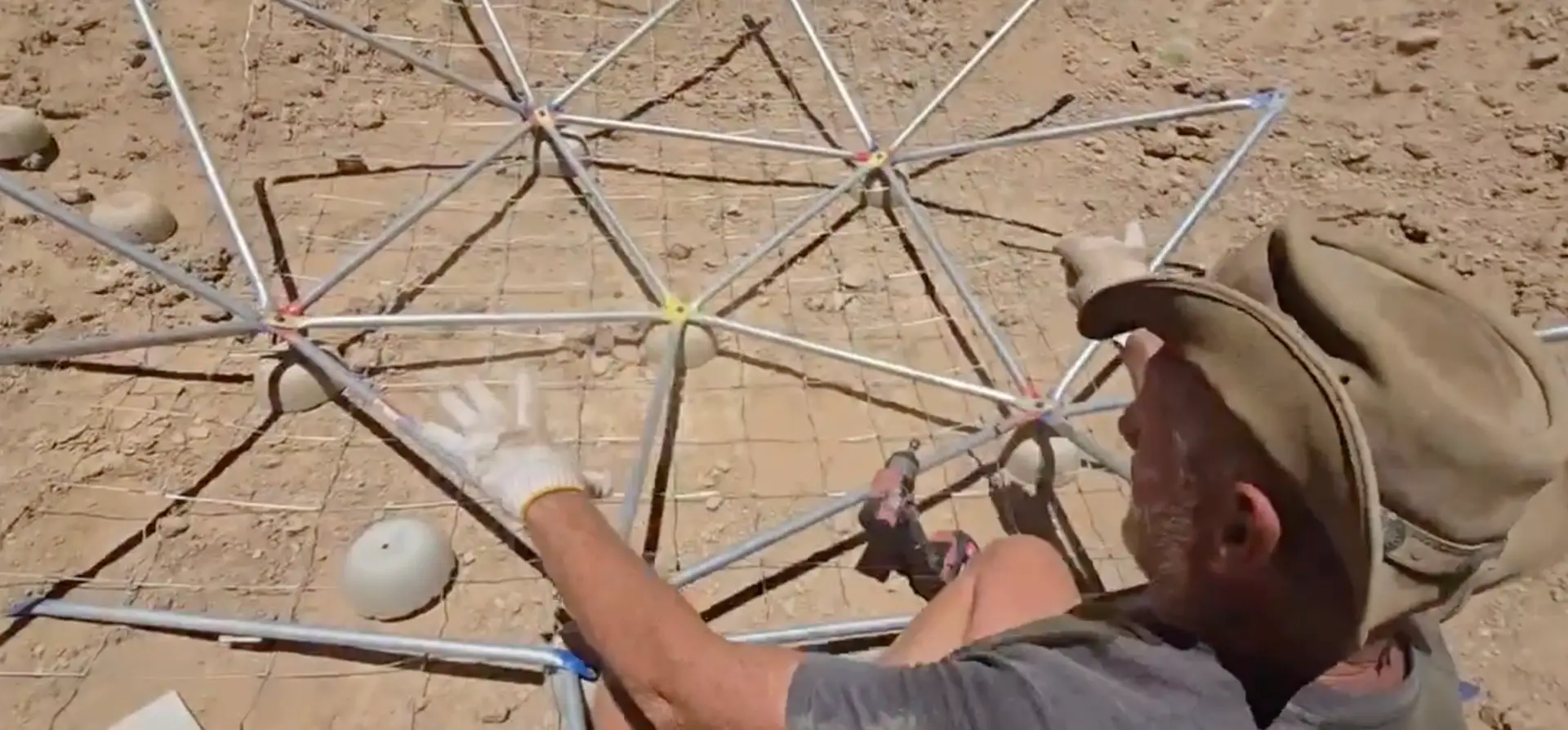
Okay, it’s time to start putting the struts together to create the sphere. But the first thing, especially on the bottom here, I need to put the wire reinforcement that’s going to go underneath there. So these struts going to have wire tied the fence to them. And I’ll start putting the border around that star. And then do another star and another.
And it’ll go pretty quick. I just need to get everything ready for probably later the day to do it, because now it’s like there’s no shade in the hole, man, it is hot. So now 107 or something, I mean, it’s something ridiculous. So we’ll go ahead and get this done to where we can do a couple of rows so you can kind of see how it’s going to work and why we needed these.
So we’re getting there. Here we go.
Welcome to occupy the land. Occupy the land. Now what we’re demoing today. We’re getting started. But it’s a, you know, 108 degrees or something. The middle of the day of the bake, you son of. We’re going to do it later. But to demonstrate what happens is this geodesic sphere sizes itself. You have the shorter struts. This is the very bottom.
And it’ll be identical at the top about 20ft up that way. Now what we do is you follow the graphic and we’ll have a graphic up there so you can see what’s going on. And it automatically gets its shape. So you can see that this is about the angle that it’s going to start coming up. So we have to put dirt underneath these concrete things.
And this is what we made in a bowl. We put a straw in it filled it up turned it over. And this is where the bolts are going in to hold it up off the ground and get it sized right, so we can still have the cow that’s in there in bed, the struts and this cattle fence. So this will get wire strutted to that.
We lay this out first and then we just tighten it on it and then we’ll embed it. Now this is what’s happening. These struts have a certain way that they go together. And the reason we have an angle like this is because it has to conform to the angle that it does. Now this hub is a complete hub and it has the yellow the short ones bordered.
All of the five stars are bordered by these red. And then you have the blue two of them and then the orange. And there’s one other size I think longer we haven’t got to yet. So put these together, I can.
This is where having no set of hands helps. But Don’s doing the camera.
And we just put it together. Paint by the numbers, and then you have. It just starts to come together. Just put another, you know, usually 5 or 6 struts per junction. This one’s a six. That’s a five. So we just keep building it and then we’ll put dirt underneath here and we mud it and so on. We’ll do it in sections.
And then that bolt can get down here. So you can see that bolt goes in there.
That sits down there. And we that up there. So that goes down there and sets like that. So we have to put you know mud and so on and Neath here and kind of get it that angle. So we just keep doing that around and around and around and start putting mud in. Now we’re probably going to do another row or two or something.
But you want to be able to get this fence underneath. So that’s another thing. I’ll turn around and you’ll see we’re just unrolling it from there, pulling it with the ATV up there, and then that will come up around it and then wrap over the dome. And then we do some others and sections and try not to cut it as much as we can.
But down here we’ll take and wire tie these to the struts and with a cinch it triangle by triangle, we just kind of get it tight, and then we just start embedding it with mud. So this angle on nowhere. And then once we get this structure then we can build whatever we want inside it. So this is how we’re doing it.
You know, it’s not too complicated as long as you’ve done it before and you got a map, but you know, these will automatically size up and get to the right hole. And that’s why it’s so important to when you cut these and stamp them out, that there is what the math says. And then there’s going to be a green that comes around the outside here.
And you can see, you know, this is once you get started it goes pretty fast. But we’re going to do it later when it’s not so freaking hot piece.
And the chicks are getting bigger. You know, the buff Workington is the small Buffy’s. They call them. I really like them. You know, we’ve had these kind of chickens before and there’s a lot smaller because they’re probably a week younger or more, but they’re growing pretty fast. That’s all they do is eat. But Donna’s got a mister up here that this is battery opera.
I guess we could plug a solar in, or we can plug it in, but it does long enough to. Just enough misting in this area. That’s why I’m sitting here. Because it’s cooler here, but it’s showing between 108 and 115 degrees, depending on which that you look looking at. So we’re going to go for a little while and take a break and maybe come back later this afternoon and do some more work.
But Donna’s over there finishing up her hardware cloth, the square metal stuff over there because she came in one time and a ground squirrel kind of got in or went through. The door was open and she couldn’t get it out and kept running and hiding behind the plywood and so on. So we came back out. It had a couple of holes that dug itself out and was going, yeah, I can get out.
Well, I just used oh yeah. So she’s put the entire floor is covered with that hardware cloth. She wants to keep the snakes and the gophers and ground squirrels and, you know, whatever the heck out of here to save them. So she’s doing it right. First time. So she’s almost done with that. She’s put that down, put dirt on top of it.
Kind of wired it so they can’t. If there’s an opening they’ll find it. And then she’s going to put this wood chip down in there. And probably by tomorrow she’ll have this open and they can run around the whole hen house. So we kept them in a little tank. Then we let them come out in this area and then we’ll just open it up.
But this is probably more secure for predators and so on. And when they get big enough, it’ll probably be about, you know, 5 to 8 months, you know, around in there they’ll start laying and then we’ll just come get eggs. And then usually what we do is we add another dozen or two about every year or six months or so on, because as time goes on, they come less productive after about, you know, 3 to 5 years or something.
And, you know, I don’t care. You know, they’re a good they get along well. All their chickens have got along really well. As long as you have enough food and water for them, they’re polite. They start getting limited resources and, you know, it becomes the Middle East in here.
Making advances.
So the inside of the chicken coop is done. But now I’m trying to fortify it. I fortified the whole coop for large animals, but having an issue with ground squirrels, prairie dogs, they just tunnel under and get in all the time. So I’m taking the hard work on it on the bottom of this part of the coop so they can’t get in.
So I got to dig down a little bit, put the cloth on it, and then put the dirt on it, and then I’m going to wet it and pack it in there before I put the wood shavings on there. But the chickens, the baby chicks are doing really good.
They’re about a month old now. Three weeks to a month old.
All right. As you saw earlier, we put the hardware cloth down on the whole section of this outer coupe, and then we put dirt in here. Tent it down pretty good, wet it and kept building it up until it was level. And now Ernie’s going to throw the wood shavings down. Next time we’ll do straw. But right now they’re just a little bit too little for straw.
Can’t navigate very well. So we’re going to put the shavings down and we’ll let them out.