



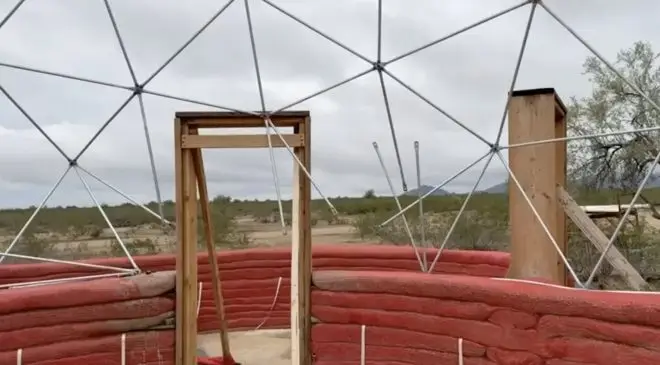
Undeveloped Side vs Managed Side — Same Rain, Different Result
Welcome to Occupy the Land. After the rain we walk
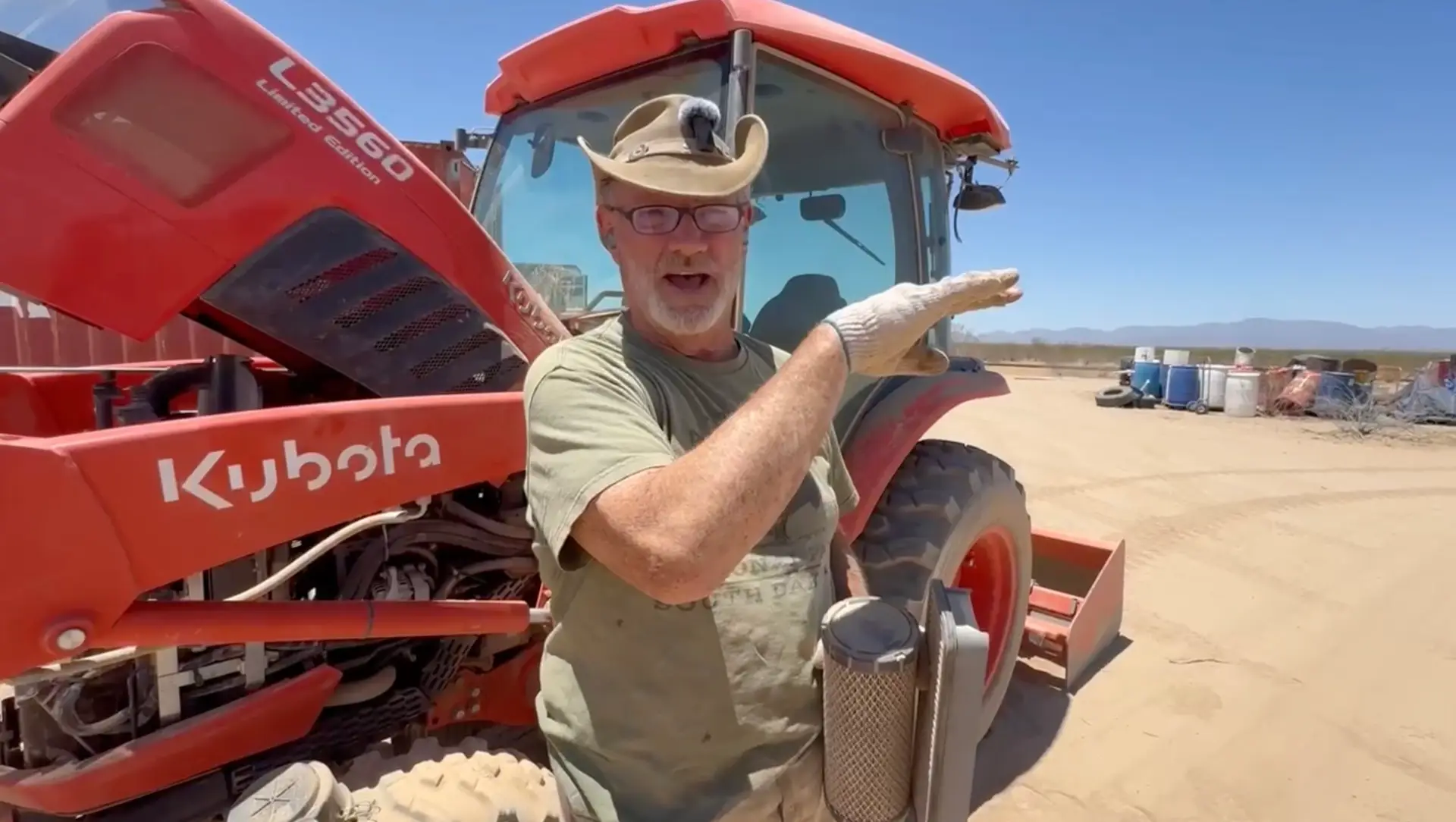
In this comprehensive update from Occupy the Land, Ernie walks through current projects and progress on the Arizona desert homestead. With the workshop pad complete, we prep for strut fabrication on the 20ft geodesic sphere root cellar while managing tractor maintenance and greasing. We reinforce dikes and berms around the sand pond to capture monsoon water, create biochar trenches for the future orchard terrace, and expand food production with the chicken coop and garden. Power systems are solid across multiple stations, and we emphasize the motivation for self-sufficiency amid rising costs and uncertainty. Steady, parallel progress toward resilience, water independence, and thriving on the land! Peace.
Transcript:
Welcome to occupy the land. Occupy the land. Don and I are taking a break to give you a video update on what’s going on this week. And we’ll put this in with all the other little video. But the first thing is, is I got to grease the tractor for doing a lot of the work in the third. That gets really dusty and everything, and every ten hours or so does the grease it and blow out stuff.
And that’s what I’m going to do now. I won’t bore you with all the greasing and everything, but I have a battery operated green man that makes my life a whole lot easier.
So then take this battery operated thing, put it in. Pull the trigger and it does the breezing. The thing is, is that I got to go around. You show here. I got to go around and clean all these arts, you know, and get them nice and clean and do that. And it gives me a chance to check all the, you know, like I need to replace this pen here was coming out.
And so I, you know, do all this time to Greece. It and it’s also over here. There’s two things that you’re dealing with this dust. I mean, it’s fine dust. I mean, it’s just I mean, but this does is part of that collegian, you know, this is what binds. It’s almost like Portland cement. So I got to blow this out.
And then I have one up here. As for the cab air conditioning, you know.
I mean, it gets dirty. So you blow these out regular or, you know, mess that up. So I’m going to go ahead and blow these out. Donna will help me clean off the search and so on. I’ll go around and do all those so I get another couple of days out of that, and then we’re going to go ahead and show us taking the tractor and going over to leveling out the berm, the dikes that we’re building with all the soil that’s coming out there.
And I’m kind of doing something over there. I’ll explain to you, and we’re going to go ahead and get the reinforcing fencing down one of the runs in the root cellar hole first, because the dome will set on that, and then we’ll go ahead and do a couple of junctions. So you just kind of see what’s going on and we’ll get started on that.
But there’s a whole bunch of things that we have to do because probably about three weeks, you know, we got maybe we’ll get a month. It’s going to be monsoon time and whatever, we don’t get ready for the drainage and so on and try and retention of the water. You’re not going to, you know, so we need to do that.
And one of the reasons why I’m doing what I’m doing over in the sand pond, because we’re going to start trying to collect the, the monsoon water, and we got tanks that we’re going to be put in. We were running up against them. We got lots of things that are in parallel and can we get them all done by like mid-July.
And if we can do that, we win. If not, I mean, we’ll we’ll make do with other stuff, but things are going well. It’s just like so many parallel things and all of a sudden, boom, they’re going to come together to go. All right, all right, all right. I see what you’re doing. One of the things that we’re going to do that is really make Donna’s life easier and be kind of cool, and I want to get the root cellar in, is the bridge that goes between the garden area and the chicken area.
That goes over, because I’d like to keep that ramp. I fill it in and just make a stairwell comes down. But it would be nice to have could just back her Polaris up, load and unload stuff in the root cellar. So we’ll see. I mean, there’s different things we can do, but you know, we’ll be right back a little bit.
We need to get this all breezed and blown out and so on. And then we’ll show you what we’re going to be doing with the dikes.
So Ernie’s getting ready to blow out the air filters. And we have to do this on our cars, on our hilarious on the tractor constantly because it’s so dusty out here. They just don’t run well when we don’t clean them.
That’s a lot of dust.
So the chicken coop is structurally done. I just need to seal the wood. And I’m going to use boiled linseed oil, which is flax seed. So it’s safe for the animals. It’s not going to hurt them, the fumes or anything like that. It’s just all of a natural type thing. So that’s what I’ll be doing today for part of it.
And the other is I’m going to be installing an exhaust fan and some misters in here, so it’ll keep it a little cooler.
The baby chicks have graduated from being in the stock. Take two now they’re in their smaller area there. Seemed to like they weren’t sure at first, but I think they like.
Well, Donna was out earlier this morning. Let me come check out what she got accomplished. And it’s starting to come together out here. I think she’s going. She ordered some denser shade cloth, a little brown, little less light. She thinks it’s too much light in here and it’s going to be too hot. But you know, she put the trough out here and.
So she’s got it kind of set up. And there’s a feeder. And I got her electricity out here, you know, just so she can see. What are we at. Oh it’s hot. So the chickens are join themselves in a lot larger area. They’re getting bigger. Donna, put hardware cloth around the rim. It’s still inside the enclosure, but we don’t want them to get behind the plywood there and get stuck or something.
So she’s got it all set up now. We still have hardware cloth to put on this opening here. And this is I just got it kind of hooked up here just to see where we want to put something. But boom, that closes. And we were like, we had this before or a chicken coop that we had built years ago.
And that came in handy. Dandy. You know, being able to open that up and use that shelf to work on. So it’s doing well. You know, I’m looking forward to watching them grow. It’ll be fun. Good job Donna.
Now the community pad that’s over a 30ft diameter concrete six inch pad over there, 4 to 6in around. I can just put the tractor in their work on it among concrete, not the dirt and everything. And that, you know, I had to tighten some stuff, do some maintenance on it. But I also wanted to check to see if the front loader would be able to go high enough with a, you know, a man lift that you put on the forklift.
And would it go high enough to be able to pick that up and then just walk it over here so it looks like we can do that and I’ll get to that another time. But I just wanted to test to see because we’re going to put it over here somewhere, I think maybe over there or over here, and we’ll work on that later.
Make a big greenhouse out of it. Now she has her garden in there, but she wants to expand that and we’ll make that dome because we just need that was always temporary. It was the pad that we’re going to build an outdoor community area and shade it, and outdoor kitchen and all that stuff. And the root cellar going here.
Now, I have of the six strut sizes, I have four of them done, and I have see 180 struts that I have to do both sides. So what’s that 300 and a bunch 360 chunks. I got a chunk chunk of chunk on the stamp press and then I’ll be done with that. So I’m going to go ahead and try and finish that today and tomorrow.
I might be able to get it done today. Sit there and just listen to a novel and kind of get on it. And there is the chicken coop. Don is going to put a darker or denser covering on it, the shade it more. I think it’s fine, but she wants it a little bit more shaded and she’s starting to clean this up.
Now. Here is, you know, we have some old free panels that my son, you know, got somewhere and just gave them to me. And it was enough power to charge the power station that I did. For now, we just have an extension cord that goes over her garden area, and then ran a cord over to run all her chicken stuff and pumps and misters and whatever she wants to do over there.
But what I did is I went through a lot of different iterations, but finally what I did, I used all of these trailers. I got two more of these because this thing worked so well. I really liked it, but I sacrificed one. I knew I was going to do this, make a portable power station. I can just take anywhere on the property and use and the I need a new charge controller because that was just not programing, right?
That’s what’s been my problem. This is one of the two inverters that we had on the bus before. We put in a new one that was a lot more capacity and did better because the charge controllers on these went out. Usually you just take the solar panels, put them right into that, and the inverter is also the charge controller, but it’s not working.
So in a couple of days I’ll have the new charge controller so it can charge from these solar panels. And we just take them, put them over. We have a charger over in the workshop that I just charges batteries, but there are 12.8V 300 amp each and I have four of them. So I put two of them because I needed a 12 volt to go to 24 volt for this to work in this inverter, because it’s 24 volt system for the the bus.
So we took and 24 volt system going into this inverter, which is powering everything, but it’s not solar charging yet. I can give you a couple of days and I’ll get a new charge controller. Put that on, because I think some of them over that one. And then we did because we kicked in off this inverter. You need to usually that’s done to power a breaker box.
You know, a control panel with breakers in it and I checked I’m going. Can’t you just run it straight to a GFC and yes, you can. So that’s what I did. So I just took some Rumex and put it in powered that. And then you can do, you know, power strips and whatever you want. We got one cord.
Go into the garden area of one to the hen house. This is enough. That is. What does that be like 7000 or something? I mean seven kilowatts, 7000W. So she’s going to have enough power to do, you know, for days and days and days and days and we can go chart. We probably wouldn’t even have to charge it until we get the charge controller, let the solar panels do it.
And I still have probably like ten extra. There’s a couple extra there, but I’m thinking we’re going to be doing a lot of little stations like this. But I like this because I got, you know, 6 or 7000W that I can just wheel around, do whatever I want on the property. So that’s cool. I’m good with that. And then she’s not going to have to do anything worrying about power.
The other two batteries that I likely will put the here make it a real man. It’s going to be as much power as on the bus is, because we have refrigerators and freezers and.
What they call mini splits and so on for climate control on the root cellar here. So that’s why we had this power station going here. And if I need to do more panels, I will buy a doubt. I will have to. So we’re getting there. You know, it’s getting them where it’s more convenient. She’s not having to haul around the eco flow battery anymore.
And now she’s got power. So we have power at the bus.
We’re at the workshop. That little room right there, that little shed has all the power there. And then, of course, she’s got her hen house and garden area, so we’re living pretty large.
So Ernie’s finished with the dome struts, and he’s loaded them up on pallets and he’s bringing them over to.
So Ernie’s finished with the dome strut. So he’s loaded them on a pallet and he’s bringing them over with his tractor to the root cellar pit. So we’re one step closer to putting this together.
Okay, here is the entire sphere. This is a 20ft sphere. So this is like double what normally it would be. We have them color coded. They’re all done. They’re ready to start assembling I’m going to start doing. We got a lot of stuff to do. The big thing is is we’re going to get two tanks of water up here and start softening this to, you know, start making the shape I’m going to need.
Then I got an empty the trailer that with all the water tanks and put the water tanks here. Then go get a bunch of soil and start piling it up where you see that pile over there. And we’re going to go ahead and just start mudding it in, you know, building it up and put those stands for it to lift it up a little bit so we can get, you know, a good dose of mud Cal Crete, you know, this hard stuff.
It’s like cementing it in. So this is what I’ve been doing for a couple of weeks. Just cutting these, punching them out, getting them all organized and ready. And it’s, you know, paint by the numbers. That’s what we’re doing. And then there’s a bunch of other little stuff to do too. But this is one of the things that we got to get started.
So here we go.
Okay. This is the fence that we’re putting around the property. And I got extra. But the main thing is it a little bit smaller at the bottom. That’s good for livestock and for us for dogs, you know. So this will go on the bottom. Let’s go out. And this is our fence. Now this is also going to be a reinforcement around the struts that help lock in the the soil and so on.
Now for the bottom part. I don’t think we’re going to be using mesh. I’m not going to worry about it that much. As we get to the halfway point going up, we’ll have this. And then probably a fighter glass mesh that’s about, you know, four millimeters squares that we’re going to put on this. I’ve already ordered that, but it’s going to be a while till we get to that.
So this is probably going to roll out. Go up the side over there, roll out that way. And we just kind of cover it and do the bottom of it. This is what I was talking about. Normally when you make a dome, you do tighten that as much as I can. The when you do a dome, you can see why I bend the ends here a little bit so that it has this angle.
Now when you do a dome, it just keeps going up. It goes up, it goes up. And this is the top center of the dome. But as a sphere we’re going to put this is the bottom. And that’s why I needed these I’m going to put this on the bottom. And this is about the middle. And do this boom.
Now that is what gives us the spacing that I want to have the.
Kalki and Cal Crete kind of give me a nice base to embed this in, where it’s going to mix up the mud in our cement mixer on the tractor and just dump it in here and smooth it out. And as you get it wet and it gets kind of solidified. Now we’ve done this, we wet this yesterday just to get it so it would harden again.
Now this here. This is the clay.
This right here. And make pottery out of you know get this and you grind it up fine. And you start making pottery. So this stuff here is what we’re working for. We’re making it hard. Now, what we did is the stuff that turned to powder as we’re messing with it and so on. Scrape this off. We got it wet and reconstituted it.
And it went.
I don’t remember well, it was around here. So anyway, you can’t tell. Okay. So it goes back in and gets really hard. So this is the bottom of the root cellar. And it’ll start to come up as it goes around. So as we build it we’ll go ahead and wire tie the fence to it. The fence will just be under it.
It’ll start in the middle. And just wire tie it and stretch it, wire tie it and stretch it and just keep doing it. And then we’ll just mud it in. It’s really that simple. When we get to the halfway point and it starts to come in again, that’s where we’re where we’ll put the mesh on, because we’re probably going to put Lava Crete on it.
It’s pumice scoria, lava rock. Okay, now you can see how much higher this is when we stand in here. You know, this is the berms that we do to control the water. Now, when I come over here and I’ll show you what’s up, what we’re doing is the hole is on over there. You probably can’t see it over there, but all of this is shaped to go that way.
And then we start cutting it back more and more and more. But we’re getting close to the monsoon. So what’s going to happen is all this, you know, that’s, you know, biochar that we’re making and but be the orchard kind of stuff. And we’re doing our second row of biochar that we’re going to make, and we might get a third and fourth one in there.
I really like to get this done up here so we can start planting citrus trees. At least now over here where this wash comes in. And there’s one there, one there when there’s like five that feed into this. But this one, I can regulate it to where it can feed up to the upper area or come down here and the overflow that goes around this dike that separates the orchard part from the water retention part.
Now, if I had a big giant loader or a bulldozer, an excavator and, you know, gold rush equipment, I would just take all this soil out. But two things I wanted to show you here. You can see this is the hard, you know, when you take the back blade on that tractor, it doesn’t go down, but a couple of inches and you can see this kind of white stuff.
That’s the calcium. So that makes the cow critter the key and it’s hard. So what I wanted to do is just run around up here and so on is just take and scrape off all the loose dust. Because this clay, this silt dust, whatever that makes the with the calcium and all these rocks that are in there, it gets loose when it’s dry.
It has it rained, you’re driving over it, you’re doing whatever. And it just makes this layer of dust. So I’ve been pulling all that dust over there for this reason.
When the monsoons come and all this water starts going this way, I wanted to get rid of the light clay and dust as much as possible. And you watch when I walk out here, you’ll see how.
I mean, you know, it’s it’s dust. So down here, that’s down here, that’s the level of where the water tank is going to go. So I have to bring that level up as it angles up there and angles up this way. I need it to angle back this way and I’ll turn it around so it comes up as a ramp.
That’s what I’m building here. The flow from there will come gradually down. So I got all this dirt here to get rid of. It’s going to take me probably a week of doing this, you know, off and on. And later at night when it’s cool, when I feel like it and I got to listen to some music or a book or a video or something like that, I just come down here, put it in the dump trailer, then take it over there and dump it.
Now, what Donna’s going to show is I’m going to go over one of the dikes. We have like three main areas that we need to build up when the monsoon comes to bake the lake up there, that we want to saturate that ground up there. So what I’m going to do is dump that and layer it, then even it out with the tracker so you can see what we’re doing and how we’re doing it.
And it’s coming from here now even though you can see.
There’s a bunch of gravel and sand in this, you separate it out, you know, and we’re going to be doing that. We keep promising the trommel build one these days, and we’re going to go ahead and show you just how much of the building materials here. But this is the hard that was down here. Now you can see all this gravel.
You know that’s in it. You know there’s quite a bit. So that’s just from the wind just kind of blowing the clay away because it’s dry. So what we’re going to do is when we put this down and it gets wet, it reconstitute and makes you know why, which is like, you know, you chip it away, grind it concrete.
So this is what we’re using to embed the dome sphere. That’s a bottom of the root cellar. So even though it’s powder now and it looks like this, when you make mud out of it and you put it in and that calcium, it dries out and it gets hard. So it’s going to be fine. But it’s only from once you get down about six feet that you start to get into that.
This other top soil up here is not the same as this stuff down here. So that’s why I needed to take this soil from down here that we pulled up out of there and put that in as the collection, but it also makes really good dikes. And that’s what you’re seeing over there. You saw me over there. So Donna’s going to go ahead and show you me laying that out and then smooth it out with the tractor.
And you know, I can do acres and acres of managing the water. And it’s coming here directly. So here we go.
You see that stake right there behind me?
Oh over there. Yeah, I know that stake is how high I need to bring all of these up. Because the top of the property up there and the back corner where we’re doing the sand dam is a difference of ten feet, which is not that much, but it means that I can control the water wherever I want it to go.
So we got the lasers out last year and so on, and kind of marked off where we knew we needed to do stuff, and then we do a little bit as we can do it, but that’s how high it’s got to go to contain all of this water and be like a lake. So that’s why we did all those holes as so that it would saturate the soil and the clay would absorb all that water, and it’d be millions, literally millions of gallons that we retain.
And this will turn into a green golf course. That’s the plan. So part of what we’re doing here is this dike will protect all of this area that we have with the workshop here, and that won’t flood. Now it goes around the property and then down and here. This is one of the important dikes. And then these here, what I’m going to do is back blade their start even in an out.
And you’ll see in the back when after I get done even and out and I turn around and come back, I’m going to tilt the back blade down and it kind of compacts it, you know, so that when it does rain, because I want to keep this as compacted and built up as much, because when it does rain, it’ll harden and it’ll be like a block wall.
So I mean, it can break out and flood and rip and whatever. And we just repair it and over the years and get keep getting better. But that’s what we’re doing now. So we’ll show you that real quick.
Now, now you got to see a lot of what we’re doing just bunch of times layer after layer after layer. Now you can see originally it’s this dust. I mean, it’s soft, but once it gets compacted and I have that back blade kind of press on it, it starts to compact it. And the more you get weight on it or even drive over it, it’ll compact it, especially when it gets wet.
Now we take the back blade, come over here to the wash. All of the washes have been flattened out instead of being rushed so that it doesn’t make a rut, it more evenly flows. We try and get this level so we can guide the water wherever we want. The thing is, is that you can see how that’s raised.
When this overflows, then it’s going to overflow. It won’t go over that way. It’ll just make a lake. We’ll have it check dammed up there. Now, any of the holes that we do, some of them around here that we do when it floods, it’ll saturate this soil once it gets in that clay. And like me digging over there in the sand pond area, it rained for six months.
I get down about a foot and it’s moist soil. That’s what we’re trying to do. And the reason it got moist soil down there is because we made that indentation over there. And 6 or 7 months ago last October when it rained, it just saturated into there. That’s what we’re doing up here so that all these plants will go green and we can start plant nether indigenous trees.
I want to get some palo verde and mesquite and ironwood and so on, and make a lot of nice little shade areas over here for future dwellings and homes and buildings and stuff like that. Now over where the upper terrace of the sand pond the orchard goes, that’s going to be fruit trees. So we wanted to make sure that is extra saturated.
So what we’re doing is one monsoon and it’s a super duper monsoon supposed to be in about over the about a month from now until last, like 6 or 8 weeks. And that’s because of the warm water in the Pacific, El Nino or whatever. And I usually causes big monsoons and it happens about average about every seven years.
I’ve been here in the valley a long time. And about every seven years you get what for. And we haven’t for a few years. So it’s a it’s you know, we’ll see. And that’ll be entertainment for you all I guarantee it. But then you’ll see why it only takes one good monsoon and we’ll fill up everything. So I have to get it ready for that.
So because maybe you don’t get it next year or the year after that or whatever. So that’s what we’re doing. And we take a break from all the other stuff because we got to finish. There’s so many things we have to finish by mid-July, you know, to make use of all the water. So that’s what we’re doing. You know banks pace.
Homestead Momentum: Root Cellar Sphere & Monsoon Prephttps://t.co/BtpvsAivES pic.twitter.com/09ahIwjAIX
— occupytheland (@occupy_the_land) June 12, 2026
Welcome to Occupy the Land. After the rain we walk
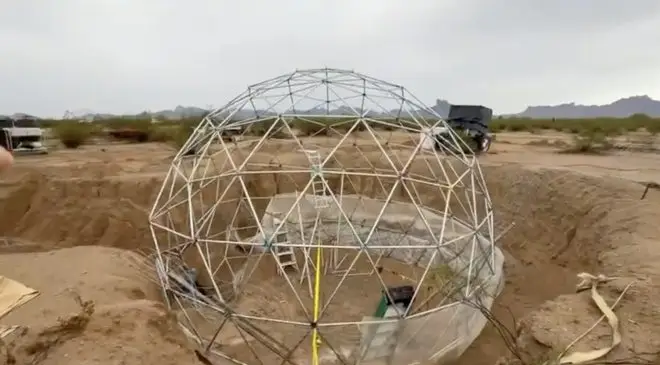
Welcome to Occupy the Land. We finish the top half
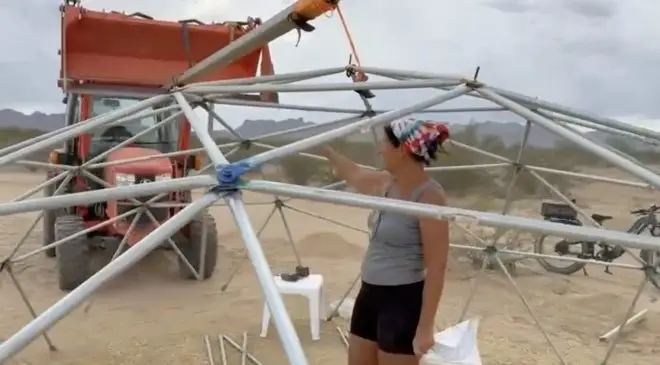
Welcome to Occupy the Land. Donna and I assemble the