



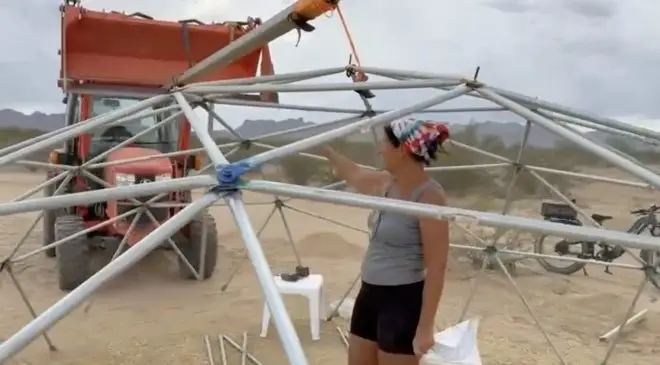
Assembling the Top of the Sphere + First Real Rain Test
Welcome to Occupy the Land. Donna and I assemble the
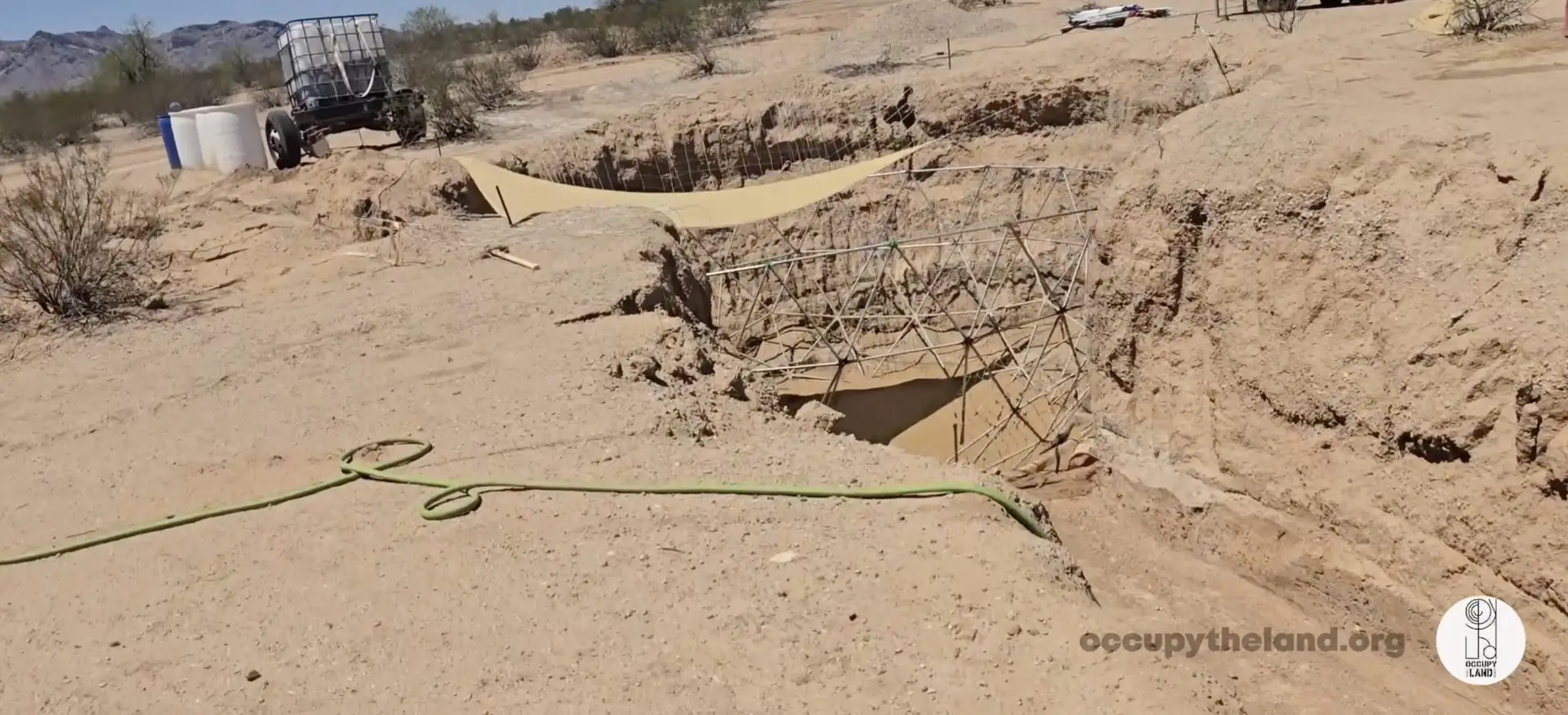
Welcome back to Occupy the Land. After a few weeks away, one solid rain event tested everything. Water overwhelmed a temporary berm, flooded the root cellar (exactly what we needed to saturate and reconstitute the surrounding soil), filled the sand pond with tens of thousands of gallons, and charged the orchard trenches and potato patch. In this episode we walk through the damage and the wins, harvest pure clay deposits, demonstrate how the experimental mud walls held up after days underwater, and show the tractor work required to reshape drainage so future flows go where we want them. We also begin acidifying the potato patch with sulfur and peat moss and outline next steps for the root cellar floor. Real desert water management in action.
Transcript:
Okay, we’re back on the land. We’re gone for a few weeks, and I carved out the drainage to do what I wanted. They did what I wanted, but it was overwhelmed. One good burst of rain for one day, and it showed us what’s up now? This is what happened. It goes down this wash, and it’s supposed to cross this road, goes into that wash over to the sand pond.
Now, what I had done, I didn’t think it was going to be that much rain. So I had built this up for it to flood. I wanted it to, you know, flood this area back there and go, and I did that. But what happened is it did back up, but it went where I got this dirt piled up here.
It went across over here and drained right down into the root cellar. Well, I needed some in the root cellar, and I’ll show you why here in a second to saturate that soil. So it would pack and it would go into the hard soil again. But what I did is I went ahead and, you know, built this back up, then dug this down.
And I need to dig that down, make more of a kind of an indentation, a ditch here so that it’ll flow on instead of coming this way. So that was I wanted it to drain a little bit into here, but you let a little bit and a lot of bet comes out because it was soft, you know, it was a wet soil, this big hump right where you probably can’t see it on camera.
But it was a high spot here, man. I just couldn’t break through this stuff. But I the back blade. The last few days ago, the day we came back, we came in and got it pretty much the way I want. And this level that rod right there is going to be the floor will be a step down probably.
But you can see this got wet up to like the second level up there. I mean it was it was a pool. So we had to wait a few days for it to go down. And this in under the mud there is I don’t know if I can step over. There is where we did that experimental thing. So let’s go see walk over here, get in the mud.
All right. That is the top of that experiment. Okay. Let’s see if we’re hard or soft.
This is moist, but it’s not going anywhere. So that is what I’m talking about. That was underneath the water for days a week. And it did not soften or go out. So I think we’re going to be fine. Now this is what I’m going to probably have to dig this down. I don’t know, this is probably about good height, you know, because that’s the top right there.
So all I need is, you know, headroom. So this could easily be the floor. And we just, you know, let it dry out a little bit. Camp it down with the compactor which got wet and I’m having to redo it. Fortunately it didn’t get any water in the crankcase or the filter or any of that stuff. So I’m going to go ahead and be able to clean it out and make sure you know and start it, change the oil and everything.
But you can see I needed it to get wet because this was not going to compact until it got wet. So I needed to get wet it compact. Then we’ll tamp it down a little bit, start to put the floor in the concrete on here, and then start working our way up. Now what it did do is it flooded from this side.
I didn’t anticipate that. And I’ll show you that in a little bit what happened there. So I had to build up the if there’s another rain where it won’t come from this side. But that’s what filled this up. One of the things when this happens, like last year, I didn’t save any of this clay, this is almost pure clay.
I mean, you can, like, do pottery out of this stuff. So I was going, you know, next time it rains trying to get out of here, next time it rains. I just scooped this up and I’ll have clay to do, I don’t know, clay stuff. So this is. I mean, it’s rare that you get a chance on the land to be able to have this clay separate like this so you can make use of it, you can see it cracking and so on, and that’ll be deep.
I’ll bet you that’s at least eight ten inches thick of clay. So what do you do with clay, madam? You will see. Now this. They got saturated a little bit. Be softer. And if I had something to hit it with, I’d show you. But when it records, it does that rock thing again. So you can see the size.
Now these we’re going to put in benches along here. This is wide enough for all our vehicles and stuff to get back that maybe you know the full size vehicles. But we’re going to go ahead and put kind of benches in here because there’s a bridge that goes right about here. And when we put that in it’s going to be probably eight feet wide.
The vehicles can get underneath it and it provides shade for an area when it’s hot that we can come down here and sit and so on. And Donna needs to be able to get between the garden and the hen house. And we put the the big greenhouse of 30ft up here. We’re going to need to be able to move around and then get into the dome that’s on top of the root cellar.
That’ll be a work area there. Now this is what happened. I anticipated it coming this way. I needed it too. I wanted it to do that. Probably not that much. But I mean, you know, it’s fine. You know, we were ready for it and that did its thing, but it came here. This is that same wash that goes to this other feeder wash that’s over here.
Now, what I did, I had a bunch of soil here, and I went ahead and piled it up to kind of prevent it from going in there, which was the plan to begin with. Anyway, as we built up the berm around the dome so they wouldn’t do this very thing. Now you can see what I did. I don’t know if you could tell in two dimensions, but what I did is, you know, kind of put an indentation here to make sure and built this up road on this side to make sure that the water coming from here flows that way to go to the sand pond.
Now, what I had done was the same thing. I wanted this to flood more back here. You got to get the height just right. How much you want the flood here? And then it flows to the sand pond. But you still get your lake back here. So that’s one thing that I experimented with. And you’ll see on the right side of the road here.
That’s where I’m building up the soil. This is the berm. The road is lower than the berm. Now, the one thing is to make sure that the water goes down this wash to the left of the house pad. That’s the house pad. And to the right of the house power. Those bushes are. And so on is another drainage.
And in the distance there you’ll see the concrete. See, it’s hard for me to see in the sun here you’ll see the concrete area right there. That is the check down. So that’s what we’re doing there. I just wanted to have some rain so I could see where I needed to lower and higher some stuff, and it it showed me, you know, so I get it.
Well, I kind of anticipated, but I didn’t need the whole thing was, is I needed water to go into the root cellar a little bit to save me thousands of gallons that I had to do to get it wet for it to reconstitute that soil around the dome. I mean, I’d have to be tank and, you know, going through a gazillion of these tanks.
So I go, you know, while we’re gone, if it rains, they can do it. And they did it. So we’re good. The wind was enough that it took out one of the spacers or the clamp down on a solar panel. It’s not a big deal, but I just go there and fix that. But that was about it. You know, we didn’t have any problems.
You know, some a couple things blue around and, you know, half a day and I got to carve because you do it when it’s wet. You take the tractor and you go around and you can just carve it like butter. You know, it’s whatever you want it to be and where you need to work. And, and then in the sand pond, the same kind of thing.
It filled up back there. It was at least 50, 60,000 gallons that was in there. But it’ll go away after about a week or so because, you know, it’s not done now. Pond liner. Now you put different kind of clays in their bentonite and so on to kind of hold it for a lot longer and eventually, you know, hold water.
But, you know, here in Arizona, you know, it goes six months, a year before it rains again, you’ll want to keep that water. And if you put it in the sand and it’s underneath the sand, it doesn’t evaporate or go away. So because you don’t even see it. So that’s the plan. It’s going to take a long time.
This is what I need. And I was able to get a lot of stuff done because it wasn’t raining. You know, I didn’t have any delays or wait for stuff, but I was waiting on seeing where the flow is and how much it really. You just need to know how much water. It’s a lot. It’s a freaking lot.
And I got some video will add from my neighbor that while we were gone, he just said, you showed a little bit of flow and where the water accumulated, and it did find it did great. It was the potato patch over there flood like I wanted to buy trench filled trenches, filled up and got that water stored and know where the flow is going in.
We’re fine. So we’re back at it. Here we go. I’m taking the tractor over to some neighbors, and either I told them after the first rain, we’ll come back and fix their roads and driveways and stuff and be a good neighbor, because I know now’s the time. But I took care of me first Friday and now it’s Monday and we’ll get over there and get her done.
Welcome to occupy the land. Occupy the land now, I showed you in the beginning of the video what kind of happened out here and what we had prepped for and what we did. But I haven’t really shown you how I used the tractor in doing it. So we’re just going to do a short time lapse to show you I got all the other places done.
I saved this for last so that I could show you how we’re doing, the drainage and why I need a tractor. Now, what’s happening is all of that rain that hits in the desert. Not that range eventually comes across here. Well, not all of it, but, I mean, I get a significant portion. Now, what we did is we built this up.
You can see this is a lot higher than the depth of the actual wash. Now, the reason was, is I built this up because I wanted it to flood, and it did rise up to the point that it went around here and then down the the root cellar and flooded the crap out of it, because it’s a lot of water, which is good because that’s what we want.
Well, I didn’t anticipate it was going to rain that much, and it had that big of an impact because it had an impact. Filled up our trenches, got our potato patch all done, the 50 or 60,000 gallons or whatever of water in our sand pond area. But now it’s time. We need to put the pond liner down and need to fix the drainage.
Especially here. And I’ve done it a lot of the other places that we need to. Now, what I’m going to do. Come over here, Donna. Things. See?
What I’m going to do is put down, stand over there. I’m going to put these rippers down and just break this up, because that’s the only thing that will break this up. I’m going to go back and forth and these go down. Now I have that chain there because it kind of holds it up over time. The hydraulics, it just kind of goes down.
So I do that to keep it up and take that off. I’m going to lower the hydraulics here, put this down, rip the crap out of this, and then take this back blade and pull that soil off where I can use it. But I need to bring this down here so that the the flooded water will continue onto the sand pond and not go that way.
Well, I had this up on purpose, but now I got to fix it. So that’s what we’re going to do. So I’m going to show you how. And yesterday I took the time after we did the initial repairs on the drainage and the roads and everything to me, about half a day it went to a neighbor that’s probably about ten miles away that we met months ago on the road.
Long story. But I knew that the way he had this stuff done, that the next rain was going to mess up his drives and all the stuff that he had planned. And so I said, when it rains, you can call me, I’ll come back and I’ll do a couple of hours of to take you forever, you know, and we’ll get it done.
So that’s what we did. And on the way out there and back, you know, which is like 12 miles, I did more of the road and contour and, and pulled the road hone that J. Noone built for me. You know, that thing comes in hand. I had to do some repairs on it, beef it up because we use it so much, but it really makes the roads nice, especially after a rain.
Because this soil gets more buttery. You can carve it, you can do it where once it dries and it hardens, it’s like concrete. It’s got to get really soaked and wet to really have any impact. So that’s what we’re going to do now is just show you this real quick. And that’s the video for this week. Thanks for watching.
You know, we’re getting a lot of response now. People starting to understand what we’re doing. And there’s more to come. The communication of this. There’s a network that wants us on. But we has to be decentralized. It has to be. There is no deep platforming. It’s noted communications around the world where we demo in that. That’s part of this.
The sustainability is only if they’ll let you. Well, we’re not asking permission and we’re not making ourselves vulnerable to be able to pass on this information and communicate with you. Pay attention. We’ll be talking about that a lot more also. So now you’re going to get the at the tail end time lapse of here of me just doing it.
And you can see why you need equipment especially for what we’re doing. Pace.
This area is the potato patch. You know, it’s next to the orchard area up here and the Sam pond. And this is dried out enough that we can kind of turn the soil. And this was, you know, flooded. And it’s like you go down a little bit, you’re going to see it’s wet underneath. There’s this got flooded. I mean it’s darker so it maintains the moisture.
And what is it that you’re putting out here? I have sulfur and peat moss. Sulfur will help acidifying the soil and I think it has gypsum in it as well. So it will help aerate the soil. And the peat moss is naturally more acidic. I think it’s about four on the acidic scale. And so this will help. And that’s what potatoes need because they have this.
If they have an alkaline environment they get blight which is some kind of, I don’t know, fungus or algae or something that grows. And it you can still get potatoes, but you don’t get as many and it decimates the crop after a while. So we’re just trying to acidifying this part of the patch and see what. Hard to keep track of what I can’t remember.
I think it might even be a bacteria. Whatever blight is thing that potatoes immune system can’t fight it off if it’s not in the right place level. So she’s just putting this black over to kind of keep it. I think it’s probably going to get it too hot. You know. Cardboard. Yeah. Sometimes you want to, you know, bake it anyway and kind of kill something, you know, the weed seeds and so on.
But we’re going to we have a bunch of cardboard because we have an Amazon warehouse of cardboard. And so we’re going to take the cardboard and put it in here and I’ll keep it moist. And the biggest thing is when you do this. Oh man, you are freaking dealing with the weeds. You’re going to have to be weeding all the time.
Which is why we like right raised beds. And so this potato thing, we’ll do cardboard, we’ll plant the potatoes that we’ve selected to use. And there’s various different kinds of really work well out here. But it’s all about the and also we have to get it down now it’s at like eight eight and a half or something. And you got to get it down to three and a half four.
And so that’s what the sulfur there is for. And the peat moss you know, as on your raised garden bed over there, the peat moss seemed to, you know, is what. Why. Well squish something it down. You don’t want it packed. You need it like area. I’m not that big. All right. So you have in your garden area it went from eight point something.
To what? How fast? In about a couple of weeks. But most of that was the peat moss. I mean, the sulfur helped somewhat. That’s more takes time, like months to kind of work into the soil. But the peat moss is naturally acidic anyway. So it’s going to it happens pretty quickly. So that’s what this area is always supposed to be.
Because when we have the rains, it floods and you can see it flooded. You can see in the pictures that we had because this is part and we kind of made it that way. It’s what intentionally this is supposed to be. So it’s just for getting calories, you know, just potato, potato, potato, potatoes. And we got a bunch of them.
And then when we just raked this with the, the greater in the back of the tractor and you just go in and just pick up a bunch of potatoes. So we’re doing this as a test, and a lot of the agriculture stuff is probably not going to be producing for a couple of years, but we need to get the soil ready.
That’s what all this is about. Now, what we had done is this right here is the bunny poop and peat moss and the biochar we burn stuff in. And that’s what this is as a test. And that worked out pretty well. So what we did is this whole area up here is going to be the orchard. So we dug this down.
And then you can see where the water came in and it flooded it. That’s what I needed. It charged this. So you just scratched the surface there and it’s wet underneath. And if you can get the biochar in there, get the down, cover it, whatever. That’s the first step towards making a productive orchard. So that’s what we’re working on.
Now. One of the things that we’re going to be going around the property, and we just start getting all our brush and everything, we just kind of dump it in there and light it on fire. It’s going to be baby and let my fire. It’s going to be fun. We get to do it a bunch of times. We did that over there and that went pretty quick.
So that’s what’s going on today. And yeah, there’s the root cellar over there. It’s probably didn’t even gone over and checked it yet, but it might need another day or two. The dry out a little bit because I want to get the clay that settled on it, so I can use that later. I wished I did that the last time it rained ten months ago down there, you know?
Let’s take a look at that. I bet you can see it. The when the clay separated down here, I just, you know, ground it back in and mixed it in with. And I really could have used that. There you go. See, there’s all that that stuff that cracks up here. That’s clay. I don’t know how deep it is.
Let’s take a look. You see and see how deep it is. So you need to have a liner. If you don’t have a liner, you know the water eventually goes away.
So what are we looking at here? That’s the top. How deep does that go? And I go pretty deep. I mean, you know, it’s going to be you know a lot of this this good. Get some good, good clay. You can make pottery out of there. So I want to save this because I can I just take the tractor and, you know, just kind of pile it up somewhere and get it another day.
So that’s what we’re doing there. That’s not really the that’s more like silt. It’s a, it’s a stuff underneath that I think is a clay. But let’s see if I can get a handle on it, get my hand down in there. But it makes good clay. So anyway, this is what we’re dealing with and you know, nothing crunchy.
So we’re going to go ahead and just keep doing what we’re doing. We’re getting down pretty low. It’s about time I think we’re going to dress this up. And then we’re going to go ahead and put down. We have the water tank that would go down, but I got to go up to northern Arizona. A friend of mine has 80 by 40 pond liner.
And if it’s the one that we need, I’m gonna get another one just like it. Because that 80 by 80 is the first area that I wanted to cover for it, to retain the water. And then with the tank that’s down there will take and put, you know, wrap it and perforate it and all the water go in.
We’ll pump the water out of there. And that is what we need to do. Now, fortunately, we have a commercial well that we’re able to get as much as we want, but we have to go get it, like over there, you’ll see.
That Green trailer has two IBC totes in it. So we’re getting like, what is it? You know, 500 and some 600 gallons of trip. And that’s does this for what we’re doing with the small amount of agriculture. But that sure as heck if we don’t have water on the land, we’re not going to be watering this, I can tell you that.
That’s why we need that. So we’re working on it, getting back into it, and it’s hot. But we’ll show you what’s up soon enough. Pace.
Well, this got buried.
That’s good enough for now. Okay. We have a bunch of mosquitoes down here. Get water and death. You get mosquitoes. So what I wanted to do is save this clay. Get down. You know, put it up, and I can make use of it later for stuff. But what I wanted to show you is clearing stuff down here. This has been wet for weeks.
This is a triangle that we did.
When I hit it with the shovel and see what’s up. You got it.
Hard. Didn’t dissolve nothing. This is what inside is going to be. All of this stuff up here is going to be with this. So this is holding up. Now we had it about this level. So that’s about the level of the floor. So I’m going to be taking this out and using this clay for other stuff. And yeah we’ll find where we got buried down there.
This rubber thing. I didn’t even know it was there. But. So then we’ll just go ahead and take this mesh and it’s not too buried. We’re just taking put it up and just start doing that. And we finished his first layer. Then we’ll go ahead and do the floor. And then, you know we’ll start compacting it. Got some gravel up here and anticipation of doing this.
We’ll put the gravel down then finer sand then compacted. And it’ll be a really good floor even then. But it’ll only be this hard, which is hard enough. I mean, you know, that’s a pretty good floor, but I wanted to have it a concrete floor. So, you know, it doesn’t matter if you got ice chests or, you know, freezers and refrigerators and stuff here.
Now, when you get up to the edge, the arm’s reach to the wall from the floor. So any shelves that we do, you’re going to be able to access them. Now we’ll probably have in a couple of areas steps where you can step up and get to another level, but that’s the height. So how much? I didn’t really have to take the floor down anymore because got plenty of headroom, you know.
Well, this is where once we get the level up, that’s where the Joyce will go and we’ll have the floor for the next level. So that’s what’s happening. So this is about the time I have a little bit of time today and tomorrow. But we got to go to a friend’s funeral in California this weekend. So we probably won’t be able to get back to this until Monday.
So by then it’ll probably be drier, damn it. But we’ll go ahead. We’ll just read a little bit and it’ll be fine. And then we’ll go ahead and start crafting this, and we get the floor in and start going up the walls, and then it’s going to start going fast. So that’s where we’re at. And that’s what it looks like.
This was the experiment.
That’s hard enough. Now what’s going to go on here is cement. You know we’ll go on here the final concrete layer that we do. But we needed to have this as the main structure to hold back all the dirt. And it’s doing great. So I’m happy with this pace.
Water Management in Action – Sand Pond, Root Cellar & Orchardhttps://t.co/tFdYAtaBED
— occupytheland (@occupy_the_land) August 22, 2026
Bitchute link: https://www.bitchute.com/video/8iEvIIbqeWJE
Welcome to Occupy the Land. Donna and I assemble the
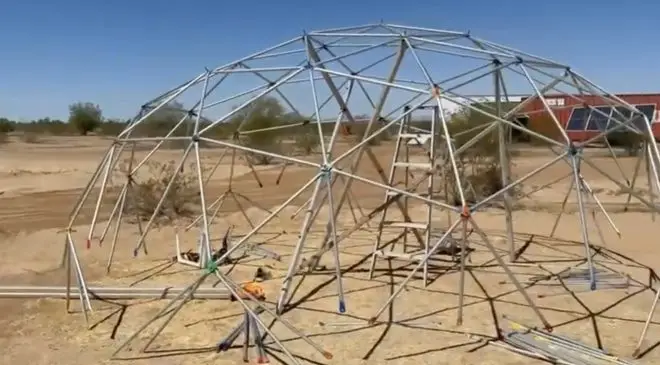
Welcome to Occupy the Land. This week we turn the
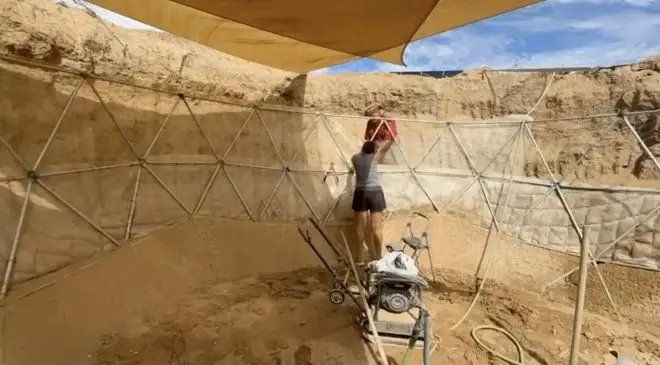
Welcome to Occupy the Land. This week we keep chipping