



Undeveloped Side vs Managed Side — Same Rain, Different Result
Welcome to Occupy the Land. After the rain we walk
In this episode of Occupy the Land, we prioritize food security by starting the root cellar on our Arizona desert homestead! With the main home pad and guest dome progressing, we excavate a deep trench for a 16ft geodesic sphere that will be insulated with Air Crete and a pond liner to stay naturally cool underground—ideal for storing canned goods, freezers, and preserved harvests away from the summer heat. We detail the plan for a gentle ramp access, earth-bermed walls, and why this is essential as we scale up gardening and animal husbandry. Meanwhile, Donna continues tending her thriving raised beds, and we balance infrastructure work with the reality of warmer days ahead. A practical step toward long-term self-sufficiency in the desert! Peace.
Transcript:
Well, the love bus is going to start getting hot. It’s, Oh, what is it? Middle of March, and it’s, over 90s in the daytime now? No, in the evening. It’s really nice, and we don’t really have to have it cooling in the evening. Really? Just fans were fine, and we go out and work the land and so on, but this time.
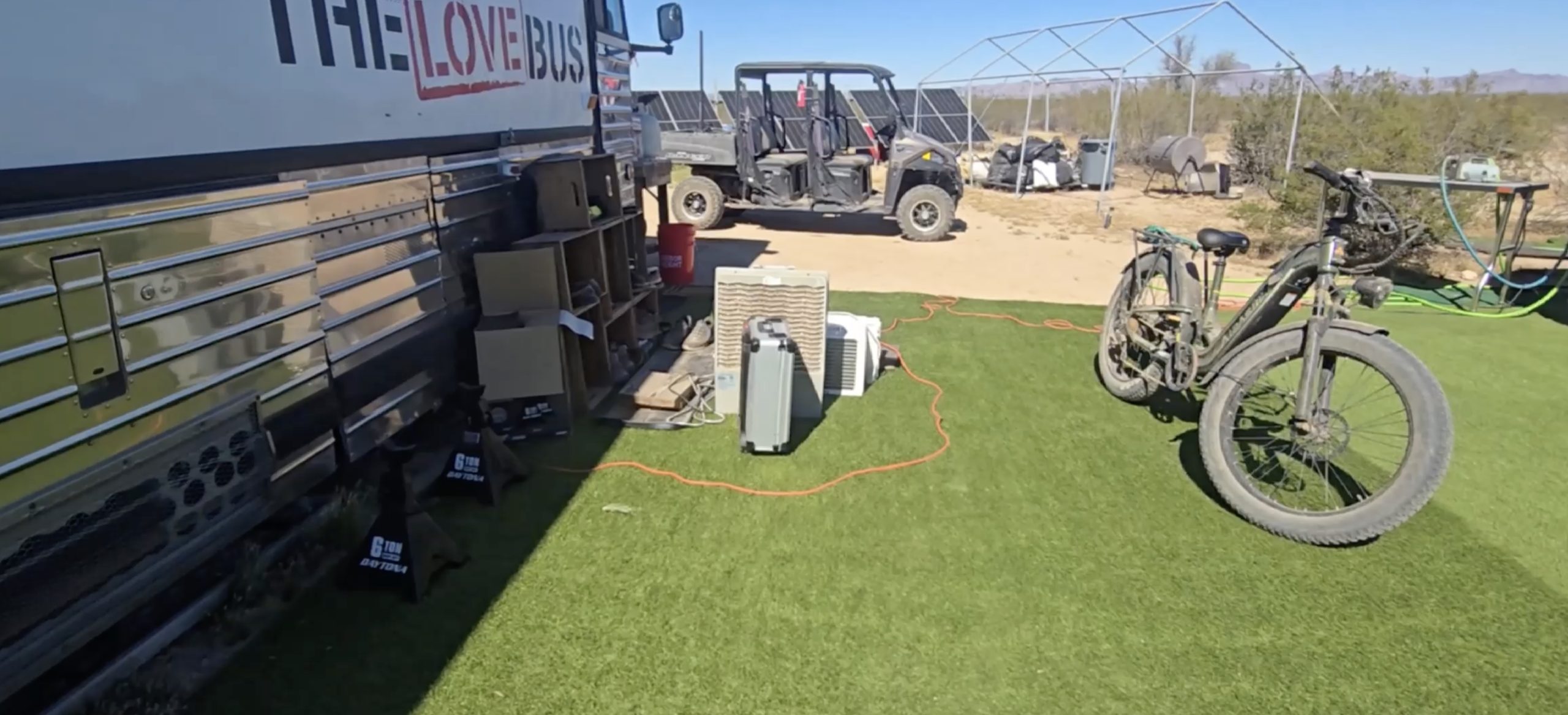
So we’re going to put the evaporative cooler back in that window right there. So we put the the approved cooler on the inside there. And it blows cool air. But it goes through about golly man. It’s like 30 gallons of water a day just to run that evaporative cooler. So that’s cool. And then we have this opening. Here is where we put the window shakers.
Now Donna’s got a washer dryer in there. And this is, you know, the washer draining and, some of her plants where she wants them. Now, what we’re going to do is we did all the maintenance on these when we put them up, too. We just got to put them up there, and it’ll take, I mean, everything, maybe 20 minutes.
It’s really not that big a deal. We made it modular for her to do it, and she wanted to get that window shaker out of the window because it obstructed her view of that. So she wanted to have the views. We got to put it back. Not that big a deal. Now, what we did is the pool. Whenever I don’t know how we did it, we kind of put this down and got some water on here.
And you can see how hard this water is. This is just from, you know, a couple times a little bit of cleaner water gets on here. And that’s how hard it is because it was evaporating all summer. And you just keep add water to it and add water to it. And all of a sudden it’s a dead sea and you’re floating in it.
So what we’re doing now is going to wash everything as much as you can with blind water. But, we’re going to go ahead and clean two vehicles, no trucks, and, you know, do stuff and, use as much of this water as we can. She’s off getting, making a run for like, 600 gallons now, but this takes, like 3500 gallons.
So that’s, Yeah. You know, double IBC totals probably 7 or 8 times. And that’s what she. She knew she had to do this. You want to have a pool, you just go for it. Well, now she’s, you know, she’s got a she’s a realtor. She’s got a real estate deal. It’s coming through. And, a portion of that money, she wants to get a big water tank hauls.
So she didn’t have to do this as much, which is kind of the plan anyway. So, she wants that. She got twice. You can do it. So that’s what she’s going to do so that we. Because we have unlimited water about six miles away. But, you have to go get it. There you go. It’s $500 a year.
You can come get all you want. So the community does that, and, it’s an agricultural, well, and we have for drinking water, we have filtration and the bus and so on. And it works great for the build and for watering and whatever and swimming in and so on. But yeah, I really was encouraging her to switch out that water because, I mean, when you start stand up in your phone up to your waist, you know, it’s getting kind of thick.
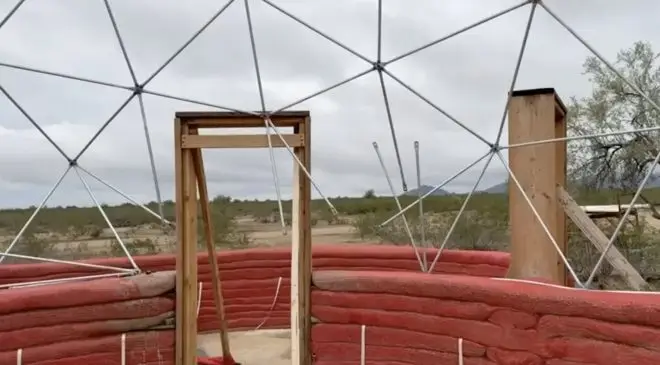
So now we got the, the dome up on the wall. And that was, you know, a big mile marker that and now it’s, you know, a lot of fun that can go into, integrating the struts into the door frames, the like kind of stuff. I look forward to that. But, that’s where the workshop comes in, and we need to get over there.
And I got distracted with building the, root cellar because we really need to be able to store more food. We used to have a lot more food on hand than we do now, and I wanted to make sure that we get back to that. But we don’t have anywhere to put it that it wouldn’t cook. You know, if you put it into the shipping containers, you know, we get the high temperatures and probably make it go bad.
So what we want to do is put it in the ground. Now, what I’ve been doing, this is the site for the home build. The main home build is here. This other dome is will be a guest home. And you know such as that. And you know, I might use it for whatever and we’ll we’ll stay in it until we get done with this.
But what we did, we got to bring this up to about two feet. Now, what you see here is, the outline of the home pad. And I went ahead and put, around it, you know, kind of get it built up. Now, we already brought it up about probably ten inches a foot or something already anyway. But I just keep getting whatever soil I need from the sand dam.
You know, the put over here and so on. And of course, the root cellar provides us a lot of soil. So I been just piling it up. So we piled it up here kind of start use a laser level and get it graded right and where we want it to go so that the water coming off these mountains go into these washes, like there’s a wash here on this side of it.
And another one right over there between this house, Pat and Donna’s garden, and chicken and root cellar area. So this is a really good place for us to put the soil. So we’re pounded up over here. And then once I get done using the backhoe, I dig the hole. I’ll put the back blade on it again. I’ll start leveling all this out because this is going to be where, we want it protected against the flooding because, you know, as much as it’s desert, when you get the monsoons, you plan on flooding, you know, and you can plan on, but this time of year also, you know, windstorms they call a microburst might as well
be a hurricane for about, you know, ten minutes, but you get the wind. So if it’s not tied down, it blows away. So you be chasing it in the desert. So you have to deal with water. You have to deal with wind. Even though we don’t have hurricanes, tornadoes or, you know, big giant flooding or something like that.
But you still got to keep in mind when you do in these few days a year, that it will have an impact on you. So this is going to be flooded. We’re going to be bringing you’ll see we’re starting to bring this up. So we’re going to go ahead and keep this coming up. And when it does monsoon this will flood.
And that’s why we are doing this. And the check dams we have over there that will back this up. And we have ordered holes in the intro. You’ll see those holes in the desert and that’s what they’re for is for well, here you go. You know, all these holes are around everywhere. Because once we back this up, it seeps down and penetrates the soil and saturates that clay and stays.
And then all of a sudden, boom, it’ll pop green. Now over there is where the check dams is on the washes. And we have one that we did as an experiment to test it and see how it works. And Don and I could do that. And, now we’re going to be doing probably have about 4 or 5 more main ones that we will do, but it’s all about controlling and directing this water as it comes down this way.
This is going to run into the home pad. So that’s why we needed to build that up a couple of feet and have it go around the build pad, or we’d be worried about getting flooded all the time. So I don’t want to deal with that. So what we’re doing now is we would be working on the integration of the dome struts, the geodesic dome into the walls and the frames and doing windows and all that kind of stuff.
But that need food, man. Now, no, I just want to make sure we probably should have made this an earlier project. But, I mean, that’s now I didn’t know with the news the way it is and so on. I’m just, just out of prudence now. Just because you need to. We’re going to go ahead and make it to where we could, store enough food here to last.
Don and I, a while. We always had, you know, at least a year for her and I. Maybe two. But then you got family and extended and friends and people you can’t turn away and Pat’s from whatever. And that turns into three months. So we’re going to go ahead and, create this. Now, the idea. So yeah, I’m sure you it’s pretty big.
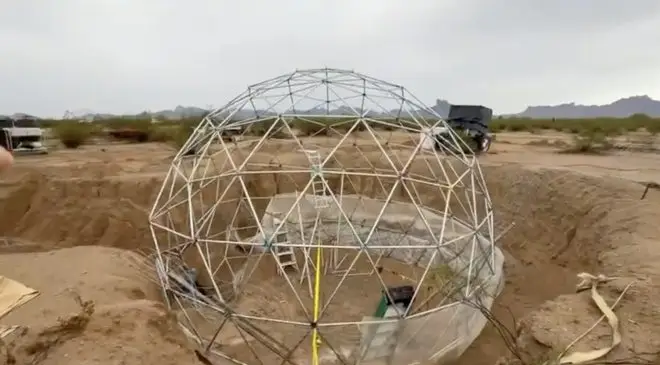
Okay. Now this is going to take a 16ft sphere, a geodesic dome that would be covered in no, hog fence and then, mesh and it’ll be a pond liner that goes in there and it will have a rounded bottom. And being 16ft high means it’s going to be probably like two thirds underground, at least. So that means it has to go down probably like 12ft.
And I’m, about seven feet there now. So I got another five feet. It’ll be quite a bit deeper than that will go in the very top of the dome will be up, and you’ll see the top of the dome, and we’ll have a landscape. It’ll be filled with air Crete on top. So it’s not too heavy of insulation and concrete, but then of course, soil.
Now the three quarter inch conduit and a four phase net. I’ll explain it later. When I do, it will hold this dirt up. It’s fine. I’m not worried about that. What I do need, of course, is an easy way to get down to it. Now of course, with the backhoe, I bring it down and I scrape it and kind of the shape, and then I use the tractor to take the soil out.
But we need an access, a doorway, and I want it to be kind of a slow ramp. It’ll be easier to get the freezer down and up. We don’t have to be climbing stairs. And we’re getting, you know, older and just I don’t want to be falling and tripping and breaking and whatever. And wheeling in stuff and hand trucks or whatever be a lot easier this way.
So we’ll make this nice. And I have an idea for this I’ve seen done before in this kind of building. So it’ll, it’ll be a nice access. Now, I could have put this back here further, and I probably should have. And, but she and I, she wasn’t here, and we agreed to put it there, but with the ramp thing, I probably should have just moved it back here, and I probably can, but that’s a lot of dirt.
And I mean, damn. So, we’ll make it work here and we’ll have, you know, kind of, sitting areas on the side and have it angled out and concreted and steps and make use of that area there also for various different things that you have to, control the water. If that floods and it comes down here, you’re going to have to have, pumps and so on and that, but be better just to kind of remedy so it doesn’t get down there.
And then you can have some, drainage and seepage down to bottom that it leach out into the soil. So there’s a lot of things that we can do, you got to take into consideration. But I and the bottom, the rounded area in the bottom, I want to make a water reservoir out of it. And you could do that with these, poly, these plastic water bladders that just go in there so we can store water down there.
And you want it to be in contact with the soil. So you just going to have a pond liner and then just concrete with the, the, dome and mesh and so on that we put concrete on because you want to transfer the coolness from the earth, because when it’s 120 degrees up here, it’d be nice to have below 70, you know, down there.
And so you’re not overworking your freezers and your refrigerators and all that kind of stuff. So that’s the plan. And we’re going to make it cool. You know, it’d be a lot of storage and it’ll be high in there. And we’ll have steps up and ladders and you know, it’ll be good for a lot of stores. Donna doesn’t see it.
She didn’t like the idea. Now she doesn’t want that. I don’t want it. I don’t see how you’re going to. Well, you know, if you can’t see it, let me be your eyes. Because I’ve been thinking about this for a long time, I. I really do want to have a ground cooled, strong sphere because it uses so much less material and accomplishes what I want.
And, that’s what we’re going to be doing. So that’s a distraction and keep me from a bunch of other stuff I need to do. And it started to get warm. But you got new challenges with that. The big thing is, though, is that, the days get longer and you get a lot more work done, even though it’s uncomfortable.
It’s hot, but I’m in an air conditioned tractor, so it’s not that bad. But the, we’ll go ahead and keep you up on what we’re doing. But this is just, you know, load after load of dirt, and then after I’m trashing this from going back and forth on the road and so on is dry. And it turns into this moon dust powder.
I mean, there’s just amazing. But, this, you know, the clay that we used for the Adobe and so on. So what we’re going to do is just keep hammering at this. Once I get to where I don’t need the backhoe anymore, we’ll put the other attachment, the back blade on it, and we’ll be able to, fix all this stuff.
So, Donna, stop yelling at me. But, that’s what we’re doing now. She’s going to be focusing on once we get caught up on a bunch of, you know, how do you do stuff that we got to do? She wants to make sure she gets this, henhouse done. She has a lot of the equipment and the supplies and the boxes over there and so on.
So, so many projects. But we’re enjoying it, and we’re progressing. Pace. Let’s see. We got the window shaker in the bus or installing that. And then we have this air conditioner running and at 100% and still charging like a kilowatt. So we’re styling coat.
Beware the Ides of March. It’s March 16th. Time to put the window shaker, the air conditioner in the bedroom there we had this template thing that we created last year, and this kept us really nice. And with our upgrade on the solar, we’re still charging at two kilowatts. This thing only takes like 5 to 700W. And, so we can run it all day and be 100%.
So I’m like, cool, you know, that’s good. And then, we need to get a new, water pump for the evaporative here. That little water pump down there got clogged up, and that works. We ordered another one for 15 bucks. 1 or 2 for, like, 30 bucks. And I’ll be in tomorrow, and then we’ll put that in.
And we even have to run that for the air conditioner for a lot of the time. But, the one thing like this, it is free, you know, and that uses like 30 gallons of water a day, so might be run the air conditioner more or help get another one. Put it there and we have the air conditioner on top, you know, on the bus.
I’ll try that out too and save. So we’re going to be fine.
Food Independence Push: Root Cellar Excavation Startshttps://t.co/OqeMYpzfsy
— occupytheland (@occupy_the_land) March 27, 2026
Welcome to Occupy the Land. After the rain we walk
Welcome to Occupy the Land. We finish the top half
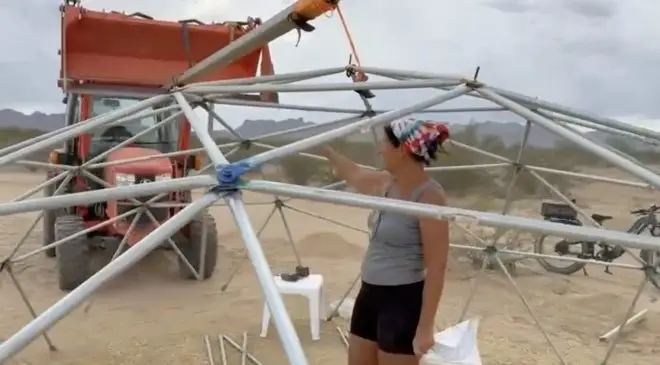
Welcome to Occupy the Land. Donna and I assemble the