



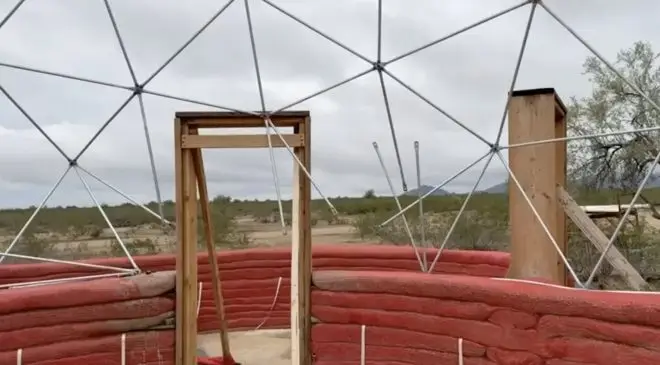
Undeveloped Side vs Managed Side — Same Rain, Different Result
Welcome to Occupy the Land. After the rain we walk
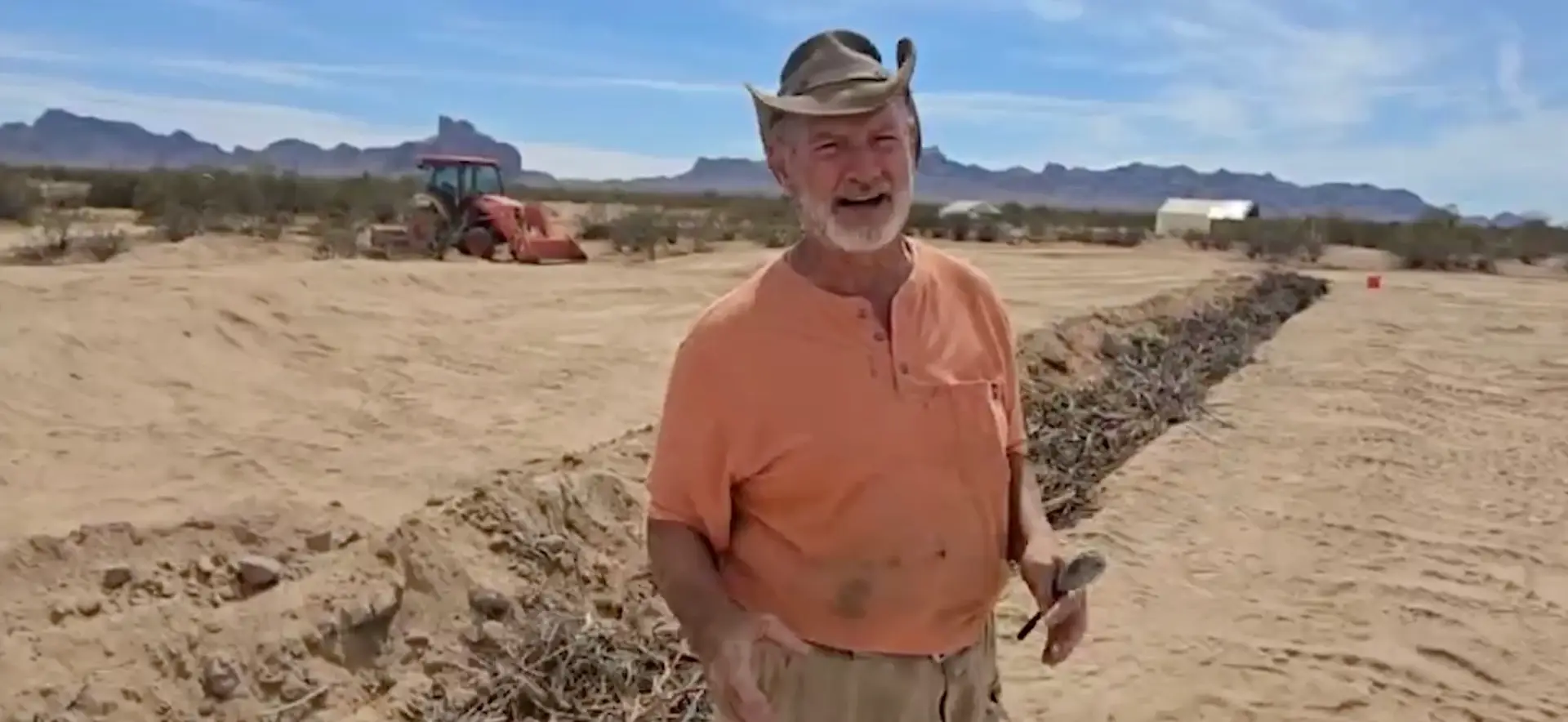
In this episode of Occupy the Land, we focus on practical infrastructure by building a concrete work pad outside the shipping container workshop. Ernie levels and compacts the area using excavated Khaleesi (caliche) soil, then experiments with a structured Adobe mix (Cow Creek) — combining the high-calcium local dirt with Portland cement and testing linseed oil sealing for a durable outdoor slab. This will provide a flat, stable surface for strut fabrication, welding, and dome customization. Meanwhile, we turn a large brush pile (including creosote) into biochar by burning and smothering it in a trench — perfect for amending soil in the future orchard terrace above the sand pond. Steady, resourceful progress toward a functional workshop and long-term food production in the desert! Peace.
Transcript:
All right. As we’re leveling, you know, the pad for the concrete pad that we’re doing outside the workshop. My battery on my laser level went out, so I got to recharge that. So I’ll take a break here real quick. I need to go get some more material. Now, what we’re doing is what you’re seeing here. This level is the level where I start putting, some gravel down, and then we’ll start putting the top coat.
And I got this compacted and down and this two. And really. Well, when I came out this morning, it was already like concrete. I could probably used it. Now, what I’m thinking I’m going to do as an experiment is that this right here as it comes out, it gives me a lot of work area and then we’ll do some shading.
But the building goes here and I’m not sure I want this permanent. Probably wouldn’t be bad idea. Don’t care. But if I was to do it with just compacted Khaleesi, which is, high calcium dirt, you know, this gravel and so on. It is like concrete. And if you put some linseed oil on the top of it, it’ll seal it so it doesn’t turn to mud.
And, I’m thinking I might do that just to test this, to see if it would make a slab, certainly for a work area like this. And, and it smooths out. It holds really well. I’ve seen earthen floors with linseed oil and it’s like concrete and it works really well. But this is outside and it’s not, you know, living space or anything.
So it’d be a really good place to experiment as we’re going to be using this material on the root cellar that we use this material to seal in the dome or the, sphere. So I’m going to go ahead. And I think that’s what I’m going to do because I’m at a level in the, and then this will be up.
These borders, these frames, these forms are going to be up about another four inches from there. That’s just to kind of get an idea of what this looks like. Now this comes out 15ft. Now what I did is I just have a, you know, just went like this and kind of went around 15ft from the center there. So that is how we started kind of get an idea here and gives me a really good work area.
And we had these triangle, sunshades that were, shade cloth that we could put post out here and have a shaded area. And so we’re experimenting. Now, now’s the time before we get to the house build. And as we get more of the soil, we put it over there to raise it up because we’re going to do that now.
The goal has always been.
Occupy the land with attainable housing. It is. What can you do using the local soil, low input and cost you know, mainly labor. And if you got to 60 something year old, you know people a couple out here doing this, can a young family do this? Yes they can. We I’m already convinced of that. And there is a lot of, you know, equipment that we have to make it go faster, but, it’s not required.
It just saves a lot of time. And it’s just us. And I’m really not looking, you know, to have a big crew out here or anything. We may do some work things as we get to the point to where we’re actually finishing up the, the first home house. But, this is I’m, I’m interested in what can be done with this quality soil.
Now, we’re probably going to structure a little bit with at least five, maybe 10% of Portland. But as I take this stuff out, I can see heavy white streaking when I pull it up from the calcium, I see why it gets so hard. And we experimented to see if it reconstitute. Well, it does. And if I add a little bit of Portland and maybe after it sets a little bit, you know, linseed oil, it I’m thinking I’m going to have a nice pad.
Hell, I can start using it now, but, I want to get it hard and I want to be able to, you know, roll wheels on it. New stuff in and out and doing my, welding and have it level for doing window and door frames and so on. Now we could do it outside that roll up door over there, but I think I have more use for it here, and I want to incorporate that into the floor when we do the, the building that goes over that, a 30 by 60 by 22ft high.
So it’s going to dominate. So we had the compactor over there. I’ve been compacting it. Reger over here. So it’s it’s hard. So that’s what we’re going to do. I’m going to go ahead and start separating out more gravel because you can see there’s a lot of gravel in the soil already anyway. But we’re going to go ahead and start separating it out.
And I’ll put a nice layer here. We could contract this out and so on. The problem is, is that we’re so remote. We’re so far out. It’s like, yeah, we can deliver that $600 delivery fee. You know, that kind of thing. But, you know, I’m enjoying this. It’s taking time. A summer is going to suck, but we get a lot of things done, probably more than in the winter months, because the days are so much longer.
And you go in the morning. In the afternoon, you do your work, inside, you know, for the sites and so on during the day. And you’re not missing anything. Now, I just put these out. These are going to get screwed. I just want to get an idea how it looks. And I probably put a gravel feather on the outside here and compacted for gravel when I get done and so on.
But this is generally the idea of what I need is a work area, because when you open up those doors, they kind of have some shade from the morning, the afternoon sun. This is on the north side, you know, it’s a nice breeze today. It’s really nice. But so that’s what we’re doing. This one give you a, you know, in the day near I’ve worked on this, so probably about eight hours total and, and get to here.
And if I don’t have to actually do concrete, we can before we linseed oil or add the Portland, you can just wet it and rework it and back and forth all you want. And then, once you put the Portland in, that’s going to it’s called structured Adobe. And that this is not the regular Adobe. This is hard.
You know, this material, this high calcium, this Carlucci stuff. More experiment with it. Take you along for the ride piece.
Well, I got it ready to pour, but I need to do maintenance tomorrow on the tractor. Change the fluids and filters and so on. Before I start asking you to do the mixing with the mixing bucket and start pouring this out. But, So tomorrow. Oh. Wet it. And compact it with the compactor there and wear it again.
Get it nice. And, maybe a little bit more gravel, and then we’ll start pouring the mix in and we’ll see how that goes. But I need to do maintenance on the tractor before I start really working it with the mixer. You know, that’s a lot of work for it. And it’s time for it maintenance. So I will have this pad done by this week hopefully.
I mean, you know, however long it takes. But, yeah, there’s always something to do, but I’m glad I got this. This will make doing a lot easier. And this is 15ft out, and, lot of work space, I need it.
So I was going to see how much fuel diesel fuel was in this fuel cell here and open this up. A little baby bird, one hatched and three eggs.
Waiting for mama.
There it is.
I have a bunch of shade cloth I’m going to put on my chicken coop, but it’s not reinforced with grommets, so I’m going to put my own grommets on there. And this is just a real simple kit. I got it at Harbor Freight. It’s got the grommets, the washers, the anvil, the setter and the hole cutter. The hammer.
And I cut these plastic. It’s hard plastic out of this waterproof wall board. It’s pretty durable. And it will. I need to put those in the hole so it reinforce the rip.
Okay, so here’s a piece of the shade cloth I want to put the grommet in. So I’m going to this is the end of it in the corner. So I’m going to have to fold it a couple of times. So it’s going to be pretty thick. So you lay it flat. This is the cutter. It’s semi sharp on the end.
I just pound it through the material. And then I take this plastic thing that I cut as a reinforcement and put it in the middle of the fabric, kind of sandwiching in between. There. And then I take the grommet part on the bottom.
And the washer part. The round whoops. The round side goes up and it just sort of clamps on there. And you take this anvil and you lay the bottom grommet part on top of it. And this is the center.
I just found it in pretty good a few times.
And there’s your grommet.
So in preparation for growing food, this is where we’re going to do the potatoes. So he’s going to scrape that down a little bit for us so we can plant them a little deeper. I remember I had a brain for about six months.
I received my best friend, my coffee, probably pretty dry. This is one of these washes that really does raise your.
Baby. Hard to tell on camera. There’s a little tiny bit of moisture down there, but as we go down the.
So what we’re doing today is long term preparation for putting trees in. This is a terrace area up above where the sand dam is. That Ernie’s clear. And I don’t know if you can see it on the video, but it’s a little higher than that. The sand dam will be. So the water is going to flow through here.
We have several washes that when it when we get the monsoon that will feed this area over here. So we have this a lot of the brush that we collected. We also have more around the property. We collected this whenever we first moved on the property about a year and a half ago. So that’s nice and dry. And so what we’re going to do is once Ernie clears his trash, this is what we’re going to plant first row of trees.
We’re going to dig this tragedy. He’s gonna pour all over that, brush, put it in here, and we’re going to start burning it. Once it starts going, then you throw dirt on top of it, so that it makes the biochar. So you do end. And what we have a lot of in the brush over there is creosote, and we checked and the creosote.
Cause what’s dangerous with the creosote bush is what you, you can burn them, all the way. So when we make the biochar will be burned up all the way. And it would be good for the soil of the farm. So I don’t know if you can see it over there, but that is a built up.
I want to be clear. That rock now with the water tanks over there, and they’ll be able to gravity feed the trees over here that we have our tree plant.
So that’s what’s on the schedule for today. And we thought it was more important to do that than working on our concrete pad because of the news and everything, food shortages, it’s it’s down the road a bit, but prices are going up, the shortages are going to happen and we need to be prepared. So we’ve got to get this done and some of the trees and and get them going and see how everything works.
So he’s going to be scraping the bottom of this compost pile that we’ve been using for a while, and you can throw things in there. We’re going to make it deeper, but there’ll be other composting.
And we’re looking to see if there’s going to be any moisture down here as a rain for about six months. So it’s pretty dry.
So he’ll scrape for a while, then I’ll come back and see what’s down there. As far as moisture content. But this is one of the washes that when it does flow, when we get a monsoon, it will come in here and kind of moisten up all the compost. And then this is the a lot of the product that we collected around the property along the road.
We just put them all over here in a pile on we we’re kicking it up for a while and letting that compost know what we’re going to do now on a larger scale is put it in the trench over here and he’s going to take the tractor and and throw it in this trench where we’re going to burn it.
And a lot of the bigger logs and things like that, we’ll take out as needed and just try to get a lot of fires burning. And what we do is once it starts to burn, we throw the dirt on top of it.
So after about 7 or 8 passes of him digging and using the claws to dig it up a little bit, you can see it’s starting to get damp. I mean, it’s still dry, but yeah, you can kind of see. I don’t know if it shows up on camera, but there’s moisture down there.
Welcome to occupy the land. Occupy the land, dawg. Okay, we’re going to have some entertainment today. What we’re doing is we had here was a bunch of branches and crews, so we were chipping a lot of things, but, we’re really focusing on food production and storage and so on. So what we did, we decided, is that we’re going to take all of that wood and we’re going to make biochar.
Now, right here is where we’re going to be putting a bunch of trees to start our orchard. That’s up here. Now, this upper terrace of the sand pond is higher than. Well, it’s hard to make out from here, but there is a divider that goes a dike that goes straight across the Sam Pond area here. Now, as I walk down, you can see it kind of angles down.
Now here is where the water storage is going to be. And we’re putting all the taking out this soil for everything that we need. And a water tank is going to go wade down the bottom of that. Okay. So that’s like now don’t little 12ft down. Now we just keep digging this out as we need it. Now what we’re doing is this lower area from the wash that comes in to this burned up dike here, it’ll be a road.
But this is what separates this lower part where the water storage is going to be. And then this upper part, that is, where the water is going to be. We have trees here. Now we need to get to it. You know, the news just got me scared, and I’m like, man, we got to get in that food thing.
So what we’re going to go ahead and do is, we started doing food production. Oh late fall because, you know, stuff. And that’s what’s over there. We have that is the hen house. That is Donna’s two raised bed gardens, which you’ve been eating out of quite a bit now in front of the green shipping container over there is the pad that we’re going to be pouring in today.
Tomorrow. We just keep adding to it. We’re about done getting to the final, for a, work pad, a concrete. And yeah, we’re we’re experiment with Adobe and structured Adobe and adding 10% Portland. And we’ll show you that in a little bit. But what we’re doing here is we went ahead and took the tractor and made this ditch, and we got all of that wood that was up here into there.
Now what we’re going to do is make biochar. Now, how do you do that? If you just burn it and it goes to ash, it’s not going to give you, you know, a lot of nutrients or anything. But if you get it going, it’s, you know, fire and you’re starting to get some coals, then you just cover it with the dirt and I’ll take the tractor and I’ll just push that dirt over it and smother it, and it makes charcoal.
And, then this is where we’ll be, you know, you’re right on it. Or to the side of it, probably over here, to the left of it will be planting trees. So I’m going to take gasoline. There and just kind of do a little bit because I need it all to burn about the same time. I want to be fighting it.
I want to light it and it go, but it’s gasoline. So when you’re dealing with gasoline, well, fortunately we’re outside. You know, I don’t think you know what’s going to burn, but the, one thing that we want to be sure you don’t get it on you and it’ll explode. Now, we’re going to go ahead and, you know, start a time lapse of this happening, and then Donna is going to videotape us doing it.
But, I don’t know. You’re confident. You’re worried? No, I’m not worried. But we’ll see what happens. But just as long as the wind, it’s a little bit breezy out here. That’s the only thing I’m concerned about. But, yeah, dust storm hits and takes a lot. But I mean, you know, it’s, you know, we got enough of a buffer, but, you know, you got a spare.
Yeah. What’s going to burn. Yeah. But here you go ahead and did you take me doing the fuel thing. Now a lot of times you know you guys you know, see that. You know I got scars here. And this is a graph that was taken from my leg. This was a gasoline fire. I was working on car back in 94.
It was a thing 30 years ago, but it was I was taken care of. And a lot of the activist friends and everything they donated make sure I didn’t have to do anything for a few months. But you had to wear these pressure bandages and so on. It was like at least a year. And it was it was a thing.
But everybody, you know, took care of our family. It was it was fine. But, our kids, they had a really that was like right after the election in 94. So that was like, you know, right before Thanksgiving. And what happened was, you know, by Christmas, we had, you know, Santa Claus coming. Firemen gave us a bunch of stuff, our, political opposition, you know, even the one became governor.
They the Democrat, the Republicans, they came by, you know, gave us meals and everything. So everybody treated us well. The problem was, is that they got so much goodies, our kids, the next Christmas, they go, well, hey, your left leg’s not burned. I mean, you know, we can get another good Christmas, but, so it was good. But that’s why you see these scars is from fire.
Donna thinks I should be more worried than I am about. I just have a lot of respect, you know, for gasoline now, but it, Yeah, I was working on the carburetor and done. And, you know, I primed it. It blew on me and ignited, and it was a thing, but, third degree on this arm. But, so I’m going to be very careful with this, because what you find out you do in campfires with gasoline, it will explode.
So whenever we don’t have lighter fluid or something, I’ll put gasoline on it, let it soak into the wood and leave it alone for 15, 20 minutes and then, you know, throw something on fire at it. You know, we’ll be standing next to it now, here. I’m not going to be too worried about it, but I am going to put a little bit on it as I go down along this and then do like a little fuze thing and light it from off to the side.
So it’s going to be entertainment. But the reason is, is because I need it all to go at one time, because when I start putting this on, I just don’t want to be doing sections. I want to be, you know, just start putting all the dirt on it and let it make biochar. So that’s what we’re doing now.
All right. This didn’t take very long. I mean, probably from the time that we started digging the trench, going through all the brush, doing a lot of stuff over here, probably 3 or 4 hours, but this burned and covered in, like 20 minutes. I mean, it didn’t take long at all. But now we got it covered here and it’s smoldering underneath.
And, it’s, probably warm. But I don’t know, it’s hot out. But, Yeah, we’re. It breaks through a little bit. It just smokes like crazy. So we have to keep covering it. Now this will go ahead and cook, you know. But without oxygen, it turns to, activated carbon charcoal, you know, whatever. Which is what we want.
Now, the creosote, you know, has some toxins for other plants or so on. But there’s, you know, I did some research and said if you burn it and use it for biochar, then that goes away. So that’s what we’re doing. So that’ll just made you got rid of that, made use of this. And it kind of cleared an area where we may put the water tank.
So now we’re going to go over and work on the, concrete Adobe. What do they call it. They call it, Cow Creek for Khaleesi. And concrete. They actually have a name for a Cow Creek because they’ve already been. Because I thought, I’m going, man. Yeah, a little Portland just, it’s going to be like concrete. Yes, it’s called Cow Creek.
So that’s what we’re going to do. And it’s, five, parts of the Khaleesi soil, which is heavy calcium that I’ve been pulling out, the Sam pond here and, putting a pile over there to use and it’s, four or 5 to 1 to Portland cement and one, bucket of water. And that’s what we’re going to use.
But we got a little bit more to level it out and put on there. So we need to finish that this week. And it’s, Wednesday. So we got another couple of days. You know, I got a bunch of shows and so on. But by the end of the week, certainly by Saturday, we need to have that done because we need the, pad to be able to do the struts.
And so on for the sphere, for the root cellar. And then we get that that’s going to take a while, and then we get back on to the, the prototype build.
Desert Engineering: Compacted Adobe Pad & Biochar for Orchardhttps://t.co/i2UJWRPrBU
— occupytheland (@occupy_the_land) April 25, 2026
Welcome to Occupy the Land. After the rain we walk
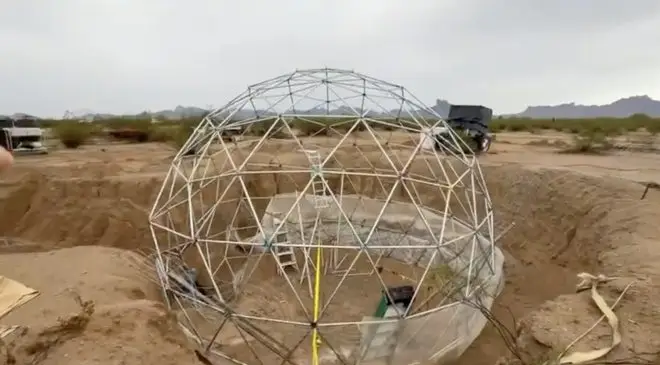
Welcome to Occupy the Land. We finish the top half
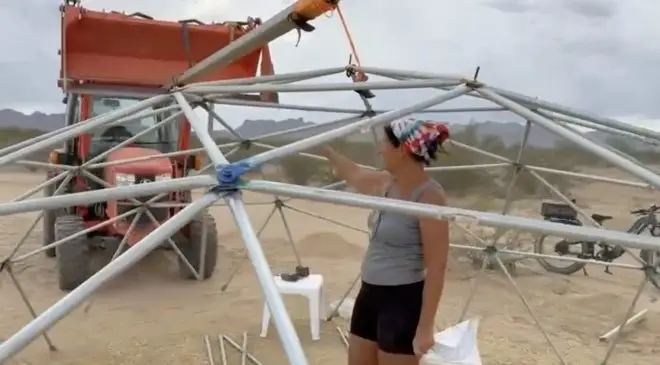
Welcome to Occupy the Land. Donna and I assemble the