


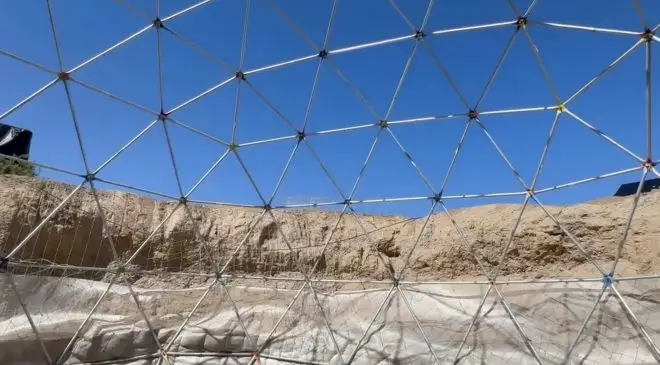
Auger Day: Root Cellar Prep & Perimeter Fence Test
Description: Transcript: Saw these two birds perching on top of
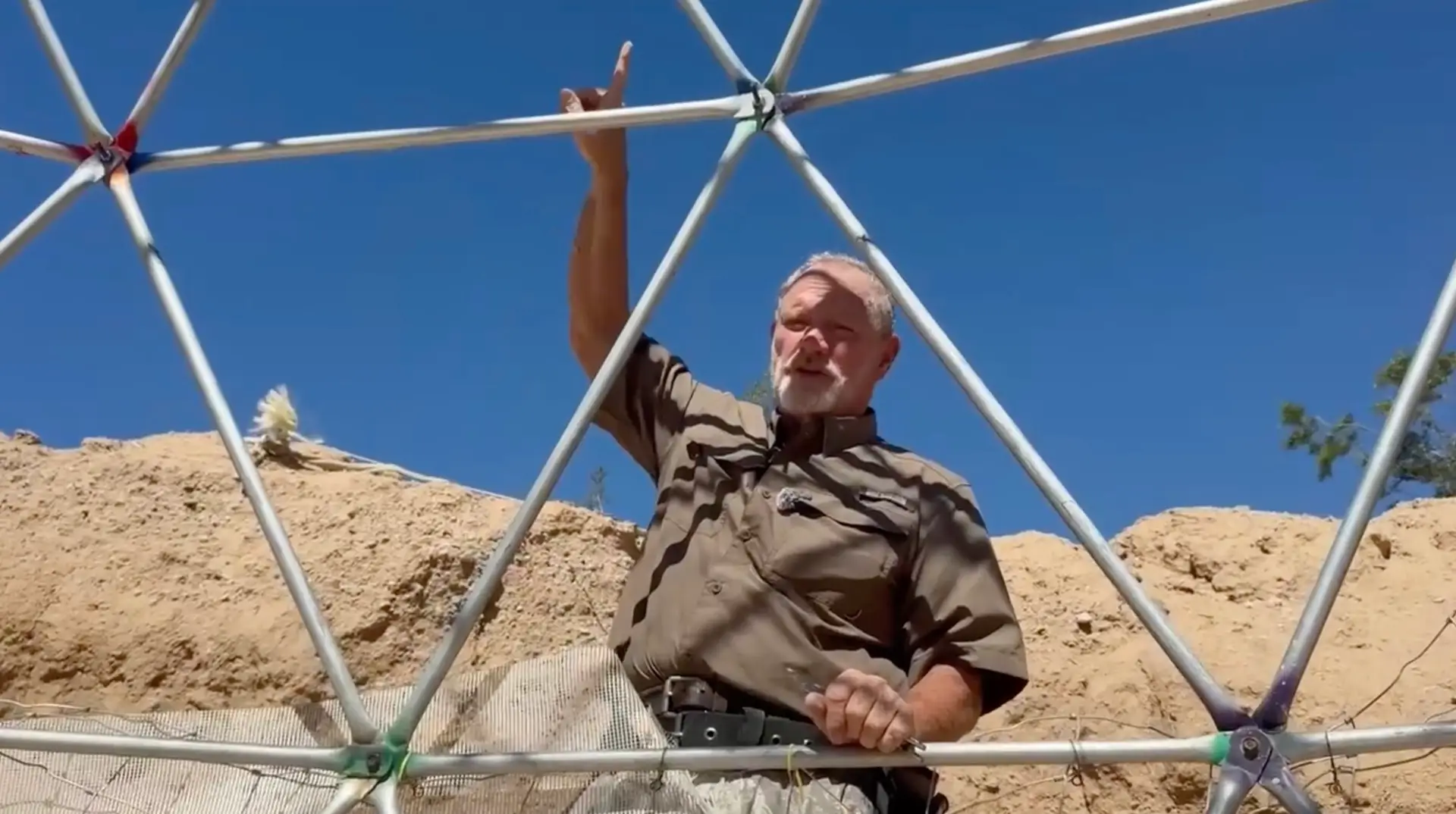
Welcome to Occupy the Land. We tighten all the bolts on the root cellar geodesic sphere so it’s safe to climb, then get ready to pull the continuous hog fence over the top and wire-tie it down before backfilling. With Hurricane Rachel on the way we switch the tractor from auger to top-and-tilt back blade, haul soil from the sand pond to raise the pad around the root cellar and house site, and drag brush piles into the road for later biochar in the orchard trenches. Donna plants two varieties of seed potatoes in the raised beds (the third still needs a few more days for eyes) and we get the first eggs from the five-month-old hens. Peace.
Transcript:
Welcome to occupy the land. Occupy the land now, what we’re doing now is, We’re going to be putting over the fence, over the dome. It’s already runs underneath it and then goes out and it’s, kind of been in the way and a pain in the butt. And I probably wouldn’t do this this way again, but I’m glad we did.
You know, give this a good test, but you could have done it in sections and wire tied it, whatever. I just wanted that one continuous and going anywhere. So but before I do that, when we put these up, you know, we had the junctions kind of loose to make it easier for it to, you know, match up everything because there’s some play in it.
But now I got to tighten all these because I got to climb up on there. When you get on one of these and it’s loose and it and like it. So what we’re going to do is we tighten these and I can use the impact. But I really want to get a feel for how tight I can get these.
And so I’m going to go around and tighten these up. And then once I get all that done we might have to get the man lift on the tractor to get to lie this or I’m going to be climbing up there and, you know, paying the butt. But fortunately, yeah, I’m just over 200 pounds. And this three quarter inch conduit, you can certainly stand on it on the hubs even when it’s half inch conduit.
But on the half inch conduit, if you stand in the middle, it’ll start to deform. It’ll bend. But this three quarter inch, even I can walk in the middle of here and it’s fine. But so we’ll be going around. This will take better part of a day just to make sure this is all tight. So it’d be more secure me walking around on it, get a feel for it.
It.
So then when I. Now that one’s loose. But this is you know, you get up here and you know it’s strong. So all these from here down I think all of them are done. I’m going around and making sure and get that all tight. Once we do that, then I’ll just start climbing up there and start pulling that over and, you know, whatever, we’ll get the fence over and then we have to go up and wire tie it down like this, you know, so that’s all tied down.
And then we’ll start bringing these up and, you know, trimming them and getting it to where it’s all covered. And then we’ll start applying this again on the outside of it. We’ll finish around the bottom part here. We’ll get the fence over and then we’ll start doing the backfill of the soil. Now in about a week we’re supposed to have a little bit more rain, which is good, because, Donna just got her 1000 gallon, you know, trailer tank thing.
We’ll show you later. And, so a lot less trips, and we have a lot of storage. IBC totes around and so on. So we have plenty of water and we’ll go ahead and get it saturated as we’re putting it in. So it’ll solidify behind this. And then once we get that all done, then it may be time to do the floor.
I don’t know, this floor is holding up pretty good. We got it level and everything and put some more gravel in. Then we’ll do the concrete and it’ll just start working up the sides. And we have a bunch of other methods that we’re going to be trying, and we’ll get to that later. But the main thing is we get a good floor in.
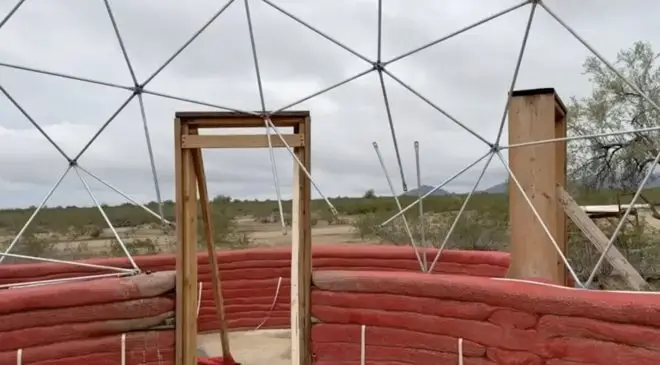
We have this bottom part done, and the trusses are going to set on the dirt here. We’ll have a concrete beam that goes around if not pillars you know, do solar tubes or something, or sauna tube where they call them and for the sit on or we just may do a ring. And when we do that, these trusses, they have to be probably about almost 12in thick to be able to span the 20 whatever feet that we want here for the roof of the root cellar and the floor for the upper part.
So that is once we get these in and engineered and how we want to do it and working, then that’s what we’ll use for doing the bridge over the ramp that comes down here. So it’s step by step by step. And the next step is tightening all these bolts. Because we when we did this one we left them a little bit loose to give it some play to make sure it matched up.
So once we got that done now I got to go around and tighten them all. And then we pull the fence over. Then we connect that down. Then we put the mesh on and we start backfilling and it’s a thing. So that’s what we’re doing.
We’re at the point on the root cellar, the dome. We need to get up from the inside and do the tie down of a lot of the fencing and so on for the reinforcement, for getting near the end of that. And we need a good extension ladder. This was a gift from a good friend, Danny, that, used it in his business or doing roofing and construction and so on.
But he warned us, you know, and I heard horror stories of them being fiberglass. It’s strong. It’s just that as it starts to get access to ultraviolet, it wears away and exposes the fiberglass. You touch it on your arms or legs or anything, and you wish you didn’t. So what we’re doing is we’re going to sand it real quick using these and just kind of go over it, and then we’ll just go ahead and take some paint and paint it, tape it off a little bit and then got to be perfect because it’s perfectly functional.
You just don’t want to, you know, be uncomfortable because fiberglass does that big time. So that’s what we’re doing. We’re going to go ahead and do this. We’ll show you the end result. And then we’ll get down in the dome and you’ll see what we’re using it for.
And that’s how you turn a fiberglass extension ladder into aluminum. Yeah, it worked out really good.
And that’s why now probably in the center part there, which is right there, I’m probably going to go ahead and go on the outside and go up. It’s kind of high. It’ll be doing a lot of this, you know, lower stuff because with that fence up there, you know, it’s uncomfortable. At least I can’t fall through that. You can fall off.
But I’ll be very helpful in later stages.
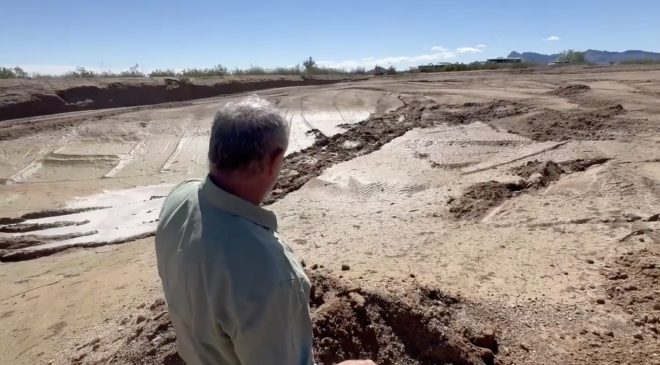
What we’re going to be doing is we have a threat of Hurricane Rachel, wherever that is, whatever that is, that is going to dump a bunch of rain on us, that pinky swear 90% of we’re going to get flooded here. And that’s for Sunday and Monday and it’s Wednesday. So I’m like, okay, well, what I’m going to do is I’m going to go ahead and this lower area here, I’m going to be bringing in a lot of soil from the sand pond and building this up.
It needs to come up at least a foot or two. And I got it up to where it’s probably not going to flood into the root cellar, but I you do need some moisture. I do need some water to get in there because we’re going to be backfilling it more. Donna and I finished doing the next row there.
And so we go ahead and fill it up to that next run, which is the halfway mark of the sphere. And I was going to go ahead and fill in the blank spots of the wire here, you know, bring this one over and wire, tie it down and get up on the dome. And and if I fall, get hurt and Donna’s not here, that’d be bad.
So I promised her I’d go ahead and do other stuff. And I’m just needing to build up a lot of this level soil. I probably don’t need to cover the creosote plants here because they’re kind of up. It wears and floods down around them, so we’ll probably be able to save those. I’m just going to bring it up like a foot or so and it’s I got it to where it channels the water around the dome and a lot of this area here, but I need it to just be higher like we did on the site for the house build.
Now the house build site here is up almost to where I need it. I still need to bring it up another foot to be satisfied. So what I’m going to go ahead and do is that. And because there’s going to be so much rain, what happens is see if you can see the mounds over there. That’s the trenches for the orchard.
So it’s going to flood those again and charge the soil there with gazillions, gallons of water. So that’s cool. I’m going to let it do it. And then after I get the soil over here, maybe before I level it, I’ll take the tractor and go around and pick up all the brush piles that we have and set it over in that area, because after it saturates, then we’re going to go ahead, light all the brush on fire, get the biochar, put the soil over it, and we’ll be one step closer to start planting the orchard.
But I need to get this area here like here, specially low area here because there’s a wash right here that, you know, flows. But when it gets overwhelmed, it starts coming over here and I need to build it up. So this is one of the washes that I need. And it runs over and fills up the sand pond along with about 4 or 5 other washes.
So that’s what my plan is today. I’m going to go ahead and change out the the auger on the back of the tractor for my back blade, and I’m going to go ahead and bring over a bunch of soil over here. That’s something I got to do anyway. And then move a lot of this stuff around and get it cleared out and cleaned up and, and start crafting a higher level for this garden.
Chicken, livestock root cellar area. You know, this is the place where we’re doing that. Now. We have this weekend a six 500 gallon water tank that, you know, we planned for, and we’re going to be placing it, you know, to the right of the tractor on the other side of the wash over there is an area that we’re going to be putting it.
And over there and the reason is, is because it’s in line, a site line with where the home is going. And we didn’t want to, you know, mess up a lot of our, views. So it’s in line, like you see the other dome over there, that area, this dome, and it goes in line with the workshop storage containers over there.
And we’re the big barn workshops going between the two. So you’ll have one line. That one won’t obstruct our view of the valley and the mountains, you know, over here. So that’s kind of the plan for that. It’s working out. That’s why we’re taking our time on the on the structure of everything, because it just kind of organically comes together.
If you’re just patient and see where everything flows and where you need stuff. So that’s what we’re going to be doing with that. And then we got to put pressure pumps and filters and so on. Yeah, a lot of work to do. But one of the things that is probably one of the last major landscaping is building this up.
So that’s what I’m going to be doing. Getting a bunch of soil, dumping it here bunch of times. And then I’ll go around with the back blade and start creating bowls of off the washes where I want new indigenous trees out here, because these trees are nice. They’re just you got to get them, you know, about four feet high.
You can pick them from around. We have a place where the cowboys are wanting us to clear an area around one of their stock ponds, and I said, you know, I’ll do that. Let me have all them trees. So that’s what we’re going to be doing. So I got to prep for that. I was going to do a lot more stuff with the auger, you know, like for fence post and all that and everything.
But this wash here is one of the ones that gets a lot of water. Now, if it comes up over here, you can see what the problem is. So that’s what I’m going to go ahead and do is start working on this. That’s going to keep me busy today because we’ve got a hurricane of coming okay I was going to show you, but I don’t have Donna here.
The whole camera I just did it. But this is where I keep my auger back here by this tree just hanging. And with that ratchet strap, it makes it easier for me to put it on and off myself. This drive shaft goes into what’s called a PTO power take off. And it’s just got splines there that this gearing kind of goes in on, that slides on.
And that’s what powers it. And that’s a separate control inside. And then I can lift it and lower it with these that go to those. They just go in and pin. And then this pivots off of there. And that’s how it works. So I just back it up, put it on the ratchet strap, kind of stabilize it, disconnect everything pulled and and I’m done.
Now go and put in the back blade on is a little bit bigger pain of but but I go do that.
Okay. Now I got to put the back blade on and it’s called the top and tilt. That means it goes this way, that way and that way, that way. And it makes for really good use. Now these, rippers here, you can put them up as high and low as you want. You could, you know, make this, you know, a different height.
And you pull these pens out here and then you can adjust it. And I got it down because I’m going to need it for raking out the brush and so on from some of the soil. And when I do that level and I just, you know, keep them up. There’s a hydraulic.
That’s right there. And then that goes to this and that plugs in to that. So and then this is the tilt or the top. You know that connects here where we had the auger and to here. And then I have to line these up with those and do it by myself. You know. So that’s what I’m going to be working on.
I’ll show you the end result. But yeah, it’s going to be a pain and we’ll see how long it takes me. Okay. It’s on now the reason you want the tilt for it to go like this is so that you can get this back blade to press on and compact, or drag it to make it all glassy smooth or something like that, and to get the inside blade to bite.
So you have the top this here and this hydraulic pushes this out and that changes orientation of the whole thing. And then you have the lift which is this hydraulic here that lifts this entire thing to make it go up and down. And then you have the tilt, which is this one which makes it tilt left and right.
So it’s all connected. Didn’t take that long. Add to polish some pins and do some little maintenance and clean whatever. But it wasn’t that bad this time, especially doing it by myself. The big thing is to have it set level and even where you want it when you drop it off, or then it becomes a big pain.
But and that’s what these two railroad ties are for, and that works out really well. And then, you know, I had to cover the backhoe and different stuff because those blue any tarps, they don’t last for nothing out here in the sun. And there is, the banner material we used to use to make signs during the evolution.
Those are great. They’re like seven year UV protected, you know, don’t rot. So I need to get a bunch more of them. That’s what I need to do. And there’s the cement bucket for the front. And then another bucket I have. And I like using this other bucket because it splits and it can grab stuff. So these hydraulics here open this bucket like a clam shell.
And that allows me to grab a bunch of brush and so on, which is what I’m going to be doing today anyway. So here we go. And oh yeah. And so you can backfill with it to you put it down and makes like a little bulldozer. I don’t use it for that very often because it’s not as controllable.
And I like the bucket better. But yeah it’s always good to have this multi. This is how I do the roads without this thing. You know the roads would be a pain to. But so this makes this probably the tool that I use the most out here that in the bucket.
And then I gotta pull forward and go get more and keep doing it a bunch of times. So in the wake of all the hurricanes in the Pacific, we got about 4/10 of an inch of rain last night. They’ll be more on the way today, but it’s very windy. We have wind gusts up to about 40 miles an hour.
Welcome to occupy the land. Occupy the land.org all. And it’s looking very nice out here. Now one of the things that I’m doing is we have a lot of brush piles that are, you know, along the sides as we cleared roads and everything. So I’m pulling those out all into the road so that we can go by and, pick them up the trailer and start putting them in the orchard trenches over there and a lot of them on fire.
Maybe let my fire. Now, this is,
Hopefully as deep as I’m going to go on this, and it’s just on the sand pond here, it’s just about pushing back the walls further and further and further. And as I do that, I create another big giant pile. But this is from the layer. So that’s the soil that I need for making all kinds of stuff and certainly backfill on the root cellar.
So that’s what I’m doing today is how was it Sunday? And it’s like the 10th, 11th. You know, I don’t even keep track anymore. But we are, Rachel. The hurricane is dumping on us. But it hasn’t been too bad. As bad as they promised, you know? But, I need to get this ready. It’s on the 24th of October.
We go and we get the pond liner, the first one to see how we’re going to be doing it. And then we got the. Where’s that? Over there. We got that tank that goes down in to the sand pond here. Be perforating that. We got the main water tank. I guess it’s going to be going over there. So we’re making progress is today I kind of just taking the day off and I’m going, you know, it’s a nice day.
I want to go out and, you know, just pulling all the bush brush and bush and stuff into the road so I can get it put on the trailer and get it into those ditches so that we can get the biochar, then that’s cool. That’s what I’ll do. At the corner pace. So it’s a nice day outside. It’s very windy, but the temperatures are very nice.
So it’s a really nice day to be outside, especially for these girls. I have the door open. They can come and go as they please, but I found a surprise this morning. I got some eggs so I’m not sure if one laid two over the last couple of days or if two of them have late, so that’s good.
These girls are five months old now and it’s about time for them to start laying.
So we’re going to take a look in the garden today. I haven’t had to do too much in here other than just till the soil. Every now and then. About two and a half weeks ago, I did plant the first batch of potatoes and they’ve already started to come up, so that’s good. And then I have a row planted in here, but I planted it a little later than the other ones, so it might be a few more days before I see anything come up on that.
And then for this entire group.
So today I’m going to go ahead and plant two of the three varieties of seed potatoes that I have, the two varieties that are ready to go have the eyes already grown on them. The other variety still needs probably a few more days, so I’m going to go ahead and just wait on those and I’ll plant them in the other bed.
But and I have these two grow beds that I used last year for a regular garden. This year I’m just going to do root crops because we’re going to go ahead and pull the 30ft dome from a workshop dome that we had. We’re going to pull it over here and we’re going to create a greenhouse. It’s either going to be aquaponics or raised bed.
I’m looking more towards aquaponics at this point. So but what I’m going to do today is get the potatoes and the soil is cooler. It’s nice outside. And that’s what really what they need. They just need some moderate temperatures. So the soil is at five and a half on the scale and it’s it’s damp and loose. I’m going to go ahead and tell it a little bit and then create the rose and stick the potatoes in.
So I’ll bring you along.
So I’ve planted the red New Orleans over here. Those are the red potatoes. These are the Russert’s. And you plant them with the eyes facing up in the loose soil. This is very loose. It’s very damp, which is perfect. That’s really what they like. And then you just cover it. Cover them. This is about six inches deep. And when I go too deep.
But you don’t want them right on the surface because they are root crops and you just cover them all.
Spread it out. And then I’m going to water them just a little bit. They need to be damp, but you don’t want to get them too wet because the roots will go bad. But anyway. So yeah, we’ll see how these how these potatoes do.
Potatoes are planted covered. And I’m just going to water this really good.
So what Ernie’s doing here around the root cellar is building up the elevation around it. Because every time it rains, the water pulls up there. Even though it does flow through the wash just individually. It pulls up in this area. And then you get things like this where you get these ruts, it just runs down through here and it flies the fruit cellar area.
So you spent the last week or so, the chickens really enjoy their time outside.
Bitchute link: https://www.bitchute.com/video/iLU7KPxucqN9
Root Cellar Progress: Fence, Backfill & Hurricane Prephttps://t.co/WmjSkP11a7
— occupytheland (@occupy_the_land) October 31, 2026
Description: Transcript: Saw these two birds perching on top of
Welcome to Occupy the Land. We extend the dike on
Welcome to Occupy the Land. After the rain we walk