



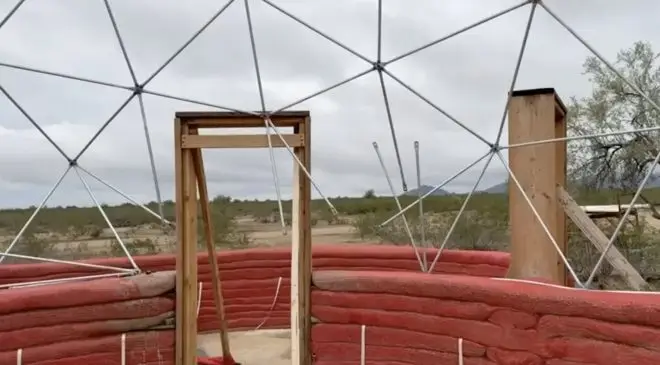
Undeveloped Side vs Managed Side — Same Rain, Different Result
Welcome to Occupy the Land. After the rain we walk
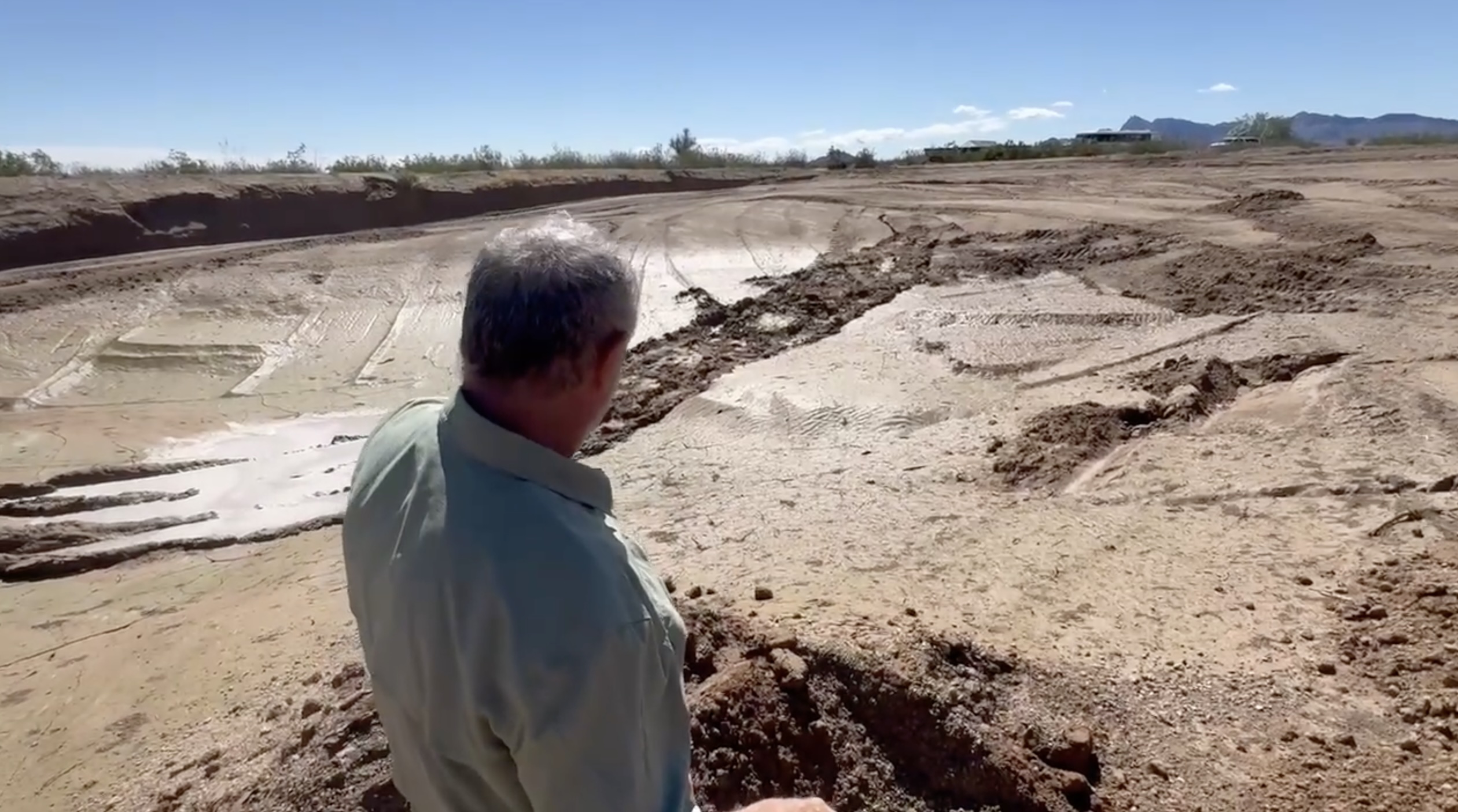
Welcome to Occupy the Land. We extend the dike on the west side of the sand pond so more monsoon water stays on the land instead of running straight into storage. The extra height will create a temporary lake, green the area for indigenous trees, and give us the option of a perforated overflow pipe later so fruit-tree terraces don’t stay flooded for weeks. Ernie shows the clay layer he’s scraping for future use, the sand and gravel that appears after every rain, and why every bucket of soil removed here is also water storage. We also switch the tractor: back blade off, rear auger on for fence-post test holes and recharge holes, concrete bucket for filling them with wash sand, and the front forklift with man lift so we can get the hog fence over the top of the root cellar sphere. Rain re-flooded the orchard trenches, biochar is next, and the potato patch is waiting on more seed. Everything is still running in parallel. Peace.
Transcript:
Welcome to occupy the land. Occupy the land.org. Now, what we’re doing is we’re going to be changing some of the implements on the tracker. But before I do that, I wanted to show you what we’ve been doing. This dike on the northwest side of the property. Well, it’s on the. That’s the east side, but the the west side of the sand dam.
Now, this protects it from all the drainage that’s coming from the mountains. This way. Now, in a few days ago, in last week’s video, you probably see this dike went right up to here, to the back road, where all the water would go back down that way into the sand pond. Now, I wanted there’s so much water here that I wanted to go ahead and contain it.
So go ahead and come up here, baby. This is a big flow of water that comes here. That’s why you get so much ground coverage, you know, and it’s green and so on. And these plants like here you can do this. Just look from here. You look at this. How much greener that is then, you know, even ones next to it.
Because it’s just you could tell much water they got just by how green they are now. What I did is, I continued, because I still got to clear soil from the sand pond area and go ahead and follow me here. This goes around and you can see this is like the brush and stuff that we need to get to put into trenches, which got soaked again by the way.
Thank you very much. So this is going to go around now I don’t know how far I’ll go up this way, but you can see there’s a wash starting to be created that, you know, years ago whenever that started going that way and that will turn into a rut. But now with the blocked here. It’ll turn into a lake.
That’s what’s going to happen. So how far up I go here will determine, you know, how green I want this, how much water I want here and and how much I’m going to mess with the topography and what we’ll plant here and what we’ll do in the future. Because, indigenous trees will freaking flourish. I they’re going to have plenty of water.
It’s like when the trenches, when you start wanting to do fruit bearing trees that aren’t indigenous to Arizona. So, but a lot of plants do great here. Apple cots. Figs. Pomegranates. Citrus. You know, it’s just had all of those. And they do. Well, yeah, they do really well. So we, you know, we do what we want.
So this is probably going to extend there’s a high area right here I might go from here about, you know, 40ft that way. And that’ll probably be enough of what I want to accomplish here. And, you got to be careful because it could overflow. Now, one of the things that we can do is about at a low area right about here, and I do a trench and I have show all that piping over there that’s well casing that I got for free from, you know, for doing a thing.
And, they. Yeah, here we come out here and speak to us about whatever. And we got a whole bunch of that square aluminum tubing and that drain. Casey. Now some of that stuff is perforated. It’s got slots and a lot of it is solid, but it’s really thick walls. So one, two, three, however many I think I need, I could just bury here at a certain level.
And once it gets up to a certain level, it’ll stay there and it’ll just drain out. And that may be what I do with this dike over here. I don’t want the orchard constantly under water for weeks, but. So we may have a leveling drain pipe that will go into the storage. So. And we may do the same thing over here.
And we just put it over there and it’ll just go straight in to the sand ponds. That probably won’t do this one. So this is how I build the dikes. This took me I don’t know how long was I out here? Yesterday. Yesterday? Gosh, I don’t know. 4 or 5 hours. Yeah. 4 or 5 hours to do this.
So it’s just, you know, there’s a day of this, a half a day. I mean, it eats up a lot of time, but usually it’s so freaking hot and we don’t bring out the video cameras. So what I’m going to do is show you what I’m doing over here, dump this load and get you a bead on that and time, you know, Hyperlapse real quick because we got to change implements.
Now the okay on that tree go in point over here to zoom in on that. That is the auger. That’s what I use to make holes. I have a foot and a nine inch auger. Now the nine inch I’m going to go ahead and test. And you see over here the fence post that are the railroad ties.
And we have them laid out about where we’re going to be doing them. But I haven’t done a test yet with the hole. I want to make sure that it’ll fit in that one. I have to go to the bigger one. I have to use more soil to pack it in. So I’d rather do this because I think that’s going to work.
So we go ahead, argue the whole put the post in, see how it fits. Just I’ve been waiting to do that and waiting for it to be wet and waiting, waiting, waiting. So what we’re going to go ahead and do is I’m going to take the back blade off. I got all everything fixed and about the way I want.
And you know, I can play with that thing forever. But, we’ll go ahead and take that off and put the back auger on. And I’ll also take the opportunity to go up and drill all those holes that I had done. Now, what we can do is I put the concrete bucket on the front of the tractor, replace the buckets on there.
Now with a concrete bucket, I just scoop up a bunch of wash sand, and then it has an opening at the bottom with a switch. The hydraulic opens it and it just falls down. So I auger the hole, fill it with sand so it doesn’t fill back in. And then it’s a permanent, you know, recharge. So I’m like, okay, I tested that a couple of times.
That works really well. So, you know, I’m kind of running short on sand. But what I’ll go ahead and do is, you know, experiment because now that it’s hard or, well, it’s wet, it will bring all that out and we’ll just fall back in, you know, with dust and powder and fill it back in. So I may do that because I’m going to have it on anyway.
I might as well go around and do that. So we’ll be doing the holes and then hopefully I’ll be able to, you know, get sand and just fill it up. And it’s going to be quite a bit though I really could use that bucket. And then on the front we’re going to put the forklift on. And you see that yellow man lift over there goes on the forklift.
So we’re going to put that on the front of the tractor and use that to take the fence over the top of the root cellar dome, so that we can start to integrate that and attach that. And, and we can climb over it and use it as painted. But we’ll do the tractor if we can’t, and we may not have access to everywhere, but we can get that over and make it a lot easier.
So we’re going to go ahead and take the front bucket off, put the forklift on and have the man lift over here, then put the auger on the back and do some different stuff. But before I do that, I wanted to show you what stage you’re at over here on the sand pond. Now it looks like it rained last night.
Donna doesn’t remember it raining or anything, but these puddles were not here, so. And then it rained enough that it flooded my trenches again. So I’m like, yeah. So the question is, do I go ahead and take the grappling bucket? You know, it’s like a clam shell go around and pick up all of, not all, but, you know, a bunch of the brush that we have around and start putting it in those trenches, because putting it in the trenches is a prelude to light them on fire, making biochar, covering them up and start planning.
So I’m half tempted to do that, but we really need to focus on the dome. So we’re going to go ahead and do this. And I got like a week, you know, before before it starts getting hard and and it may rain. Probably not. I don’t think it’s going to be raining for another couple of weeks at least, you know, until some hurricane gets up from Mexico or something.
But what we’re going to go ahead and do is just real quick, I’m going to show you. We’ll come over here and I’ll explain what’s going on. This entire area originally was to be the water collection, but it got when we did the math. It was just way more than we needed. And the whole point of this water was to be able to have it available, you know, and pump it to where we needed it or on the way down here.
It already go to where we needed it. Well, we wanted to have fruit trees. Well, there’s no better place than up there because as the water comes in from up there, it waters it before it even goes to storage. And I don’t have to pump it back. I mean, that just be dumb. So we went ahead and did that and then put a dike here.
Now this is where we can get, you know, a million gallons. I mean, you know, it’s how deep do I want to dig? So the bottom of where we’re probably going to go is about where it is now. And that’s where the tank that’s going to, absorb the water, be perforated and go in. We pull it out of that and then it’s dispersed.
But most of the dispersal is done with the water wash system that we already have, and it goes where I want it to go and not where I don’t. But eventually it winds up. Whatever’s extra comes here. Now, what I’ve done is we crafted the roads that go around it, you know, they have access to it and get around it and work on it and so on.
And this came in and it didn’t have just enough that it went up to this level here and then stopped raining and went down. If it broke through here, you know, all that would, you know, go through. And when it rains, it does. It breaks through everywhere. So what I’m doing as I can’t go down, you know, I try and almost got stuck.
And, you know, I just wanted to see how deep the clay was so that it is impassable. And then it rained some more and put. I don’t want to play that. But what I do want to do is keep extending. That’s about as far back as I’m going to go to that corner of where this road that goes around it here about how deep I’m going to make the bowl, because I still want to be able to come around.
And when we put the liner down, the liner may go on that road. And then we have, you know, sand and gravel that will go on top of that and hold it down. And then it goes this way. So increasing the size of this. See take a look at this. Zoom in on here. When it rains, just the rain washes all that.
You see how much sand and gravel there is just on the surface? I mean, it’s just, you know, tons. And what we’re doing with the trauma, we separate all this out and then we backfill against the tank, you know, with all this sand and gravel so that you don’t even see the water. It doesn’t evaporate. You know, the liner holds it.
It’s there for never Norways. And it gets filtered as it comes through with the sand and the hyper Adobe bags. It may be a year or two before we start really getting into that, which is why I need to have the settling area and I’ll explain that. So come stand about here.
This angle is what I’m pushing back. It’ll stay at that depth at the bottom and then go that way and then go this way. So expanding this pond is me just removing this dirt. Every bucket of dirt that I do is that much water. I mean, you know, I mean, you know, at least, you know, a third of that, you know, one third of any container with, you know, Soleil or Gravel or whatever is about water.
So you you do a two liter bottle and you fill it with sand and gravel. A third of that is water, which is why this is about an acre. An acre foot is, I think, 326,000 gallons or something like that. It’s about 350, let’s say. So 350,000 gallons per acre foot. I do an acre and I have it, three feet of gravel.
One foot of that is water, 307,000 gallons. Now, we have probably, you know, a lot more than that. You know, if it filled up to its max here. But you kind of get the idea. And I need the soil, I need it. I got put it in places, I got to get it from somewhere. I might as well be here and kill two birds.
So what we’re going to do, except the two herons that we had on our dome over there. Donavan heron, she’s going. What the heck is this? You’re like. They’re like, big, like flamingos or something. Well, the salt River valley that runs through Phoenix. This was big herons. I remember as a kid, you know, you have all the marshes and everything before they start damming up everything and so on.
And the marshes, herons come here. You can see them big blue birds, white birds or whatever all over the place. And when it rains like this and you get some of the marsh area, they they come hang out. This is a nice time of year for them to do that. And we’re not that far from some marsh areas.
And our 30ft dome is the highest spot out here. So of course that’s where they were going to go. Now, Beavers 100 200 years ago. You know, before, you know, white man settled here. Beavers were everywhere. It was you know, they were like every couple of hundred yards was a beaver dam. So the valleys were just green. Well, that they they harvested out the beavers and then, all the way from Tucson, the border up through, I mean, lots of beavers.
You can just check that out, Arizona beavers and tell you all about it. And, one of the things is that it also created really good grasslands around the valleys and so on. So they bring in the cattle and the cattle strip mind all vegetation off of everything. So Arizona is not really the way, it used to be.
But if you retain the water, you know, like if you had grass and you didn’t have cattle grazing the crap out of it, or you fence it off from them and you do what we’re doing, it’s going to be a Beaver, Ernie and Donna Beavers. That’s what’s going to happen. It’s going to you’re going to see, but it’s going to take a while.
So this is what I’m doing here is taking this. And yeah you can see it’s.
Clay.
Yeah. You can make freaking pottery out of this stuff. I mean, this is what binds, you know, a lot Adobe together is this stuff. And what happens is it separates in the lighter stuff comes here. So this is just tons of clay. I’m thinking I’m going. The reason I went down here is I’m going, man, if I could scoop all that up and save it, I can make use of this later for something.
I mean, I get me a big pile of clay up here, so this is like a a clay catcher. Boom. That stuff is. It’s amazing. So what we’re doing. Come stand over here and look this way is this wall I’m pushing back. Once I got down to the depth that I wanted here. Now it’s just making it bigger and bigger.
Now I’m coming down at an angle. It did come to about here and then went down. So I’m digging back this soil here. Going down, down, down and angling it up there. Now come here baby I want to make sure they see something.
Now, this kind of upper terrace here. I’m leaving this higher and it’ll go across over to the dike, because all the water that’s coming in from this main area over here, because it comes in a lot of areas, but it all comes around to there and here, this one I can close off at some point. I may not want this coming in because I want most of the water coming back up here.
So that’s one reason why I’m doing network over there. But this coming in, it will pull in an indentation up here. I’ll be bringing this down so that the first water that comes in to the storage area starts to settle. Now, the hyper Adobe bags that you see on the buildings over there, hyper Adobe bags, they’re like onion bags or porous.
They’re very UV resistant. Leave them out like seven years. And, you know, they hold, clay and sand and gravel and they’re great. Adobe. They’re bricks. They’re just 3D printing. Adobe brick is what it is. Now, if I fill it with sand, you know, I just take the sand and gravel it, we trommel out, it’ll be profitable. I mean, it’ll it’ll be a filter.
So I go ahead and I put out the sand pond and then on the edges I would go ahead and right on the edges I’ll just put that. And it would stop the clay and sand and build like a little damn. It will settle behind it. But I want it to settle mostly here first. And then what does go in is a lot cleaner.
And then of course it’s filtered going into the tank. So the reason I wanted to do that is I don’t want to, you know, silt this up. Now, one of the options we were thinking early on is that we put aeration like we did with our sand filters that we did for our aquaponics. We had drilled holes perforated in PVC and we had a pump that would it was like back flushing a pool filter.
It would just come up and all that light material and everything get back washed out. Well, we could do a whole big giant, you know, like trickling system underneath the sand here. And, you know, all of a sudden it’s raining a lot and all the muds coming in turn on the air pump and all that fine particulate, it’s up and then, overflows out and cleans it.
That’s a lot of work. And then if you had to fix it later in years, it’s kind of a good idea. But you know that that’s a little bit too complicated. So what we’ll go ahead and do is try and keep it out. Now we’re going to have it pumped from the tank into a larger tank that has a curved bottom on it.
So all the particulars will settle and we can just, you know, flush it out and draw from, you know, like a few feet up because it’s a tall tank and disperse it and filter it and do whatever. But most of this is for agriculture and animal husbandry. It’s not for us. We don’t use that much water, really. So I’m, you know, we’ve been on a bus for years.
I mean, you know, we don’t use that much water. So when Donna, you know, doing laundry all the time. So what we’re going to go ahead and do is, keep it this depth and just keep coming back now each season. You know, after get the rains and so on, I can just, you know, take and move that filter hyper Adobe bags, you know, a foot off of the plastic, then roll the plastic back and then start expanding the sand pond more.
I’m going to be needing the soil for bunch of stuff. And, I got a lot of different works. I can put the same build up the dikes higher, I can make a big giant pile and, you know, let the kids play with it, whatever. You know? So I got plenty to do with the soil. Now, this right here is a build up as I take with the back blade, and I kind of pull it out of there and kind of smooth everything out just to make it easier to work on and not so bouncy with the tractor.
This is the this come from a layer that is that heavy calcium hard concrete stuff. And so I store that up here so that when I bring the dump trailer over here, I’ll scrape all that stuff, put it off, and then we’ll take it over to where we’re going to be using it on the, root cellar. So you got different soils that do different things for different reasons.
And, you know, big thing is I say it, say it with me. Here we go. Need the trauma. We’re working on it. I got the steel for it. We’re doing. We have in a month. You know, one of the listeners to show and reader and watching, you know, aki site and everything also does some homesteading northeastern Arizona, but it lives in the Valley and he’s very interested in to do the dome things.
I said, hey, you, you buy the EMT conduit and I’ll show you how in the day we’ll have her done. You can put it in your trunk and boom, you go home and, you know, make it go work. But, so he’s going to come out and he’s a welder. He’s going to help me well up the trauma and I’m getting everything ready and done, you know, a lot of the work.
So that’s what we’re going to do right now. I’m just going to take this from this area right about here and just kind of angle it down to the bottom of that. And that is a lot of soil. It’ll take me out here for five hours and, you know, did quite a bit of work. You probably can’t tell, but you can see where all soil went.
You know, it’s over there creating another dike to flood this. That’s how I’m doing it. I can see where the water goes. I see where I, you know, can store it, where I can plant stuff. How? And the biggest, concentrated agricultural effort has been this up here. And Donna, I leveled out and fixed up and got already her potato patch.
Are you going to try and do that today?
Not today. I’m still waiting. I ordered more potatoes and because. Long story, but no, I need. I have more potatoes coming in, and it takes a while to grow the eyes and stuff,
so. Well, are those other ones bad or good or. A couple of them are bad, but, I need I need more for over here, too.
Oh, I’ll go plant one. Just say I did. So we’ll go ahead and start working on this. Everything’s in parallel, you know. How come it’s taking you weeks to do this or weeks? Because there’s freaking 15 billion things to do and it’s timing. You have to do a lot of the stuff of the tractor on the roads and the earthworks.
Now, while it’s moist, when it’s raining after, right when it stops raining, right before the next rain, there’s all these different things. Well, now we’re at the point to where, you know, I got this to retain a lot more water for the next rain. I’m going to go ahead and dump that bucket over there. I’m going to come back here kind of, you know, well, I think I got it full already and then I’m going to dump it over there again.
Donna can show some hyperlapse of that. Then we’re going to go ahead and take off the front bucket, put the forklift on, put on the rear auger. But first we have two more struts to finish on the upper dome. We’re going to go ahead and get that done because once we get that done then we’re going to need to put the wire over the top.
And we need the tractor main lift to do that. And then bind those together, then the mesh, and then we start backfilling backfill and start getting it up. It’s going to start going pretty quick. So that’s what we’re doing. Why we’re doing it pace.
Bitchute: https://www.bitchute.com/video/4bFInlALAK7L
Sand Pond Progress: Clay, Gravel & Why We Dig Herehttps://t.co/Ngc0SGf9Lu
— occupytheland (@occupy_the_land) October 16, 2026
Welcome to Occupy the Land. After the rain we walk
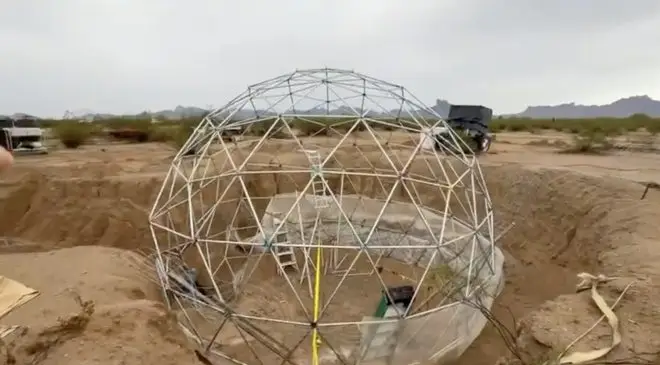
Welcome to Occupy the Land. We finish the top half
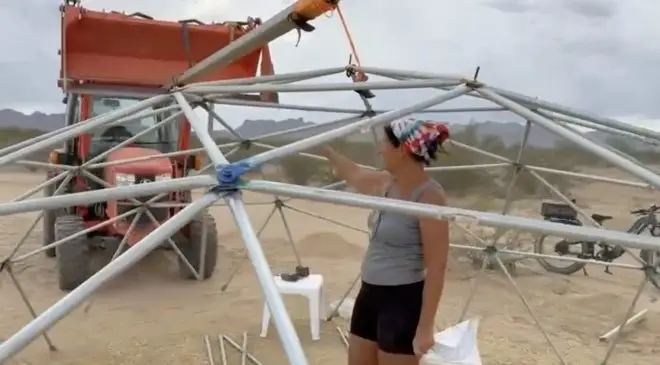
Welcome to Occupy the Land. Donna and I assemble the