



Undeveloped Side vs Managed Side — Same Rain, Different Result
Welcome to Occupy the Land. After the rain we walk
In this episode of Occupy the Land, we focus on workshop organization and preparation for mass-producing the EMT conduit struts needed for the 20ft geodesic sphere root cellar. Ernie welds custom racks from salvaged metro wire shelving poles onto the shipping container wall for efficient strut storage, repairs the road hone with welding, and discusses ergonomic workflow for cutting, stamping, and handling 160 struts. The setup emphasizes using salvaged materials, 220V power, and keeping everything accessible to accelerate progress on food storage. A practical look at turning the workshop into a true fabrication station while balancing multiple homestead projects in the desert! Peace.
Transcript:
it’s all in parallel and it’s coming together. And the main thing you know now is we keep taking soil out of the sand pond area, because we’re about at the point to where we’re going to be placing the tank. And when the water starts coming in, we can extract it from there, process it and use it certainly for agriculture and the animals.
And that’s what we’ve got to get ready for the monsoon. I got a couple of months to get ready for that. And if I don’t do that, then it don’t get done. And I’ve got like another year. Usually there’s kind of two rainy seasons. It’s like beginning of the year in the winter, you know, January, March around in there, maybe December and then of course, the monsoon.
July, August, September round and there certainly August. But and that’s why we did the Jackalope Freedom Festival the first weekend in August. Because right in the middle of the monsoon, up on the rim in the mountains, it’s like 7 or 8000ft, you know, you’re kind of. Oh, and it’s cool. 70 whatever degrees was 120 down here, and it rains every day, even a little bit.
So a bunch of damn anarchists doesn’t start a forest fire, you know? That was our thinking. You know, it’s going to be hard to have a forest fire during the monsoon. So this is where we’re at. I mean, there’s a lot of other things that are going on, but you can see what occupies our time. It’s going to be the production of the sphere struts and the construction of that over there.
Once we really get going. And it’s just a bunch of little stuff and obligations that we have friends, family, professionally, shows, site whatever. But we’re plowing through a lot of that. It’s just getting hot, man. You know, it’s always going to get hot. So we’ll go ahead and bring you on that and then you’ll see the progress. And a lot of it was infrastructure, this power thing.
And now we got to deal with the water. But you can see all of the channeling of the washes, all of the channeling of the roads, the grades of the roads, the water, the drain. That took months and months, you know, hell, just to get out here, you know, to be able to get the bus out here and then to do all that.
So it all drained to that. That was the original plan. And we’ll do some aerial footage with the drone start showing you, you know, kind of graphic. You get an idea in your mind, you see what I see. And a lot of these little things that we did were testing to make sure that that would work, that would hold, that would direct, that would drain, that would, that would, that would.
So now that we have the confidence that we built what we need, we can start getting into more stuff. But it’s probably not going to be until we’re going to have a big workshop. You know, a lot of friends and family wants to come out and whatever, but I don’t want them to suffer in the summer. I mean, hell, in the winter.
It was too cold there, you know, you know, freezing in their cars or, you know, in our tents or something. We didn’t have the facilities for it. So by November we probably will. And people will bring out the bees and have some that friends will loan for people to stay. So plan on if you wanted to go to Arizona and occupied the land, see what’s up and help and learn.
Probably November, you know, like a middle early November, you know, after Halloween before Thanksgiving. And we’re going to have workshops out here because now what I was saying, I go, have you do what I don’t even know yet where we’ve gotten to the point where we know we’re going to do this here. This here takes this many hands for that.
A crew of three and this equipment and peace out. And you do that and then have somebody else do it the next day, and you shift over to learn something else. And about the old three, four stations, man, you get learn and you see the confidence that I have in doing this in the desert. And I don’t have a lot of the problems a lot of other people do, you know, I mean, we have bugs, you know, in the, you know, the cows are out here or something.
You know, the open range, you know, sometimes you get, you know, more flies than you want. There’s like two weeks at a time. There’s these little beetle things that, you know, but they don’t bother me too much. And then, you know, scorpions, you know, you go out with a ultraviolet light, a black light out here around these plants, and you’ll just see them glow all over the place.
Okay. There’s that. So scorpions, they don’t bother you unless you’re, you know, sticking your hand on them or something. Snakes. The only snakes I’ve seen out here have been, you know, non poisonous, you know, constrictor.
Whatever they call them boas or something out here. Then the rattlesnakes, they’re always hiding into something, but they let you know they don’t come attack you, you know? But. So you got to be conscious of that, you know, other than that, we don’t really have an insect bug problem. Now, sometimes during the monsoon, you get some standing water, which is one reason why we want to have it.
You don’t see it. It goes under the sand. Mosquitoes in the desert, you get, you know, a lot of standing water somewhere. Many mosquitoes come from somewhere. So there’s that. That’s not like a plague, you know, or often. But every now and then you’ll notice it. So you got to make sure you don’t have, you know, use tires with water in them and breeding mosquitoes.
So there is a lot going on out here. And it’s just Don and I on 18 acres now we’re developing about ten of it right now that we’re on the rest of it. Just leaving on the other side of the runway. We got a runway for like ultralights that we’re going to be doing over there, but we had the runway.
But you know, you’ll see it. It’s good for parking. Got a lot of parking. We have a lot of friends come out. So that’s where we’re at. What’s going on? You know I have to go dump it, you know? How do you you gotta go set up the camera and, you know, and the time lapse. You, me driving you, you know, imagine it.
I drove that trailer over there and dumped it on the house. Packed. So this is when Donna’s around. You know, she’s off today, but when she’s around and get more footage done. But I just wanted to explain to you that there is a plan. And you can see. Now, here, I’ll show you. I think here you can see.
You know how much. I don’t know if you can make that out. How the road has been built up around the sand pond. So this blocks all of this water flow that comes this way, comes off of those mountains, and it finds all its way in various different washes and low spots. Like, here’s a low spot here.
And then this turns in like a little lake back here. So you can see from when it was raining, you get a lot of these grasses and so on. And what we’ll do is this will be another planting area. Now this is just exactly what we want to happen. Like we’re doing the upper terrace up there, you know, for the orchard.
So this will get a lot more water and retention and soak into the ground. And if you dig down, even though it’s been 5 or 6 months, about a foot down, it gets wet. You know it is. While I’m pulling that sand out there. It’s heavy in that trailer because it’s wet in that corner. So you can do trees.
So what would go over here? I don’t know, you know, maybe some citrus will go here or something. You know, it’s going to work because we’ve been living in the desert for freaking since the early 70s. I have I know what can happen. So that’s what we’re doing. And it’s just beautiful out here. I wake up every day, you know, by ten, 11:00, my batteries are 100%, you know, I know I got, you know, full power on my workshop in the garden area.
Donna comes and checks her garden every day. We, you know, get site work done and the shows and everything and come out and do some progress and get something done. And, and it’s just you have something to do every day and it’s just not that bad and it’s beautiful. And then when it is a monster in the summer, all the sun sets are freaking awesome and they’re right over that mountain.
So and that’s called courthouse Rock, because I know anarchists got to have a, you know, trial by ordeal place or something. I have no idea why they call it that, but the. Yeah. And here you can see the washes. We take the tractor and we flatten it out. So it’s not like a big rut, you know. And it and it dispenses the, the silt and soil and everything fast.
So we build this up here, and then it flows across the roads and then it goes into the pond. Now there’s one and there’s another one right here. And then where we had the house pad over there, that large clearing area on this side of the dome, you see that we keep dump. That’s why I’m taking a lot of that soil and building up over here.
And we got to get it up, you know, maybe another foot or so. So I keep bringing that over there, and I was worried that I wouldn’t have time or enough. And as time goes on, it just keeps getting built up. So cool. Now on both sides it has a wash it the reason we bring it up because it’ll flood if we don’t bring it up, and then it diverts over to the this wash on this side.
And there’s another wash between here and that skid steer. So maybe you can see how much it’s building up so we don’t have to worry about the house getting flooded. But that’s the main primary house. All of this stuff that we’re doing here is experimental. This is so us to learn what to do and how and what works and not.
And then the bus is self-contained in 1980. MCI freaking not going anywhere. I drive down the road at 75 miles an hour. I don’t care about the wind, so you know that it’s cool. And there’s Donna’s truck. She took my, you know, guy. Was it? It’s like a 2003 F-150 stand cab. Just nothing. But it runs really well, and it’s doing good.
So she’s going to, you know, as a gift to me. She’s going to put some desert tires on it because I’m worried about tires out here all the time. Now. What were the reason I need to get that stamp press done is not just for the root cellar that we’re doing, which is a full one of these. It’s almost the same size, about the same size.
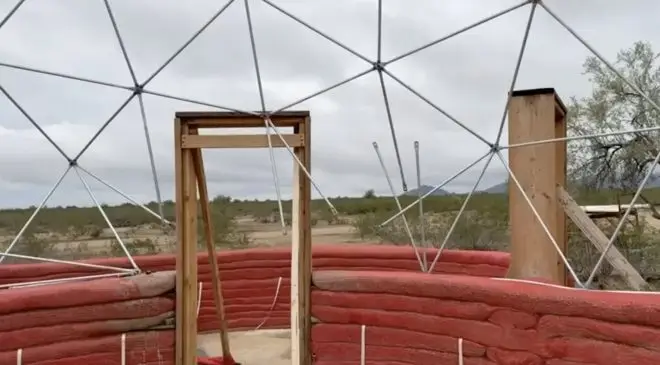
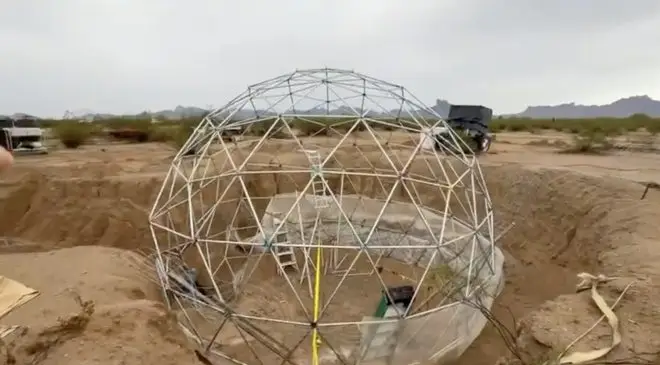
Just imagine that as one big giant ball that’s going down in that hole. That’s what’s happening. And about half of this that’s will be what’s sticking up out of the ground over there. Now it’ll have a floor just like this has a floor here, but underneath that’ll be the ceiling for the bottom floor. So that’s where the root cellar is going to be.
Now these are hyper Adobe bags. I’ll give you a close up. This you just, you know, put in Adobe, you know, wet soil and maybe some Portland and it just.
Pardon. It’s like a rock. Well they interface with each other. You put wet it a little bit and it’s just a solid wall. Now the reason you have this concrete here we put some Portland in there. This is rock. This is hard. This is concrete. And the reason is, is because we, you know, you got the door frames, you want it, you know, these cleats that are in there.
You want a hard solid so the door doesn’t move. And then we got to take this dome and do a bond beam around this, you know. So this has just got placed up here by the tractor just to get it out of the way and make sure I can even get it up there. And then you see over there we took out, I started disassembling some of the struts.
And what those do is get fashioned and customized, and I use the stamp press to have them interface with the actual door frame. We’ve done this before on a prototype and you just, you know, screw them into it and it all becomes part of it. You have the concrete bonding that connects both the dome to the hyper Adobe bags, and then that goes into the doors and windows and everything.
We have windows that will go. So I’m really looking forward to getting to this part. This is going to be fun, and we got a lot of experimentation that we need to do on this so that we know what we’re going to do with the primary build. What you see on the cover of Occupy the Land Org, that is the plan of what we’re building.
But we need to have, you know, all the little detail and how we’re putting in and everything here. Now, what these white straps are, they’re called hurricane straps. And you put a few bags to hold the weight and it has it on the inside and the outside, see if I can grab it. And what this will do is it gets a bond beam.
You have the concrete, then you since you down, they got a buckle and it’ll hold the bond beam, you know, and down to these hyper Adobe so that no matter what the wind angle anywhere. So it’s just I don’t think it would go anywhere anyway. But now it’s just, you know, because it’s, you know, we’re testing stuff and you definitely want to over engineer now over here, we added on this room because we just wanted to have more space for a washer dryer, a shower, bath, sink, toilet and everything.
And the plumbing is in there and we just got some stuff. We had the stop where there’s my drill, there’s where that impact was you. So there it is in the shade. Well, you go ahead and.
The roof that’s going to go over. That is something that we got to test we haven’t done before. The interior walls and ceiling. I have an idea. You know, a lot of this stuff you get off of YouTube or they’re foreign and it’s amazing. I want, I want, I want to say this before we go. It is amazing how many d cool ideas pioneers did it doing it in freaking Siberia, Russia.
You know that they are using different materials in different ways with different adhesives and different, different different. That is working way better than things like drywall or rafters or joist or, you know, coatings or infrared reflective coatings that, you know, cool. The shipping container out in the middle of the Sonoran Desert. I mean, there’s so much of that stuff, but no, it’s not in the code.
You’re not allowed. We’re not, you know, because it threatens an industry. It is everything about that. It’s all health stuff. It’s on food, growing farmers. I mean, man, you got to ignore all the crap and what? Well, you have to. And this code said, you know, is it friendly advice? Is it Uncle Sam saying, you know what you should do and what’s been proved?
No, it’s for some special interest. It’s for some industry. It needs to be protected from the better of I. I can’t keep track of how many shows I do on this kind of stuff. So we’re ignoring that, taking a lot of the I go, that’s a cool idea. I shall try that. And that’s what we’re doing, so I apologize.
You’re not giving you a detailed up close and, you know, different stuff we’re doing. But you can see it’s a lot of stuff. And when we get into, you know, I promise you. And I’m sorry, but I wanted to show you the actual punching out and then starting to put together the geodesic sphere. And we’re going to be getting to that hopefully this week.
I mean, you know, you can see there’s a bunch of stuff we got start cleaning up from other projects that we’re doing, but we’re mainly this week we’re going to be sourcing the water tanks. We’re going to be getting the pressure rice system we’re going to do in the filtration we get. You know, a lot of that just we want to get that situated where we want to put it, get it ready and then continue for the preparing for the monsoon so we can process that water.
Now, in the meantime, I have to get the root cellar done because we need to be able to start putting food in it. And, you know, preserving while it’s summer months and you can get a lot of stuff that’s in season and preserve that. And once I do that and get the planning of a lot of the stuff and the root crops and the potatoes and the trees, and then now we just got to wait till it starts producing.
So that’s what we’re doing. And, you know, we’re not sitting on our hands.
We had some work to do on the property and our tractors in the shop, so they gave us this skid steer on loan until we get our tractor fixed and back. So doing some more clearing on the property.
So here’s an update on the garden. I’ve got a bunch of things growing for the spring. It’s still pretty warm, but I do have some of these things. As long as you keep them cool and shaded, they’ll be okay. Tomatoes. There’s all kinds of little peppers, chili peppers, jalapeno peppers, cilantro, lettuces, celery, green onions, peppers, green peppers. I think I got one under here somewhere.
And kale. Different kinds of kale. Beans starting to grow up the vine. They’re peas. Purple cabbage, red cabbage. And I have over here a grape vine. It’s dormant right now, so hopefully in a couple of months it’ll start to sprout a little bit. Takes a while. That’s the storm. You sort of have to wake it up with the heat.
There’s some carrots. And then over here I have ginger. There’s a bunch of ginger growing under there. And in here I have radishes and tomatoes. But I’ve got something coming in and eating the leaves all the time, so they just keep not making it. But anyway, doing pretty good for as warm as it is, it’s about 100 today.
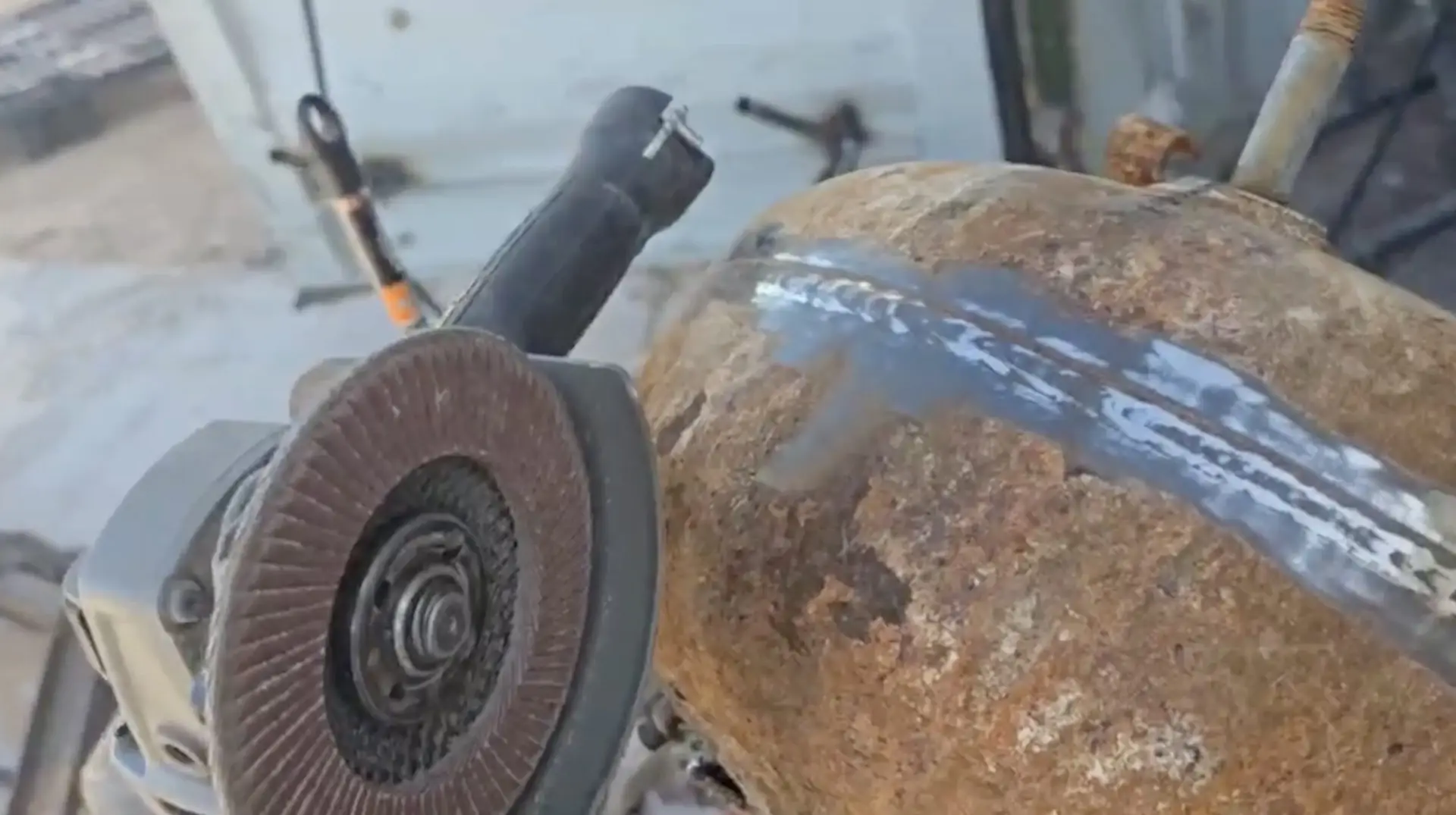
All right, it’s time to start processing all of the EMT conduit conduit into the struts for the root cellar. I gotta clean all I’ve been cutting stuff for welding and getting things prepped and lubricated and putting up the rack. And while I got the welder out here on the pad, I’m going to fix my road hone. You know, I have, you know, broken here.
The support struts are those are replacements. I got a weld in its broke broke, broke broke broke. And it was because we were pulling it 30 miles an hour around. Well, when so much on the property as it was the roads coming in because one of my neighbors has a small car that when it kicks out the rocks, they get on the road and causes her tire damage.
So what we did is we went ahead and had this pulling really fast. And when you do that, it kind of twists it, but it throws the rocks to the side of the road. It worked really well for that. But man, it was beaten. It was amazing. It lasted this long. But we have enough of the material and I can fix it.
And I got some, you know, scrap whatever because I won’t be able to get my tractor until early Tuesday and the roads are starting to get rough and they need to do this anyway. So while I got the welder out here, we’re going to be doing that. And then today when I get done with that, we’ll go ahead and clean all this up and get the, you know, all the conduit over here.
And I’ll probably put a rack up there and, and we’ll get the punching that bad boy out and start putting the root cellar together.
Okay, I’m still getting ready and that’s what I’m doing. It’s too windy out there to put up cameras and time lapse and so on. So I’ll just tell you what I’m going to do and I’ll show you. But you have to hook up the compressor. And I brought it over from the other one. It’s on wheels as wheels over here.
And you put it on the plasma cutter because it needs the air pushing out the end as you make the arc to blow away the metal. Now, what I need it for is I got this old pancake compressor tank that got burned up, but I saved this stuff because I need the metal. So I’m going to go ahead and use these brackets, maybe cut this thing and make a little squares and stuff, because I need good thick metal like this to reinforce this.
Now I’m going to go ahead and fix my road home, but you can see how it twisted. I guess you can see it this way. Better it twisted, you know, just from running it really fast and it broke it. So I can weld this. How long would that hold? You know. So I need to get strips of good metal.
And I got a bunch of different stuff. I just want to start using what I got and start welding this up. And then I’ll fix these back here and weld that and put new reinforcement crossbars on bad, blah blah, blah blah. So it didn’t take us long to do it new, and I can kind of fix it here and then get it so I can smooth out the roads and stuff again.
And I didn’t want before I got in the processing this while I got the welder and stuff out. I wanted to do this. So I have, you know, broke out my plasma cutter. I haven’t used that one yet. And then I got, you know, you know, there’s a lot of, you know, just little tools and stuff and different hoses and I’m going to need that.
So glasses. And then I had this old it got heated and I put this on my lap when I’m doing this stuff over here. But because it got hot and it started to fray and so on. You get all that little fiberglass it, man. You know, like that I, you know, heck no. So I got a new one out, you know, that I had.
And because I really like these, they’re just you just put them over you and I got my, you know, Wheldon apron and so on. But I just do little bits sometimes and I don’t really need to get all outfitted. Plus, it’s so hot out here that you’re kind of concerned about, you know, being overheated, but you get your gloves.
The main thing is glasses. I mean, you always get to wear safety glasses on everything. That’s I learned that just by I wear reading glasses. And I’m so thankful I got glasses on so many times I can’t even count. Definitely protect your eyes now. Welding and shorts. You know, like I got, you know, not. It’s kind of like making bacon while you’re naked.
I mean, you just know better, but sometimes you just want to make bacon, you know? But the. So that’s kind of what I’m dealing with here. The. I just got it up on the welding table. Now I have a welding table over at the end of that table over there I could bring out, but I haven’t got everything set up the way I really want yet, and probably going to have a flaw that goes outside that roll up door over there for bringing stuff out to.
And then I got this, you know, work area, which, you know, this is why I needed it for exactly this kind of stuff. So you get this stuff done, then you start doing this other stuff. Well, what I’m going to do is start cutting this up so I can get the metal reinforcements I need to fix the road hone, and then we’ll start cleaning.
I got all the brackets up and storing my stuff and getting ready. And then, you know, this week I got so many. I got trips to the tractor place or working on that. I got to get some supplies. We have to get some reinforcement mesh and hog fence for the root cellar build. I got, I got, I got, I got.
So we just keep you know plugging at it and the next stage now finish this road hone and then I’ll clean all this stuff up to get in production of the struts.
Oh, and yes, I was wearing, you know, goggles so everybody can get off my butt. Already know where that’s going. I took them off where you could see I was wearing them. But, yeah, you protect your eyes.
I know, I know, I know when you’re doing the small areas, it’s not that big a deal. But if I’m going to go around the circumference of this and make two halves, you got to sand it, you know, get down to the metal or it won’t make the arc the contact for cutting it. Now the compressor, the reason you need to air.
Once you create that arc at plasma, then it needs the air to push it through and make the cut. So you got to clean that to get a good arc. And then the compressor just, you know, pushes it through, but you got to clean it first. So there.
Well, I’m not going to show you a close up of the welds because they’re not. I’ll show you. You know, they’re not. They’re not super purty, you know, but, Yeah, you know, but the but they have the capability to be, you know, if I get out on the welding table and get all, you know, it shows that it can do it really well.
It’s just that, you know, I don’t care, but we could dress them out and grind them. But I just needed it to be strong enough, and I could stand on those on the bottom. You know, yanking on these, they are not going anywhere. I thought I was going to have to put braces and brackets and all this. Just a steel metro tubing, you know, corner stuff that I had extra and I needed to do, you know, to put up.
Well, this. Here you have these and as I produce them, just put them up there and stack them up like I did those. So that’s that’s 40 of them and that’s holding it. I need to get them up there, you know, so I can access them to process them and so on. So I already did that. And then I got this rack over here.
That’s convenient because as I take them off of this and I, you know, I’m all about ergonomics, man. You know, don’t be taking more steps and you got to take more in a step. Step and a half at too far. So be cutting them here. Get a pile of them you know. Bring them over here. And then I put them over there.
Now probably we’ll get the mix of this down because I spend more time now getting prepped for the prepping, because every minute or two on 160 of these, all of a sudden you’re adding a couple of hours. You didn’t have to. So that’s why I’m spending some time on this.
https://www.bitchute.com/embed/gZ2j1I0pP1UO
https://rumble.com/v7aap3i-root-cellar-momentum-welding-racks-and-road-hone-repair.html
Welcome to Occupy the Land. After the rain we walk
Welcome to Occupy the Land. We finish the top half
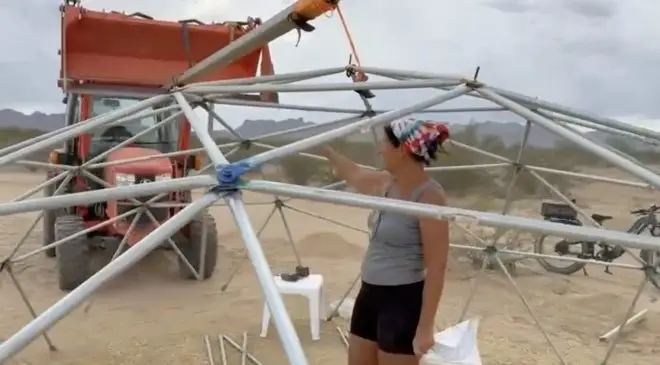
Welcome to Occupy the Land. Donna and I assemble the