



Homestead Maintenance Day: Slime, Shredder & Sphere Floor
Welcome to Occupy the Land. This week we turn the
In this wide-ranging update from Occupy the Land, Ernie shares where the Arizona desert homestead stands after a busy stretch. The concrete work pad is complete and ready for strut fabrication with the stamp press for the 20ft geodesic sphere root cellar. We cover water retention in the sand pond (Khaleesi soil, auger holes, future orchard terrace), biochar production, energy redundancy across three power stations, food production scaling, and upcoming fence/road work. Ernie also discusses emceeing the Nonconformist Series “Surviving the Zombie Apocalypse” and the core philosophy driving everything: self-ownership, rejecting delegation, converting paper assets into real self-sufficiency, and building for Generation Next. Inspirational progress at 65 in the desert — no excuses! Peace.
Transcript:
Welcome to occupy the land. Occupy the land. Now we’re back at it. We had a last couple of weeks. Been really busy doing a lot of stuff. And this weekend is the nonconformist series Surviving the Apocalypse. That starts tomorrow. You know, time this goes up and you can get your tickets. You go to. Com, you get your tickets to watch like the dozen presentations and, and you can get it to where you can watch it later.
There was a lot of good information in there, but it sucked up a bunch of our time. Now one of the things is that, you know, I’ll show you that when we do these struts for the root cellar that we’re putting down, I need somewhere to put them as we process them. So we’re just taking this metro wire corners, the poles that the metro wire goes on to.
And we had a fire a year ago and it just got hot enough. It just melted all the wire and stuff. I mean, it was a thing. We’ll get detailed on that another time, but it gave me a lot of metal and scrapped and sheet metal and, you know, stuff that we wanted to save for projects like this.
Now, what I wanted to do, I’ll show you a close up is, you know, would this hold or not? Looking at it right. There you go with this hold. You know, welding drop that, you know, and I’m, you know, yanking on it and this thing is holding. Well I’m going. Okay. I was thinking I was going to have to make some kind of bracket or whatever, but this shipping container metal is thick.
And, you know, I’m playing around. I got better with the welds. It was a, you know, was getting better at it. But one of the things is that we have 220 and when you get to 220 and you’re doing these welders, oh, it’s my blender. And I really I just pull this out, you know, it’s on a cart and I just pull it out here, turn it on the gas.
And we have more than enough electricity. Now, the 220 is for running the stamp press and doing the cutoff and so on. I’d hope to have this under production by now, but we’ve had so many things that we got to contend with and they’re still working on my tractor. They’re pinky swear and that it’s going to be done by this Posey coming up.
It’s Friday afternoon now. And so they gave me a loner of a skid steer that is wheeled now I had one when we first bought the tractor. They were kind of late with it. So they gave me a loner while they were getting it ready and it was a tracked skid steer. Now track skid steers. I think they’re a lot more stable.
They don’t, you know, trash the ground as much, you know. But that little four wheel, I mean, it just beats the crap out of wherever you’re working. And then it makes it in the moon dust and then it gets stuck. Then. Never mind. I just put it back on the trailer and it may take it in the day or next week when I go get it.
So what we’re going to do is go over and take a it’s so messed up from that thing, you know, that it kind of trashes the sand pond. But I got the trailer loaded up and I need to dump that because I need to move around some water and I need the trailer for the IBC tanks that we do now.
Donna’s in town doing some, you know, she’s a realtor, she’s doing real estate stuff and have some other things. So she’s going to be, you know, back like Saturday night and then back into town and so on. And that brings up that was something on the telegram we were talking about, you know, energy prices. You know, the energy is I don’t have that problem now.
We’ve spent probably about, I don’t know, 20, $25,000 over the years accumulating the equipment that we need for producing electricity. Now, the electricity on the bus, we have about 13kW of storage. We have a 6000 watt inverter charge controller and about it’s producing we have nine panels at about 500W, but they generally produce about nine and half of that or something.
So we get, you know, 3.5kW an hour for about 4 or 5 hours a day. And then it kind of goes down depending on where the sun is. But we generate a lot that’s like, you know, we can fill those batteries up, you know, 3 or 4 times a day. But so we use a lot of the power during the day, but we always go into the evening at 100% and they’re 40% in the morning.
So power is not a problem. And that’s just one. So we have the workshop that has an even I hardly ever use it, you know, like 220 with, you know, plasma cutters and stuff. And we have the lights on in there and run over our tools and power the batteries for the hand tools and so on. So it has like 15kW as opposed to the 13 on the bus.
So I even got more and I have another 15kW that is available for Donna’s garden. Well she doesn’t really need any. So I just put like 4001 battery. But I have four batteries for that now. The reason is because when we do the root cellar, we’re going to have refrigerators and freezers and dehumidifier. And one thing is water.
What if you could just pull the what? You just pull the water, suck it out of the air because there’s some humidity here in the desert, like 15%, 20 or something like that. But during the monsoon. Whew. July, August. That shoots up now because of the heat. It has to cool it down to condense that water and it drip into whatever.
But at the bottom of the root cellar, it because it’d be in the 70s, even in the summer, so we can produce a lot more water. Now they have units that are, you know, for $20,000 you can get, you know, 60 gallons a day, which means like a third of that in the desert. But, I don’t need that much.
You know, with this sand pond here in the monsoon, we’re going to have plenty of water. Now, Donna is like, I don’t want to be drinking dirt. Water. Well, I do, I mean, clear whatever else is out here. And then you have, you know, a filtration systems that you can do. We have the sand filters that we want to experiment with.
We already have been. That’s working pretty well. And then you just let it settle as a as it comes into the sand pond here, I’ll come over here and I’ll show you as it comes in to this storage area. You slow it down and it settles in the sediment and the, the dirt and so on settles down, I don’t know, maybe once a year or every three years or something.
Come in with the tractor and you scoop up a lot of the sediment that’s used for soil amendments, and you got some good soil because it has almost equal weight, you know, it’s silt and clay, then wash sand and gravel, you know, here, I’ll show you. So as you look at this, see, where’s my hand? You know, you look at this and you can see.
There we go. You can see that’s a lot of sand and gravel. You know, when you separate this out and which is what we’re doing, you know, with the trommel I keep talking about and we’re near getting ready to start doing that. You can separate this out. And the sand and gravel is what’s going to go around the tank at the bottom of the sampan area.
We’re going to be pulling the water from. So you can see why we have this. You probably can’t tell, you know, on the.
Camera here, but this is raised so it stops it. And that’s why we need the check dams to back this up and flood all of this desert out here. And we get a lot of growth, but it also takes a lot of the particular and sediments and stuff out of it as then it overflows. And we have kind of, you know, filter straw mesh tube, you know, use the hyper Adobe bags and stuff it with whatever and where we have a lot cleaner water.
Come out now, you’ll see this right here. See if I can get that down. You can see this. I don’t know if you can tell on the camera how much that’s raised up, but you had this raised up. This is the dividing area between up here, which is the orchard you keep here. And let’s talk about now, you saw a few videos ago where what we did is we took all the brush that we had collected over there from clearing this lance, all this creosote stuff.
And we still have quite a bit we can clean up. And what we did is we dug a trench here and we put that in it and we lit it on fire and boom. Then we got going really good. Then we put the soil back over it and let it make biochar. Now we have our neighbor. One neighbor that we have in five miles is raises rabbits.
Now they do it for showing rabbits. They don’t eat them even though they they know how and could. But these are show rabbits. But they got for years and years they have like five foot wide, 4 or 5ft tall and 20ft long of rabbit poop. And that stuff is the best you research that. I’m telling you, man, that stuff kicks.
But so what we did is we’re going to take get all and start doing this because we got to start planting like a month ago for a lot of the trees and orchards that we want to do because we’ve had citrus, you know, orange, grapefruit, lemon, limes, apricots, figs, you know, pomegranates. I mean, you know, they grow really well here in the desert.
You just gotta have enough water. And what we found out is that citrus takes a lot less water than we thought. It’s like 35 gallons a week or so. So I’m going. Yeah, we filled this up. Now you can see what we’re doing is pass this. See, I don’t know if you can see the raised area, the dike here, but up here is where it gets the water the first.
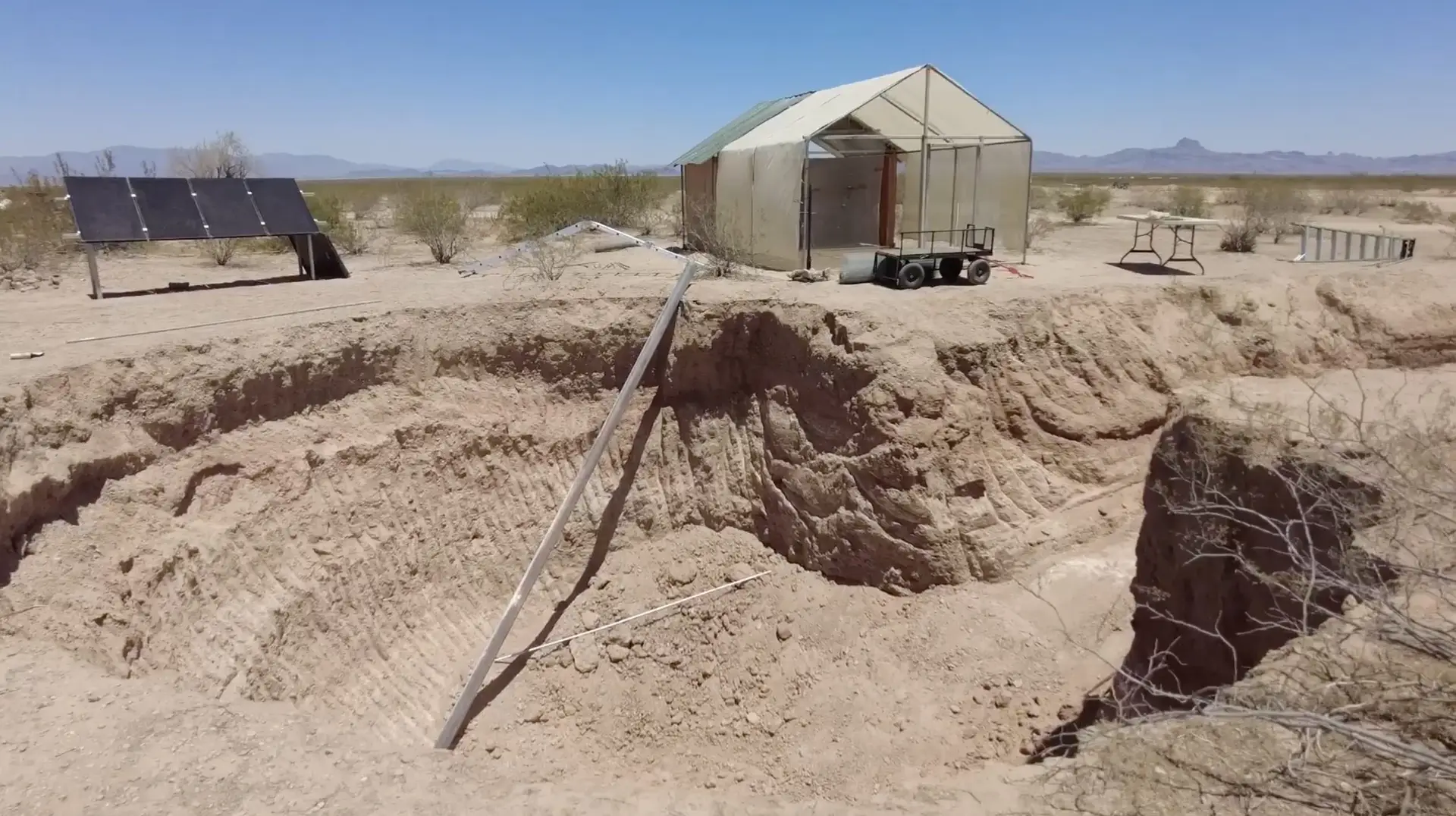
So this floods and then the overflow that we’re building, you know, over here we’ll regulate it to where once this fills up and saturates the ground for the trees, then it starts flowing over in this storage area. Now we have the tank, you know, that goes down here. And I’m just now at the bottom of that. So what we’re going to do is if you can see it goes down, down, down, down, down.
It’s hard to see on video. You got to have stereo human eyes, you know, get get the AI robots be able to tell. But this is about the level. This is ten feet or so below ground level. You put a ten 12ft high water tank. They’re perforated, wrap it around, and then all the accumulated water will go into that and we pull it out.
But we’re not just leaving it open hole. We need the trommel to separate the soil and I mean the sand and gravel. And then we’re back filling it with that sand and gravel so you won’t even see the water. It doesn’t get algae, it doesn’t evaporate. And the big thing is that, you know, gets filtered as it goes, eventually makes it down here because you can see and then, you know, we’re using the dump trailer to take this out and put it where we need it.
And I was trying to use that skid steer. That’s why it looks so messy. You know, with my tractor, I can back blade it as I take it, and it’s a lot easier on it. But that four wheeled skid steer they gave me sucks. And I’m taking that back. But the this is the area and you can see around the edges, we build the roads and we have it up.
So this is what the water thing is. We have enough electricity. We have the garden area that has like 15, 16kW, the workshop 15 16kW. And we have we only have the storage on the bus is where our primary is only 13. So we have more power, you know, decentralized around the property than we do what we’re living with.
But we have more generation over there because we use most of the power during the day. Now on these other ones, as we go to the garden, you know, and the workshop area, you know, we have enough generation that we can fill up the storage. Now, what I did is we need to get into manufacturing the struts for the roots.
I mean, the yeah, the root cellar building, because what’s going to go in the bottom of the root cellar might be a water generator. Well, when it’s 70 something degrees down there, you know, and we put it down there, it used a lot less power and we might be able to generate some pure distilled water. Now, that is because Donna is not convinced that we can take the monsoon water that comes down into this storage here, because it’s a lot.
Get a blown away box. We have a lot of water. I mean, this will be, you know, hundreds of thousands of gallons. I mean, you know, one storm. It’s amazing. I’ve already seen how that works. Well, we take that and we can process it. Sand filter it. You know, with Sam filter pump like we did for the pool.
We got one here. We’ve been testing. I think it works really great. And then of course, you know, it’s hard water. It’s got all mineralized or something. But a lot of it, it’s just rainwater that comes off pretty quick and I don’t think it’s a problem. We’ll get tested and so on. But if I can generate, you know, even 30 gallons a day, ten gallons a day, that’s more than what we use in the bus for washing and bathing and so on.
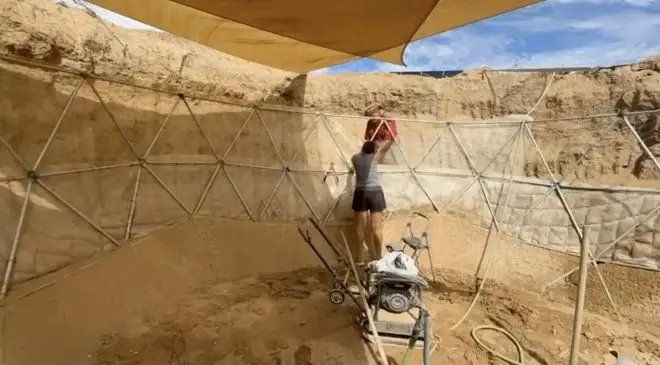
So this is big. Now imagine the geodesic dome in a sphere that comes up and down about 4 or 5ft. You’ll see the top of that hard stuff there. I don’t know if you can tell where the teeth of the bucket started. That’s about where a little bit up, it’s about 3 or 4ft from the top is where the ceiling for the bottom and the floor for the top, because the dome will come up probably about as high as the wall on the chicken coop over there.
Now she’s got all the stuff she’s about ready to order chickens. Even though it’s summer. We had to get a lot of misters and water stuff and everything we had familiar with how you deal with chickens, and she’s just like, we just got to get them because we’re really focused on food more than we are the building, because we’re comfortable in the bus.
But I mean, dang, I’m not comfortable thinking about supply chains and costs, and I’m glad we’re not doing energy. If we had an electric vehicle, we wouldn’t have. We’d cut our transportation cost and fuel about, I don’t know, down to a third because what we’re every time we go to town, we fill up because the round trip is, you know, 150 miles.
So you don’t want to be without fuel. Now we have the fuel cells for diesel, and our diesel capacity is about about 300 gallons, you know, but 300 gallons times five is like a lot. It’s $1,500. So we’ll go ahead and stock up here in the next week or so. Get all our diesel and everything because we need it for the tractor and for Donna’s truck.
But. Man do you buy it now when it’s high, is it going to go down? We got to deal with Iran. How fast? I mean you know it’s just screw them. So what we’re going to do is go ahead and get stocked up on everything. And we have I have the hog fence that I need to get to put under and around for reinforcement of the geodesic sphere that’s going down into the root cellar.
Now, the big thing, you know, this trash here, the big thing that we’re concerned about is getting this root cellar done. And I have all it already. I finally got, you know, the power is done. We got the pad out there. We got we got we got there’s just all kinds of stuff that we got to, we got to do.
I mean, you know, welcome to our life. You know, I got in the last couple of days, I’ve done got 5 or 6 shows and you got to edit and you got a post. And then we had some back end IT problems on the site that we got big upgrades. So I’m looking forward to that. You know, that Derrick did a good job on that.
And then of course, Miranda is doing the editing of this and she needed a show. Yeah. Give me something, man. You’ve been busy. So this is what I’m doing here. Kind of give you where we’re at now. I’ll show you this as I’m going down this ramp I did with the tractor. Then we back it up, you know, the backhoe, pull it out, and, you know, it’s just a thing, you know, getting this all out.
But down here, it’s going to be a lot cooler when you get down below. Let me see if I can.
A little bit cooler, but I doubt, you know. You got to get it all filled in before you get the benefit of it being cooler. But but it works. Been done. But you can see how much gravel there is in this. Now there’s different layers. And this is what we need for our concrete, for drainage, for a lot of stuff.
And then, you know, the mud is great Adobe for making, you know, bricks and doing check dams and walls and stuff. But all our material is here, you know, and I don’t have big rocks, so I’m not really dealing with that. I could use them and I can go, you know, a couple of miles away. And they have a lot of them, but we’ve done our roads and so on.
I, I promise, you know, in the next few weeks, within the next month or so, that we’ll go ahead and have a bring out the drone, start going over the plan, the aerial, the grades, and maybe do a little bit of animation or drawing on the computer screen to get to where you see what the plan was, because there is a plan and it’s and it’s going there.
The only thing that we don’t see is only a couple of rain events that we’ve had to kind of prove the concept and that we’re retaining it, and how it soaks in with the auger holes and all that kind of stuff. So that’s been proven to my satisfaction, and we’re just waiting for a good monsoon. And all of a sudden, boom, that sand pond fills up.
Which is why I got about two and a half months, if that, to make sure that I get it to where I save enough of this year’s water to get us to next year, that’s I mean, it’s going to be we’re of a year’s worth. I go drought in three years or something. I get all the water that I have planned for, but I wanted to do that.
And the reason was we could do it well, but it’s very expensive, and I still wanted to make use of the land and not have to pump the water everywhere I need where I’m doing something or grow it. I just wanted to be automatic. It’s natural. It just because you can help natives did it, you know? I mean, that’s how the Arizona canal system was just dug from the Native Americans that were here, that did it.
You know, you go to Phoenix and all this canal system, they were already there for hundreds of years. So that’s what we’re going to try and do here. And the big reason also is because you can’t get anyone to dig a well without a permit. And the state getting them put in the push pin with Ernie. Well, permanent half to no I don’t.
So we’re just going to hold off on that. Now this is the solar panel for the workshop. This is what, you know, powers all the batteries that are in this battery house that we did. Now here is it’s 15kW. The only thing that’s different about this is this is a 220 inverter. So I got 220 that comes in this I got two 220V that goes into the breaker box that’s in the front of this.
And then we have a 220 that split it in the two one tens. And then we have a 220 that goes in a wire over to the other shipping container. And we had 220 in there because, you know, plasma cutter and stamp press and welder and so on. That’s working really well. And that’s all from this one. I think this thing costs like $1,200 or something.
I wasn’t that much, maybe even under 1000. It’s working great. And these batteries I think I got these are 12 volt 300 amp hour. Yeah, 300 or 350. But that means I got like 1516 kW, which is more than what I have in the bus. And these are always fully charged. The solar panels are keeping them up and then I can weld all day.
Got the lights on in the workshop. Power is not a problem. Now. What we did also is we close this back up. So I don’t forget the what we also did is that for Donna’s garden area, we have some batteries that we did. And that was oh the same ones or similar to these here. She doesn’t use that much, only needs one battery.
We got for the reason I needed the four is because the root cellar we’re going to be having, you know, a refrigerator freezer. And maybe you know what I was talking about, you know, a water generator from the air. Just out of principle, because we can, you know, it’d be cooler down there to be more productive. Now, what I did over here also is I wanted to have some water, you know, just to wash my hands down here.
I get a chemical on me or, you know, you’re greasing, you know, the tractor or something. And we’re going to put this sink on the front here. There’s a pump that Donna, you know, gave me one of the pumps that she was using. We have some other pumps. Yeah. You buy, you know, stuff. And the reason is because I like it decentralized.
I don’t need just one. One thing goes out and you can’t do anything. Well, we have portable batteries. We have three different stations. Now, this little water thing here, it’s kind of cool. You press on that pump.
And it makes water, and then it drains out and you can put that somewhere. But this whole bottom take has water. I’ve yet to undo this thing because. What’s this. Oh you hang a towel on here. Cool. So we got this. Just so I had. I hardly use it, but it’s nice to have. But I really want to get this done, so I have a whole bunch of little things to do that.
And the other thing is, you’ll see we have power chords that are coming out from the breaker box and outlets on the inside of this. I need to put an outlet that comes outside because I need to have one, you know, like at the bottom corner of the shipping container there so that I can power pumps over here and different things because we use this also for construction.
You know, when we’re doing construction over here, we need the water and we need power and we need, we need, we need. So it’s just, you know, that little stuff. Now this is a copper grounding that you do. I have like three of these around because you want to ground everything. So you touch stuff. You don’t get electrical.
Now this is where I’m going to be spending some time when I get time and I can’t do anything else. You know, I’m working on this front part. I got some more shells and so on because we cleared out the welders and everything. So I have a lot more area, but you need to really do what I did in the back here is make use of all the height.
You want to have stuff stacked up, and you can get to it and out of the way. And you know, I separate like this is, you know, the battery work and area and cabling and so on. I still got to organize that more, you know, and here’s kind of a work area when I’m doing battery stuff or, you know, stuff.
And then I have another table in there, has anvils and everything, you know, pressure washer, electric. I just plug it in and do it. I works on one of our batteries, you know, grinder and so on. A lot of the tools. Now we’re going to be putting in more shells that I have over there to take a lot of this stuff I got around here just being in the way.
And but this is where the power station comes in from the inverter into this. Now what this is, it comes in at 220 and it takes and splits it into two one tens so that we can have 220 and 110. Now this is what goes to the workshop. Boom, boom. 220. And the only thing I have on here is this for the lights now.
So it doesn’t draw that much power. Now these wires right here are each, you know, for each of these breakers here that I can power. And do you know, whatever, you know. And I had to get a whiteboard, you know, for all the private. This is what I got to get to just in next couple of days. And we got the fence to do.
We got, you know, the ordering of the fence post, putting up fence. We got to buy, go spend a few thousand dollars. And all of which is cheap because, you know, we have a contact out here that has all the stuff that I need and it’s a third of the price of buying it new. He goes auctions and gets you and and going, damn.
So I let all these guys scrappers and, you know, stores of stuff, auctioneer people and you start creating this network of contacts and I go, yeah, well you need some tractor and work. You need a septic tank dug, you need a little fix of your road of something, something some give me a deal of whatever. Or they’re like, nope, nope, cash.
So silver or crypto or whatever. So we’re using it at all and developing these relationships. And I get stuff for like, God, at least half if not a third of what, you know, we need, you know, for the stuff we need. Now I have these barrels is how we’re going to be making the.
Trommel for separating the soil. So I got these for that. And then this motor here, this kind of our lay down, we got, you know, stuff. This motor is what’s going to power it. Now. It doesn’t drop it like seven amps or something at 220. So I can even instead of having it up here all the time because we need really to bring it over there down into the sand pond.
And that’s where we’re going to be using the tractor to do a lot of the separation and getting the stuff that will go around the water tank, well, electric. So what do we do? We use these really nice trailers that we found some of them over there, you know, guerrilla cart kind of stuff. But there are some others that I’m just like, man, these are awesome.
So I went and bought two more and we can just build Power Station on it. They’re rugged enough and made of metal and big enough tires and so on that were I don’t think one of them is over there, the ones that I like. But you put in the inverter, the batteries, you need a charge controller, maybe even a now a couple of solar panels that you click out.
We got some portable, use them all over, fold them out ones, and then all of a sudden, boom, you got a power station. I can run that thing all day long on electricity with it never going out all day and a little storage into the evening. And we’re styling. So I’m big on this electricity, man, I tell you.
So this is where we have some automobiles that we’re bringing over and they’re being stored at, you know, friends and family that we have and and matter of fact, we have our Jeep Liberty being worked on. Now, the engine, there was something rattling or whatever. So they’re working on that. Be nice to have another vehicle for that because it gets a lot better gas mileage.
And we have different things that we put here. Now, you know, this is like the lay down yard for a lot of the equipment for the tractor. And I’m looking forward to getting this. Oh here we go. All right I’ll show you. Last Mother’s Day a year ago, Donna and I came back and all of a sudden, the fire was just dying down.
Everything that we had in the dome, 30ft dome area, we had a mid-sized charge controller, and it burned everything. I mean, damn, you know, like there was a air compressor that was one of the remote mixers. It had a bunch of shelving, jaw, horse, you know, all kinds of stuff. But I saved all the metal and we replaced most of the stuff, what we really needed, and it was just an accumulation of an old man over years of I had and I wanted to save, but we selected what we really needed.
And I saved all this metal because I needed all this metal. I was, you know, having to go, I don’t have to go get metal anymore for a lot of the projects. So this is what we’re using that for now. These eight foot railroad ties are what’s going to be the fence post. You know, if we’re going around, I have to buy the antique fence, you know, that we’re doing now.
And that’s going to be one of the projects that we do is we take and put these fence posts around and put the fence on them and stretch out tight, and we got friends that know how to do that. But that’s about, you know, that’s the back northside edge of the property. So that’s why, you know, that one’s there, that one’s there.
And you can see them on down. That’s the fence line. So we got them about where we need. We’ll get all, you know pretty perfect about it. But then we’ll go ahead and auger the hole, put them in, have the mixing bucket on it with the Adobe maybe a little bit of Portland. Poured it in there packet boom.
Let it harden. Start stretching fence. So that’s a project and it’s getting hot. So I was hoping to get this done when it was cooler. But we had other stuff that were, you know, more priorities. The erecting of this building is going to be a thing once we start. It’s going to be weeks of and that’s not going to happen until we have like a work party next November.
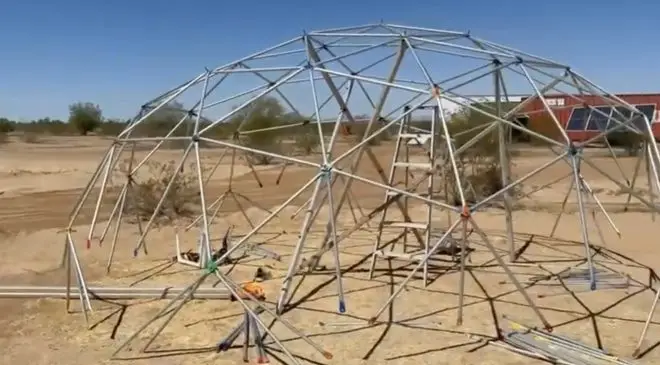
But this is what, you know, we’re looking at. And this thing is 30 by 60 by 22. And it’s a double truss. And this is going to be a thing. And it’s going to go between those two shipping container workshops over there. Now we’ve accumulated the you know, we have a lot of supplies and stuff over here. But this is another 30ft dome.
This may be I think I’m going to use the other dome that was in the fire over there because it didn’t care. It didn’t do anything to that. And the concrete pad and the dome is the only thing that survived. And the stamp press and that motor, because they happened to be by the door now, which is good.
But this is another 30ft dome that we can put up. And I’m probably going to use the one that we already have and just lift it up with the tractor from the inside, and it’ll be a big greenhouse. Now as part of a, you know, a speaking field, Palm Springs, they convinced me to go. They give me all this two inch square aluminum tubing and a lot of the well casing that’s over there we can use for drainage stuff and everything.
I don’t know yet, but, you know, that’s good to have. I’m glad we got that. And so I’m going this aluminum square tubing is the crap, man. I’m telling you, I use that for all kinds of stuff. And I’m learning how to take weld aluminum more. Now these blue things reason you see this PVC stuff. This was originally an aquaponics system that we had at our home in North Phoenix, and it uses a lot less water.
The problem is, is that it’s like a chemistry experiment all the time. You got to stay on it. You’re like all day, every day or whatever. You get it out of whack, a little bit of sand, everything dies, you know? So I’m not really. I’d rather have a bunch of square foot gardening, you know that. You know, not one goes down.
All of them do. But that is a water efficient way of growing stuff. And it does really good for things like, you know, lettuces and yeah, a lot of little garden stuff. It does, but it’s just so finicky. You can’t leave, you know, go a week away and come back and expect it to be all done. Now. J noone helped me.
Well this, this this concept, it’s called a road hone. And it’s just once you get it all leveled and everything so you don’t have to tractor and back blade. And so you just drag this around, you know, on the back of your vehicles or so on. It just kind of smooths out the road. Well it was so rough coming, the road coming in.
And when we did it, it popped a lot of rocks that you’d have in the middle of the road in. Our neighbor has a Kia Soul. Little two will drive with little tires and everything. And those little rocks are just, you know, she did not like it. So the way we got them off is once it was done, we took this and we were dragging it at about 30 miles an hour.
And when those rocks hit that point, it’s throw them off to the edge and then you have this back one that would kind of smooth out whatever. It just beat the crap out of it. It was amazing that it lasted as long as it did, but it broke it in some areas. So I need to get it over there and weld.
This one reason why I needed that pad. So this is the pad that we poured. Now it was an experiment. You know, we were looking at different, you know, combinations and ways of doing it. I think we got it down. If we were to do this again, how we would do it. But it works level. It’s what I needed to build a lot of this stuff on.
Just roll out the welder and we get on it. So that’s what we’re doing there. So there’s so many things that we’re doing and I’m sorry it’s not appreciably going fast enough to really make good videos at the you know, but doing the video is what takes so much freaking time, you know, just to set up stuff and going over it when Donna’s not here.
Desert Build Update: Fabrication, Water Retention & Preppinghttps://t.co/bjUoiFU00E pic.twitter.com/yykBZDNset
— occupytheland (@occupy_the_land) May 18, 2026
Welcome to Occupy the Land. This week we turn the
Welcome to Occupy the Land. This week we keep chipping
Welcome to Occupy the Land. This week we’re focused on