



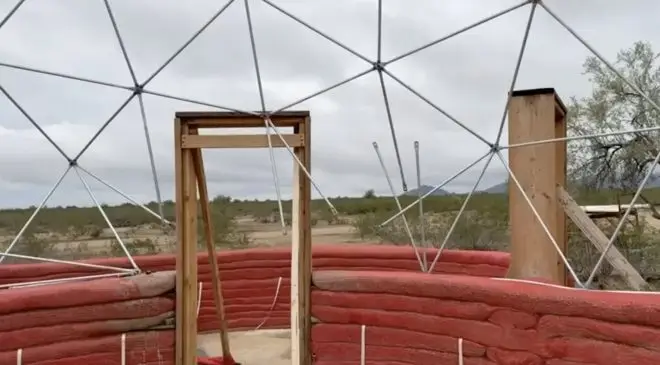
Undeveloped Side vs Managed Side — Same Rain, Different Result
Welcome to Occupy the Land. After the rain we walk
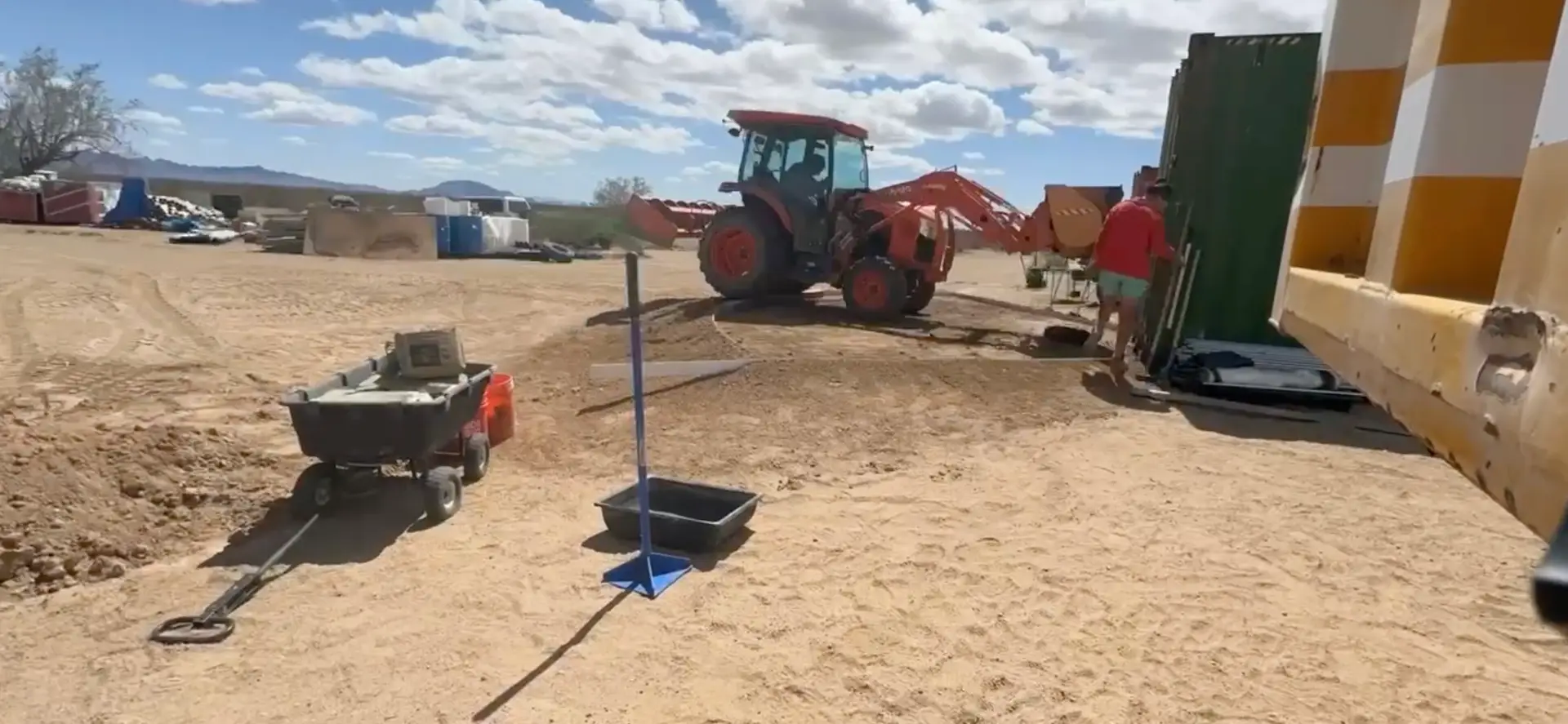
In this episode of Occupy the Land, we build a functional concrete work pad outside the shipping container workshop using local Khaleesi (caliche) soil mixed with Portland cement — a structured Adobe technique called Cow Creek. Ernie levels and compacts the area, experiments with different ratios and reinforcement (including fiberglass mesh), and tests how the high-calcium soil hardens for a durable outdoor slab. This pad will provide a flat, stable surface for fabricating EMT struts with the stamp press and welder as we prepare the 20ft geodesic sphere for the root cellar. A hands-on demonstration of using desert resources for attainable housing and infrastructure while progressing toward food storage and dome integration! Peace.
Transcript:
Now, we had some, mesh that we had for the home bill. We got a bunch of these. We had a fire, and this stuff got damaged, and, we use it to chop it up and put it in to the stucco mix and so on with basalt fibers. But, we’re taking this, and we’re just putting a layer down.
Just one more reinforcement could make use of it. Why not? Well, that’s not going to work. It’s not going to hurt. So we’re going to go ahead and put down this fiberglass mesh. And, we’ll put a steel mesh on a couple layers up. Now, Dana, cut the basalt rope into sections. Now, we’ve done this before, and this stuff just turns into really fine hair.
And we did this when we did the check dam to test this, and it worked really well. So we’re going to include that in the mix when we start pouring. Portland and the Collegium at Cal Crete out of it. And but we want to make use of that. So we’re doing that now. We’re going to make it kind of runny.
This first one over it, we’ll cover it with soil and then we’ll wet it down and compact it get it all embedded and overlap this. It’s now better than not. So we’re getting ready to start pouring. But we wanted to make use of this stuff. We may do more than one layer. We may, you know, keep layer cake in this up and see what happens.
So we’re going to try it out for you all. Well, it’s a nice day. Unoccupied land. Occupy the land org. Now, the reason we got these shipping containers, because the actual workshop that we originally built, which is that dome over there, and it has a 30ft concrete pad that was just supposed to be the pad. And we put the dome over because we had it to make a workshop.
And I like working in the round. I really liked it. But the, polyethylene cover that we had on it would just flap around in the wind, and then it started leaking and it was just a pain in the butt. Now we needed stuff. Out of the rain was the main thing. And working without the wind. Now what happened is last Mother’s Day, which was.
God, may be about a year ago. Charge controller was mis sized, and it started the fire, and it burned everything. Well, anything that we had in there, you know, is gone now. We took out all the metal and cleaned it up and set us back about a month and a half, but it took us about 3 to 5 months.
We got all the stuff that we needed replaced and so on. But we did these shipping containers and we built it up. We raised it about two feet and 18in or so, put them on railroad ties, and got them level and parallel with each other because a big building goes in between these and it sticks out about this far.
It’s, 60ft and those are 40ft, and it’s 30ft wide. It’s 22ft high. So it’s going to dominate. We’ll get to that whenever. But, this is why this is here. That’s our battery. House today. I wanted to get it outside of this. I don’t want to have to deal with that again. You know, having the fire.
Now, one of the things we had roles of, various different kinds of meshes that we’ve been testing, the fiberglass stuff that was in there got melted. I mean, it just, you know, destroyed it. So we didn’t want to throw it away, but we’ve been using it inside, the mixes and so on. But you can see it, like fuzed.
It melted and there’s glass. So it was a hot fire. I mean, that was the thing. And we’ll show you, you know, some of the debris, from that later. But we have no negative waves, no negative waves, because we were, you know, it was a mother’s day. We came in just at the tail end of it, and I sure it put on a show, but, were like, yeah, you know, we roll with it, but what we’re going to do is we take that fiberglass and we’re putting it underneath, this layer of soil just to make use of it.
And it’s not going to hurt. But this is what, you know, happened to it. It just, you know, got burned and whatever. Not really useful for what we have it to put on the domes for. We’ll get more stuff for that when we need to. Now I’m thinking I have one. I got to wait a couple of days because it’s, Saturday and, this is Saturday.
Yep. Sorry. You lose track and, won’t be able to get more of the metal till Monday, but I got to take the tractor in because they got to do a valve thing under warranty for whatever they may. Give me a skid steer, you know, as a loaner for me to be able to put the, mixing bucket on, we’re going to try and get it done, you know, this weekend.
If not, I may get a loaner from them while they take their time working on the backhoe. Now we’re going to go ahead and embed all this fiberglass. Then we’re going to start doing the mix. And we got to get the you see over there the mixing bucket on the tractor. And we’ll go ahead and start mixing in Portland and the basalt fibers and, put that on top.
We get this all kind of taken care of, but we’re going to go ahead and compact it with the compactor right there and, get this down and harden reinforced. And we may put metal mesh. I have one that will go down the middle here. And I’m thinking, well, should I get more and do it? You know, I’m thinking I want to test it.
We’ll have it with the metal mesh and without because if this thing fails, I mean, I can fix it or whatever, but this is really a good test for a lot of things that we want to do with this cow create, you know, a clean sheet and Portland cement. So we’re just going to go ahead and do this and try and keep it as, locally sourced material as possible.
And, we’ll demonstrate. You know how this works. I think we’re going to be okay. But I really want to test this because we have so many different buildings to do, so many different, building methods and materials that whenever I can test them, I do. So that’s what we’re going to do here. I’ll let you know how it goes today.
Well, I’m going to take over a load of sand and so on. We got plenty of that, you know, different places around the land that I can go get some sand. I’m going to add some more sand to it just because. Because I want to take that over and incorporate that into the mix.
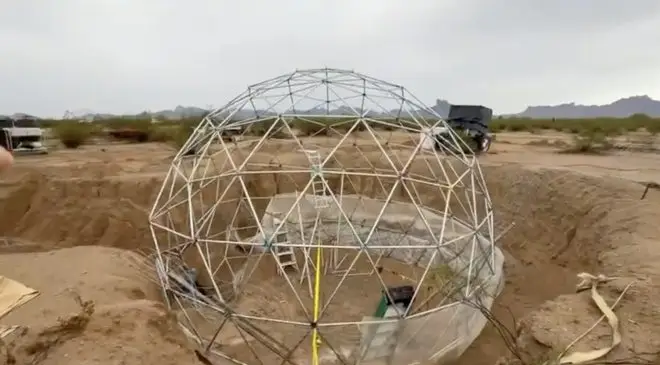
All right. Well we want to do is demonstrate before we pour the, slab out there what we’re dealing with. You can see how big the hole is here. You know, Donna’s down in the bottom. Now, this Khaleesi here is what we’re having to plow through. When you wet it, it’ll absorb water and it’ll start to, you know, turn to mud, or at least break down into clumps.
But, you’re dealing with this hard stuff. Now, this is what where we’re going to be putting the sphere. And I want to show you this is what we’re dealing with. The stuff just like concrete. Now I’m going to have it here. Donna, you hold it. I’m going to hit this with a pick. Anybody that’s, you know, thinking it’s not strong enough.
I’m going to go up here, take this pick. Now I’m going to hit it hard. We’ll see what happens. You got it, Donna? Yeah. That’s what we’re dealing with.
I mean, you can break it loose, but I mean, damn. Now, if we put Portland in there, now, whatever. So we’re going to add some Portland to it, and, we. Whoa. And we’ve been, mashing it, and we got some steel mesh. We want to go ahead and do part of it, and it’s a lot larger than I thought it might cover the whole thing, but, this is what, once it dries and Arizona, it’ll dry, and, but it’s outside.
If you get monsoon or rain. That’s why we may put some, I have a sealer, a concrete sealer for it, and, I might even just use linseed oil, but we already have that sealer, so as long as it doesn’t get soaking and just wet and just sit there, it’ll turn into this. And as long as you keep it sealed, you know it’s never going to go away.
So that’s what we’re doing. We’re going to try it with this. Here we go. Okay, I have a sledge hammer out here. We’ll get it out a shot. All right. I’m telling you.
Well, it rained last night. Kind of sprinkled a couple of nothing. Well, today. What’s the temperature now, Donna? You know it. You know, we’re we’re freezing. Man. 67, 67. Oh, my God, we’re going to die. You know, this is the cold for us. It’s windy, but it’s going to be, a good day for pouring. You know, windy kind of dries it out faster.
And so we’re ready to get going here. So we’re going to show you that I am going to go get some sand to add to it. I’ll run over with a mixing bucket and one of the washes. I’ll get some sand and we’ll get going. Here we go. All right. Well, we had this one big piece, but we had a bunch of extras laying around from remains of other stuff.
So I guess we’re going to put more mesh down than we thought we would. But, this is the screen. We’re going to go ahead and dump it here first. Now, what I did is I went ahead and just had some, from the I don’t know what these were from. We got them with the, railroad ties, but, I can just drive the tractor up on there after we mix it and go up there and dump it.
We’re going to start from there and come this way. Once we start, we really need to finish. So it’s kind of late in the day. What time is it? Yes. It’s like 330.
All right. Welcome to occupy the land. Occupy the land board. Donna and I are now getting ready to start stamping out the struts for the geodesic sphere that we’re going to use for the root cellar. Now, we need a just flat work area here, and we want to experiment with, you know, Cal Crete Collegiate. Soil that has a lot of calcium in it.
And it gets really hard. And we did this platform and it’s good for us doing what we did, but it didn’t come out as well as we want. We bit off a little bit more than we could chew, and the reason was we needed to do it all in one pour, because we needed to get the tractor to, the place where we bought it for them and do some maintenance on the the backhoe.
You had a leak of thousand and I had to get it there. So we did it Sunday. We finished it up. But the problem was Saturday, whatever this last weekend. And I want to go ahead and show you what we did. The experiments in different areas with different mixes to see because we needed to know. And this is good enough for us to make use of the platform for me to do no welding, and it’s pretty level, you know, but I’ll explain a lot of the different areas and experiments that we did and what the problems and challenges were.
And we ran out of Portland. And, so I need to get some more mud and I can fix a lot of the areas and so on, but I’ll show you what’s up. But it’s useful. Now we’re going to go ahead and use it for us to do the struts and the creation of the sphere and start putting that together, this weekend.
But, I just wanted to give you an update and we experiment. They don’t always work, but our experience with this is we should have started right next to the doors here and just worked our way back instead of doing there and then the corners and then filling that in. Because our screed, we have a big aluminum screed.
It’s only 12ft long and it was 15ft out. So we tried to do it to where we had the edge on each one to do that, the end where narrower and then on the corners and so on. If I give you a close up and it’s not a fail, you know, it’s not a mistake. It’s just happy accidents, you know, as Bob Ross would say.
So we’re, at the stage now that we can use this platform for us to bring it out the equipment and do, what we need to do to make the sphere. So that’s going to be this coming week and start punching out the struts. And they’re probably take us a couple of days, but, if I get up at six in the morning, I figured out the calculus and it’s going to be, probably about ten hours of work to get that.
Does we do it in a day? But we’ll go as fast as we can. Let me show you some close ups and you’ll see what’s up. Okay. Now this is the northwest corner of the property is like right over there. And, here’s where we have the laydown yard. Now, that’s where the, backhoe goes, but we had to take the tractor with it.
It’s the only way we can transport it. So I take the tractor trailer and take it into town and do some town work and so on. While I’m in, we have the forklift that goes on the front of the tractor. The 41 bucket that opens up like a clamshell ring, you know, pick up these railroad ties and so on.
And then we have another, front loading bucket that was, you know, came with the tractor, but I wanted to get that for one. Then we have the back blade and we have all that stuff off. And this is the cement or the Adobe or the mud mixer or whatever. And this works really well. It’s heavy, but, that’s what we were using as we did this over here.
Now I’m going to show you what we started off with. It kind of proved that yes, it can be done, but, it hasn’t fully cured you. I think it’s really going to take a month or so before to do that. Now, what we did, what we’re going to be doing is, we’re going to be taking these 160 ten foot long, three quarter inch EMT conduit, and that’s going to make the sphere.
So we have to process those. And in here we have you know, when I put up all my tools, there’s one thing I’m going to be doing over the next couple of days is just cleaning and getting all organized. And so I’m going to get in mass production. There’s cuts to struts to length. I got, you know, them measured out where I put this stop and how long they are and so on, and process a bunch of these.
And then we stamp them out on the press here and, and then we put the struts together. And I just need some room because I got to do some welding and so on. And inside here is tight. So I need this. Now what we did is we did the soil along with a little bit of sand, a little bit of Portland and straw and basalt fiber.
So I’m not thinking it’s going to crack too much or destroy, but it’s, Yeah, we wanted to experiment. Now, this screed here is 12ft long. Now it goes 15ft out to the end here. And it wouldn’t reach. So we did the corners and we did here first and started here. Now, the one thing about this is that you could still, you know, it’s not hardening.
You still get a thumbnail. I know what’s going to happen. It’s going to I wonder what that was. And it’s going to cure and it’ll solidify. No keep getting harder and so on. I think it’s going to be fine for embedding the, the, the sphere into the hole for the root cellar, but even more, it’s dry here.
Yeah. I guess it’s kind of harder, you know, it’s getting a little bit of indentation, but, this is working well, am I thought this was fine, and we should have, you know, added the next layer here and then another layer and come out this way. But that screed only reached to here. So then we thought, you know, then we’ll go over and we’ll do it at the corner and we’ll start doing that corner.
And then we did this corner. Now this came out pretty well, but we were running out of time and it was starting to set up and get hard. And I had, you know, a little bit of left over. I just wanted to try and see if I could put this over, but I did it too high. And then the, latches on the bottom of that door scrape that I don’t care.
But this middle part, this is where we had the problem, and it just was setting up too fast. And it’s kind of rough, but it’s hard and it’s level. So I got area. I can pull things out and work. So it was a good experiment. I’m going to let it cure for a while and then we’ll see. And I have the little mixer I brought that out, you know, and separated some soil.
I get some finer sand and so on, and maybe I can put the coating over, make it prettier and and so on and, and see how it works. But it’s fairly level and, it’s where I can bring some stuff out and do some work. So practically and functionally it’s going to be fine. But you know, we needed to know, you know, how much to add and how.
But this cow Creed or the Khaleesi, it does make a earthen floor. Now I could put linseed oil on this and kind of waterproof it, but it has some Portland and to keep it from just totally disintegrating. But I need I want to learn a lot from this and use it’ll be I don’t know, as long as I need it.
Yeah, but one thing that we learned is this much concrete. This was like, God, man, it was an all day thing. And it was, a lot of work and done, and, I mean, just the two of us. It was a thing. But we had. That’s a table saw there for, you know, do some wood forms and stuff that we’re doing for the, bond being that we putting on the dome over there to bring connect the dome with the stem wall there, the hyper Adobe bags, that’s going to be a concrete bond beam between the two.
You know, put those together. Then we get to start having fun with that. But I need this for the customization of a lot of the integration of the door frames in the windows and how we’re going to get to it. But first I got to, you know, cut these EMT conduits down to size and start making a big, giant 20ft sphere ball that goes into the root cellar area that goes over there.
So this is what we’re working on. And, we’ll keep checking on this pad. You know, it’s it’s high. You know, I don’t know if you can tell. It’s probably a good two and a half, three feet up from the level. And eventually we’re going to be putting a building here that’s over there. And that is the building we’ve had since we came out here.
It’s a 30 by 60, 22ft high, and that’s going to be a tank. And when that gets here then do I want to keep this? So I didn’t want to make it so permanent that I couldn’t integrate, you know, no concrete here. So I probably I don’t know, I’m going to do either. Gravel floor. Just have concrete foundation pillar around 12 inch.
Set the trusses on for the building. But, I needed to know how much of the soil we could use, because we can’t really get a concrete truck out here because. And I don’t think he’d make it, but it’s, $600 delivery just to come out, and I’m like, yeah, so we’re going to be doing this ourselves a lot of time.
And I didn’t know if this stuff would work. And I think a semi works. And we tried a lot of different things and different combinations and so on. But time will tell. That’s what we’re going to find. We’ll share that with you. But it worked out pretty well. It’s going to do what I need it to do and it could be semi temporary.
I just take the tractor and crush it up or pour, but I think I’ll keep it, you know, for a it’ll be here for a while because I need it. So that’s where we’re at. We’re going to go ahead and start working on the sphere for the root cellar and processing all of the struts, and you’ll get a lot of information on that.
That is, you know, really the core of the builds for a lot of this stuff, other than the hyper Adobe bags, which I really like. There’s a lot of other material. And I appreciate a lot of you guys sending me ideas and stuff that we could do. And then it’s really nice weather. And one of the things we have two of these nice, electric bikes that we want to take a trek across the desert we haven’t even really explored.
And that’s one reason why we got these. I use it a lot just for traveling around on the property and everything. And, you know, hours walking around. But, and this is my tractor, you know, I’m going to call them tomorrow and see how how much time they have, because they’re going to be a while. Then, I’m going to get a skid steer as a loaner.
And I could, but yeah, just be a pain in the butt. And I had stuff to do that day. So I’m going to go ahead and, start probably we’re going to go to an event in Prescott tomorrow afternoon and stay the next day and visit with some friends and the weekend and, my sister lives in Prescott, and it’s gonna be Derrick Rose and Larkin Rose.
I had him on the show this last week promoting the event. I think Donna and I are going to go, so we’re going to head out tomorrow, drive up the Prescott, stay overnight at my sister’s, and, get to say, yo, what’s up to everybody? They’re interested in this kind of stuff, so we probably won’t get to doing starting to stretch until Sunday and then for next week, well, at least get started.
So you’ll see us making that. But that sphere. Imagine a big 20ft ball, you know, like there’s one of the domes over there that’s a 30ft dome. I’m thinking I might bring that over here. That was just, you know, the workshop before on the, 30ft pad that we had that, was the workshop I like working around.
It’s very ergonomic, but if you don’t have a permanent kind of concrete, ceiling, roof, the wind just beat the crap out of it, and it’s, you know, it’s temporary. So we may just take the tractor and lift that up in the middle and just walk it over. And if I put it over here somewhere, you know, we may have a big greenhouse because I think we’re going to need to do more food that we can produce there in the garden.
The chickens go in here. And then we have the upper terrace, on the Sam pond over there is going to be the orchard, but this is what we’re going to be filling. I mean, this is, you know, saying it’s deep. Well, when we put that sphere in here, the bottom part, bottom ten feet is going to be the root cellar to be access down this ramp.
And then it’ll have a floor that’s probably about three feet down, four feet down from the ground level there. And then the dome will stick up here and it’ll be about two thirds of that. So we’ll have a big workshop on top. So, that’ll be Donna. This is Donna’s area. So we’re, you know, taking care of Donna, but that’s what’s going on.
We got a lot of projects simultaneously and a lot of things going on. Just giving you an update.
Desert Workshop Upgrade: Concrete Pad with Local Soilhttps://t.co/0GTvBY366b pic.twitter.com/f28bV6q2cy
— occupytheland (@occupy_the_land) May 2, 2026
Welcome to Occupy the Land. After the rain we walk
Welcome to Occupy the Land. We finish the top half
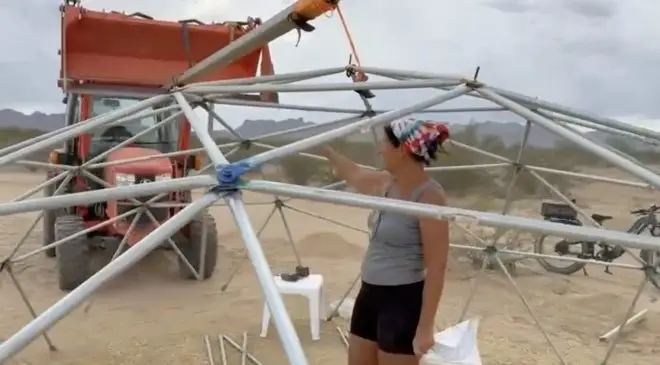
Welcome to Occupy the Land. Donna and I assemble the