



Geodesic Root Cellar: 16ft Sphere, Struts & Hardware Breakdown
In this episode of Occupy the Land, we dive into

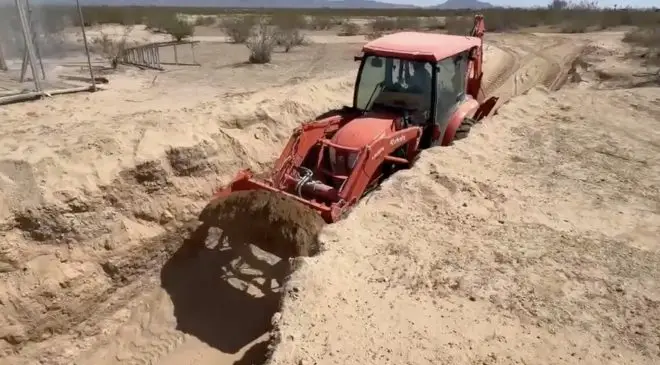
In this episode of Occupy the Land, we make major progress on the root cellar by shaping the bottom of the 20ft geodesic sphere trench. Ernie carves the reverse-dome floor for the sphere, explains the ramped access and second-level floor plan, and experiments with wetting the ultra-hard Clichy (caliche) soil to create a moldable Adobe-like slurry that re-hardens — potentially eliminating the need for Portland cement in the lower layers. He details how the sphere will sit mostly underground with only a small portion and skylight above grade, using hog fence, EMT struts, and a final reinforced stucco coating. The project advances self-sufficiency by creating cool, long-term food storage while repurposing excavated soil to raise the main house pad. A practical, experimental look at desert engineering! Peace.
Transcript:
Okay. Taking this back a little bit, it’s going to be angled anyway. And we’re going to put a bridge that goes from here to here, the front. And it will be able to Donna’s player has to go underneath it. Now what I’ve done is I’ve gotten down to the, level that I wanted to do, and that is the bottom.
Now the center needs to be that depth. So once I get most of this dirt out, I’ll take this stuff from the center and kind of pull it up to the side, because comes up there and we’re going to go ahead and have, it molded it, probably wet it a little bit and do an Adobe kind of, slurry to get it to shape exactly how I want.
We’ll put the pond liner in. It’ll be nice and smooth, and then we’ll have concrete. Spacers that we put in to give the space between the actual struts and the hard fans and the, mesh so that you have like, 3 or 4in thick of the concrete and batting the struts, and then then we’re going to have some fun once we do that and we put the floor in the bottom, it’ll be up probably about four feet from the bottom to create a floor.
Now, because we’re doing a 20ft, I went ahead and screw it. You know, we’ll do a 20ft as opposed to a 16. That way I get a second floor. So we’ll have a door that comes in right about there or there, probably there. And and then I’ll go down a couple of feet, a couple of steps, and then you’ll have the where that Khaleesi is there, that line, that white line there.
That’s where the equator of the sphere is going to be. And it’ll be 20ft across on a ten foot radius. Now that will be a floor. So you’ll have, rest of the dome will be sticking up here, and it probably be about, you know, the side, the height of the wall on that chicken coop, and it’ll have a skylight in the top.
And then that way it only has, you know, just a couple of feet out. You know, to where you’ll have soil. And then it goes in and it’ll be above the ground, so it won’t have that much weight on it. And, it’ll be concrete, but we’re going to be using lava Crete. It’s scoria. It’s like, pumice knows that.
Well, matter of fact, those mountains, they’re just black with you know, volcanic rubble. And they take and, sell it for landscaping. But the small shake, you know, the the fine particles and everything, it’s really, like, way. So I’m curious to see how much that’s going to be. But you it’s it makes like Air Crete. It’s like cinder blocks but a little bit lighter.
And, so it’s not going to have a lot of weight on it. And, you know, we’re over here working on Donna’s, battery solar stuff, trying to get that done as we got time and she has time. And then I’m going to pull this out and turn the tractor around. Start hauling that out. Now, what we’re doing is I’m putting it over here.
Where? The House bill. It goes. So all that dirt. See, I’ve had to raise this, and I got there. That was a lot of dirt. So I got to raise this quite a bit. We had probably ten inches. We’ve got another, probably foot or more. And you can maybe you can see it’s raised up and I need to get it up even more.
And, I was worried. Now this is going to take a long time, but, you know, I need to put that dirt somewhere. So I got, you know, two birds, one stone or one half stones. But, so things are going well. It’s just, you know, I, you know, I could show you a time lapse for me. It’s just digging, moving dirt a bunch of times.
That’s just what it is. Now, this is one of the washes here that’s on the north side of the house site, you know, and this is how we’re controlling the water that comes around. And there’s another one on the other side. So that’s why we had to raise this. So when it floods off of these mountains, it doesn’t flood the house.
So time and pressure run it pace.
Okay. It’s kind of hard to get the scope of how big deep this is, but I’m at the bottom. And this is a ten foot conduit and a ten foot PVC. So this will be the center. So ten foot that ballet ten foot behind me, ten foot ten foot. And it’s a more than ten foot radius. Probably like more like 12.
But I need the space to car so you can see, you know, I just have it angled around the side here because the bottom will be the deepest, and then it’ll start curving up, you know, right away. And then, equator will be right about there where the top of the gouging is into the Clichy. And this is.
And then you get some extra dirt, and maybe I got a little bit extra here to be able to form it. So now it starts of the fun part. And then I’m going over, to Bob’s a friend of mine, and we’re wiring the new motor for the stamp press because I’m going to need to start doing that.
Here we go. Now, one thing that I did, I brought my F-150 down here. Well, a little bit. I just want to see how wide it was and probably got it stuck. But, you can see the front tires here. That’s how wide this is. So I might widen it a little bit more to get a pickup in here, but I really just for Donald’s Polaris, it’ll sit down for down here.
And of course the tractor will. So I got the hold on stage two.
Okay. What we’re going to do is I just want to check this. It was only like less than ten minutes ago that we. You know, who’s this down there goes. I mean, it’s just amazing how this stuff just disintegrates. So we’re going to go ahead and, you know, write this down because this area here has a ten foot diameter will be the floor.
Now we could go like 12ft or something. I got to do some math and find out how far up because keep in mind we want to have a ceiling of at least eight feet, if not ten feet. That’ll go up there. Now, this, well casing we just have a bunch of this that were given to us. And this is 20ft.
So we can put this in the center and kind of go off of that and do some measurements and so on. But you can see once you wet this, you know, it just turns into moldable clay almost. So that’s what we’re going to do is get at least a ten foot for I might go 12 so that we have a nice floor.
When you come down, you step down and you got a nice floor. This cavity down here, I don’t know how high it’ll be, but we’ll build where we can put water down here because water hits thermal holding of temperature and the amount of energy that goes from liquid to gas or down the ice, it’s enormous. And it’s much more than even soil.
And, and I’m thinking we’re going to be putting some water underneath the floor here. We have access to water, but also help with thermal mass. And then the dirt that we had left over here before without taking it out. I kind of moved it out here because I need to carve this into, like, a reverse dome. And, so we’re going to be doing that and carving it, and then we’ll start, we already did the wiring on the stamp press, and we got that taken care of.
And, we’ll start making the struts. Now, the struts are made out of this EMT conduit. So what you do is you cut it to the lengths that you need, but you add an inch for trim on this side, an inch on this side. So whatever the formula is, plus two inches, then you cut and you get at least three per ten foot section.
And then you have the it’s rounded and curved and punched a hole and so on. And you just put the struts together. So but this is ten foot and it shows. That’s a ten foot radius. So as I go around.
Now know got a ten foot radius all the way around.
It’s hard to get close over there, but I need it to be probably a lot closer than it is over here because, I don’t want to be filling in more than I need to. So that’s what we’re doing is now we need to get the base done and the lowest part where it’s going to be. And then we start kind of.
Crafting it up and carving it, and then we’ll start making the struts and we’ll start putting them together down here. Now underneath the struts, we’ll put the hog fence. And we had some samples over there and or just, you know, fence or like six eight inch squares, heavy wire. And they used for, reinforcing concrete pads.
I may just use that, but we put it down and then it’ll be underneath the EMT conduit, the geodesic struts. And then you take wire and, the twist wire or whatever you call that for doing rebar. You know, together. And then we’ll fasten that to the dome and do that as we go up. And then we just take and fill in dirt on it to give it, a only about 4 to 6in thickness.
Now, when we do this, the hubs, you know, we’ll have like, concrete and the hubs will sit on here like this, and you have the bolts that go through all the ends that go around. There’s 5 or 6 struts that go out, and then we’re setting it on the concrete to give us that spacing. Or we may just use Adobe.
We’re we’re working on that now what will happen is this will be filled and embed the mesh and the conduit. So you’ll have that conduit that will be sitting on here. And it’ll be just mud it over along with the mesh and we’ll make it smooth. Now of course, the final coating will be reinforced stucco that will reinforce with, you know, basalt fibers.
So that’s, you know, I’m feeling pretty good about it. And I know there’s a lot of concern people have for moisture from I’m telling you, there hasn’t been any moisture down here for thousands of years. I’m just saying. So it’s we’re not Georgia or Pennsylvania or California. This is Arizona. It’s totally different. So you want to keep the water out.
But even if it does get infiltrated by water, it just dries out. I mean, you know, that’s why we need good ventilation. We’re going to obviously need to have ventilation just out of safety when you’re low like this, you know, whatever heavy bad air, whatever won’t come down here. So you need to have ventilation. So with a 12 volt duct fan of water and we could use this.
Now these here we could use as vents. We can just put down from the top. When you put it down the ramp here, going into the bottom, we could auger holes and have it guilds and get more cooling from the soil. So we got a lot of options. But the first thing is this we got to get to the bottom of the 20ft diameter sphere, and then we start building up from there.
Half of it is ten feet. That goes about up to where you see the, bucket markings on that Clichy. Now, that means that from the top you have about 3 or 4ft that you step down into. That’s going to be a floor and a ceiling for here. So we have a high ceiling. We have a floor for a workshop that’ll be on the top.
And probably, you know, a third of the dome will be sticking up above ground level. And the top center will be a skylight. So you get a lot of light. And I’m, you know, if we have the floor, probably won’t get the light down here so we can course light it, or we can have solar tubes, you know, come down.
But, we’re at this point, you know, you’re going to see I, I have no idea exactly how we’re going to do it, but we know we’re going to do it. You’re doing it wrong. Yeah, but we’re doing the pace.
Okay. Now, what we’re doing is this Khaleesi is really hard. You know it is. And you can kind of crumble it off, but.
I mean, it’s like rock. And it just. Even heavy equipment has a hard time with it. So. But what you do, if you just dampen it, you know, it turns into this. Now the question is does this re harden like this stuff. Or we’re going to, you know, test this out. We just need to know if we’re going to be able to.
Get this stuff wet. Do it like concrete and put it on the glitchy walls in the hole. And not even need concrete because it doesn’t get any moisture down there. You know, they’re worried about vapor barriers and, you know, the condensing of moisture in the dome and all that. Well, it’s the desert. So, you know, the rain. Just get over it.
But what happens, though, is that you need to get ventilation. You need to have exchange air down there. That’s probably more important than moisture is just so you don’t have heavy gases down there or radon or, you know, carbon monoxide from vehicles or something. I mean, you know, you just want to be able to vent. But what I want to do is we’re going to just set this out for a couple of days.
I won’t take very long and, add this dry and see if it’s as hard as the dry version of this, so can re harden. Now what I want to do is I’m going to take this these put them in here wet them and go ahead and smear them on the walls down there with the gouge jeans. That is from the backhoe bucket.
And see if it integrates back with the wall and hardens itself. Is that does that. It’s going to be interesting. We’re going to have some fun with that. So this is a little experiment that we’re doing. I’ll let you know how it works out.
Okay. Now these are dried. You know, the hard.
It gets. Sucks up the water really fast.
Just starts to crumble.
Almost immediately.
So this is what we’re going to do. I’m going to let this turn into kind of a paste. And then I’m going to go ahead and, try smeared it on the wall. Now, I don’t I don’t need that much to drain out the water. And this one soaks a little bit. Yeah. See, it’s already gone. If it gets wet, it’ll do this but will harden back up.
So let’s go down there and find out.
And turn raw.
So I’m just going to wet this just a little bit. And then go over and smear this on there. And then check back tomorrow and see if it’s, integrated itself into that bleach. And is there.
All right. It’s just waking up. Oh, that. And then where? This is wet.
I will come back tomorrow and see if that’s hardened like this. Has. And going back into it, because this what happens is this up here. What I’m gleaning from what I’m reading is that all the calcium and so on, that’s in there just leaches out over millennia and comes down in the here and hardens and dries. And that’s what makes it so hard is calcium.
So I just want to see if it’ll, you know, re calcify and make it hard. And it looks like it’s already doing.
Well that does that. That means that we won’t even really need any Portland. And we’ll have it in direct contact with the wall because there’s no need for vapor barrier, because there is no water. But we do need ventilation for it to rotate and get good air. But, as this will do this, we’ll take this Khaleesi or cliche that we can pull from the Sam pond as we’re bringing it out, and use that as the layer to embed the, EMT tubes, the geodesic struts and the hog fence into right into the, the dirt and then not the hardness of the Khaleesi.
And just do that and then we’ll put, you know, cement over it and embed the rest of it. But this will make it a lot cheaper and a lot easier, which is one thing we’re going for. And we want to demonstrate experiment because we can base.
20ft Root Cellar Build: Carving the Sphere & Adobe Testshttps://t.co/9HzvfA5wNS pic.twitter.com/Xt0aIrs5D3
— occupytheland (@occupy_the_land) April 11, 2026
In this episode of Occupy the Land, we dive into

In this episode of Occupy the Land, we prioritize food

In this powerful, reflective episode of Occupy the Land, Ernie