


Earthbag Progress: Cleats, Straps & Ready for the Dome!
In this episode of Occupy the Land, we resume the
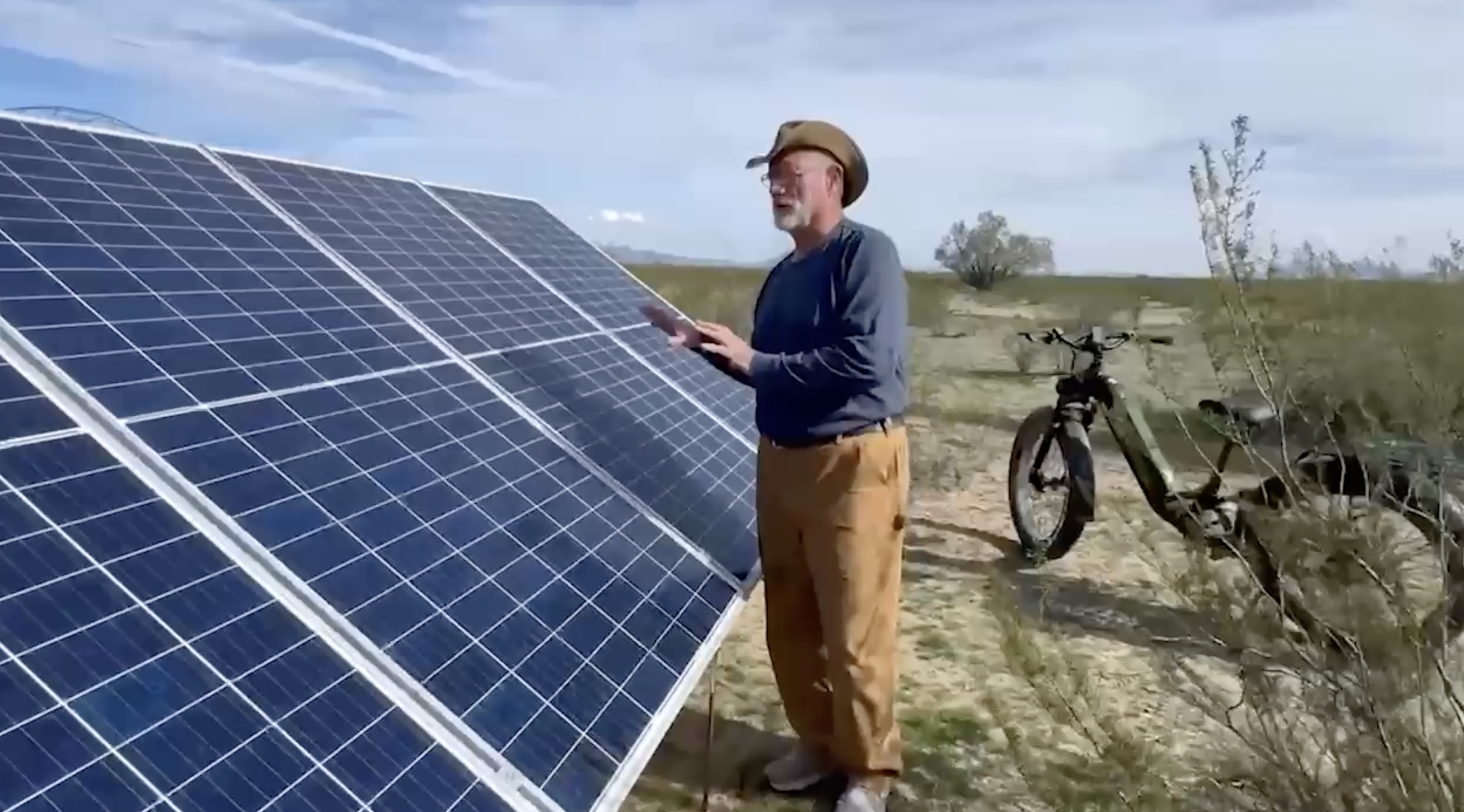
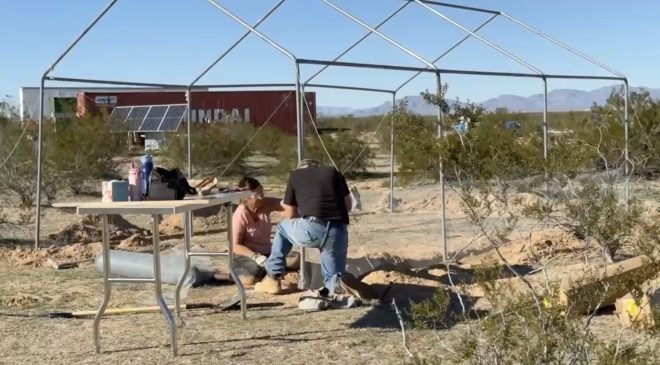
In this episode of Occupy the Land, we finally complete the power setup for the shipping-container workshop on our Arizona desert homestead! Ernie swaps out smaller panels for four high-output 535W bifacial solar panels, delivering reliable voltage to the 48V inverter and 15kW battery bank. The mobile battery shed (built on a pallet platform) is finished and leveled, housing inverters, charge controllers, and batteries safely behind the container for easy access and future mobility. Donna assists with concrete stabilization while maintaining her thriving garden beds. With the workshop now fully powered for welders, plasma cutters, stamp press, and more, we’re set for dome integration, strut fabrication, and future builds—celebrating another major step toward complete off-grid self-sufficiency in our peaceful desert oasis! Peace.
Transcript
Now, here’s Donna’s, water tank that she’ll have eventually. And we’ll use one of the battle boards. And I got a solar generator I built in that little box and a couple of the little panels that we could use that she’ll have power out here to run her pump on that. Those are extra water. You know, we just have an extra tank.
Now, on top is a pump that is battery operated. It can go on its own, but she’s got a little loopy battery pack that only puts out, like, 600W, but it’s enough to do watering. So Donna comes out every day and waters her plants and babies them and so on. Now, we used to have a shade that went on this third of the chicken wire, but it shaded it too much.
And just a a week or so. When did you take that off? It’s about a week ago and a half ago, a week and a half ago. And man, these just blew up. They needed more sun and that was a test. We wanted to make sure the other one over there was growing a lot more. And we. When did you put these up?
I think in October. October. So it’s been, you know, a few months, two and a half months or so and they just went stupid. So we know we can grow. And that bunny poop would be working. Good. Now, one thing that I’m going to do is we have the water tank over here so that we can, put the pump over here and she have an outdoor sink so that she can do some prep and so on.
We’ll get her another table. And she likes stainless steel. You know, the stainless steel we have to worry about stainless steel. We do stainless steel. And that’s one of the philosophical decisions we had, is that the sun beats the crap out of everything. So we wanted to make sure that we had stuff that would last. We don’t have to replace it.
It’s cheaper that way. Plus you a lot of these things like this was only $130 or something like that. So it’s working out. Now. What we’re going to do is we have to put everything that we grow in behind fencing, because if you don’t, the bunny’s be a common. Now she’s put certainly as we do the chicken coop over here, it’s going to have the hardware cloth, this mesh that will go around so that when you got chickens.
Oh, animals, they’ll they’ll tunnel in. They want to go get some. So we’re going to go ahead and do this. But we need to put up fencing. We have chickens before and they always come back. They know where home is. So you don’t really lose them but you will to predators. So we’re going to have to see how that goes.
We’ll be doing some experimenting with that. And today I got to go replace those solar panels with some larger ones that we have. And I’ll explain that here in a minute. Okay. Now this is the electrical breaker box that we had from our old home. We put this outside of my studio. This is probably got over ten years ago that we did this experiment with solar.
That was back when, you know, it was new and fresh and you had to learn a lot of things. But we had the breaker box and I just got this one is power so that we can turn on the lights and everything here. And I just flipped this one switch. Now we’re going to be taking and running a line over to the other shipping container so we can power that for the welder plasma cutter and the stamp press.
Now the stamp press is what makes the struts for the dome. And I want to use this area over here. Now this is me digging the trench for that line that’s going to power this over here. And we’re going to move a lot of the equipment over into that. And we have a lot more storage in there. We put in shelves.
You seen that? Probably. And then, you know, there’s just a lot of stuff on the outside. Now we’re going to be putting a building that will go in between here. And we can put a lot of the accessories for the tractor in, and we can keep everything on the sun. It’s about the sun. I’m telling you, you got to get it out of the sun or all this plastic and stuff with this right now, what we did is we decided to put the, I don’t have a microphone, so you got to stay close.
The, what we’re going to do.
Is we put our electrical back here and it’s all done, you know? But this is the problem that I ran into. I have to redo the solar, and I’m going to, you know, change the panels in here because I was very concerned about how much voltage would go over what the inverter can take. Well, this can take over 400 some volts and convert it into 220 and it goes in, have a splitter that has two legs.
It goes, 120 or 110 and 110. And then I can transmit that over to the other shop and have 220 for a lot of the stuff that I want to do there. And 110. But the thing is, is that I didn’t take into consideration the minimum that the, inverter needed. Well, for me to get up over 120V for it to start recognizing it, I’d have to put up six of the smaller panels, and I just didn’t want to take up the room for that and rebuild everything.
So I have more powerful panels that we’re going to take down from another remote area that we did to power the workshop from before, when it was the dome. Well, I’m going to switch and bring those over here and they’ll go here.
So these panels, I’d have to extend it and put six panels for it to get enough power to be recognized by the inverter, the charge controller. So what we’re going to go ahead and do is take this down. I’m going to put the bigger panels up and the oh yeah, that would be better. Anyway, I just had these and I just thought I’d use them.
And that was a mistake. And it was my fault because I was so worried about it being overvoltage that I wasn’t taking into consideration the minimum voltage that you needed. So that’s what we’re going to be doing. So today we’re going to go ahead and take these down. We’ll use them for other stuff for Donna’s garden or different things.
And we’re also going to need to power things like the electric Gate. We’re going to be, able to power a lot of other remote areas that we want to do as we’re building different stuff. It’s always nice to have more panels. I have probably another ten or more. So this is when they were free. So I’m like, okay, you know, we’ll make use of them.
But I need for bigger panels. And I can use this to, put those on. So that’s what I’m going to be doing today so I can check off the list. Freaking power to the workshops. So that’s what we’re going to be doing today. And I’ll show you when we get done.
Okay. These are the panels that I’m going to use for the workshop. These produce I’ve been to twice as much as the others. Now all I have to do is just loosen these up, take the panels out, put them on my pick up, take them over, and we’ll go ahead and, Yeah, just loosen those and just slide them out.
Now the dome over there is what we were powering before that. We moved the workshop and stuff down there. That. But I’m going to leave the array here and use the other panels because this is going to be a common community kind of outdoor kitchen barbecue area. When we actually build a home over there. And so I want to keep the power here.
Now a lot of times, you know, I, my brother in law was, why don’t you just have one big area of central lines, the run wire. So 18 acres, man. I mean, that’s a lot of wire wires. Expensive if you have to run it a long ways, you got to know where it’s at. Yeah, it’s just a thing.
But I’m also two is one. One is none I like having or I can always have different power stations or I can charge batteries that in an emergency we can use it and I can just roll out wire. I have, you know, various different wires and spools that I can, you know, make use of in an emergency, which has already happened several times out here a couple of times where we had to upgrade the battery system on the bus.
So we’re just going to go ahead, take this out. And the same thing with the water. You know, Donna wants to get a big tank that we can fill up and not have to worry, you know, about taking trips, you know, every week and so on. But, until we get the sand dam and make that to where that’s a large portion of our water that we can distribute, we’re trying to make it to where to pointed out over here, you know, this is where you see these little holes that we’ve dug here, and this gets burned up and these washes will back up.
That’s what the check dams are all about, because it makes a lake out of that. And it seeps into these holes that are about five, six feet down, and it saturates the soil. So we can plant trees. Now, the trees that we’re going to do over in the sand dam area, we have a terrace up there down those probably like two acres that it is.
Well, probably almost an acre of that is going to be higher than the sand dam where we store the water, and we put a tank down the bottom of it perforated, and we pump out of that. But we have to purify that water, you know, be a little baby. It’s clean. I mean, there’s nothing out here, you know, other than whatever comes from the air, but the, water that as it gets to that storage area, will go through a higher terrace where we’re going to put the fruit trees we need or I’ll, I’ll take of where we plant in some.
There’s going to be food production now out here we want to put some indigenous trees that don’t need bathing. Now, the palo verde, the mesquite, ironwood and various other plants that we can make nice areas out here and planet do what they call Zuni bowls. You have like a indented area, a little berm, so it stays there. Then we have the water back up and it saturate the soil and they will grow and get stupid.
You’re saying, I know you have water out here in the desert. Things grow. So what we’re going to go ahead and do is, decentralize the water. Also, at least for now, we got like eight of these toads and we don’t go through that much water certainly now. So until we get the large water system going, which we’ve already demonstrated, that it works, then it all goes there.
So what we’re going to go ahead and do is have different water stations, like Don has got three big giant like thousands something gallons or by a garden that she doesn’t need. You know, we have a couple of those to go around. Well, I’ll take one of those and put them over by the workshop. So I got water and wash my hands and that kind of thing.
She has it over for the bus to be able to do laundry and all I can. Our drinking water. And we have, you know, super filtration system, whatever for drinking water. So probably there’s going to be another water station up here so that we can have it for sinks for their outdoor kitchen or a community area on a 30ft, or round dome pad that’s here.
Now, that dome is not going to stay. There. Never was. We were going to use that for some other stuff in the home build. So this is temporary anyway. So now we’re getting into work. All right. We’re going to you know, get the power the way I need it for the workshop. And these panels will do it because we only use that much.
And we got a big 15 kilowatt storage. So as long as I can keep in charge and I’m not down there running stuff all the time, I got plenty of power. That’ll be fine. But the other solar panels didn’t put up enough voltage for it to be recognized by that inverter. I was worried about it being too much, but it takes over 400 and something volts.
This is not putting out that much. It’s getting up there, but it’s not that much. So we’ll be within the band that it will charge the batteries. And that was something I was worried about being too much, and I found out I didn’t have enough. So that’s what we’re doing today. I’m just going to going to show all the details of it or Hyperlapse or something.
We’ll just show you the end result. But, just loosen these slides out, put them in the back of my pickup, take them over there, switch them out, and we’re good. So that’s what we’re doing now. Occupy the land.
Well, we’re finished switching out the four big panels. These are 535 watt that are bifacial. So they put them up high like that and they get energy from the backside as well. Well, four of them beat the crap out of four of them. And Donna’s my concrete woman. You know, she’s while I was doing all that and finishing up, she’s putting some more concrete in her.
Stabilize them for the bigger panels. So she’s the oh man on that. And, I got everything else done and, everything just plugged right in. I mean, I still took a couple hours, few hours, but, you know, we got her done, and.
Workshop Power Done: 535W Panels & Battery Shed Complete! https://t.co/D449COuBeY
— occupytheland (@occupy_the_land) February 7, 2026
In this episode of Occupy the Land, we resume the
In this episode of Occupy the Land, we walk the
In this episode of Occupy the Land, we push forward