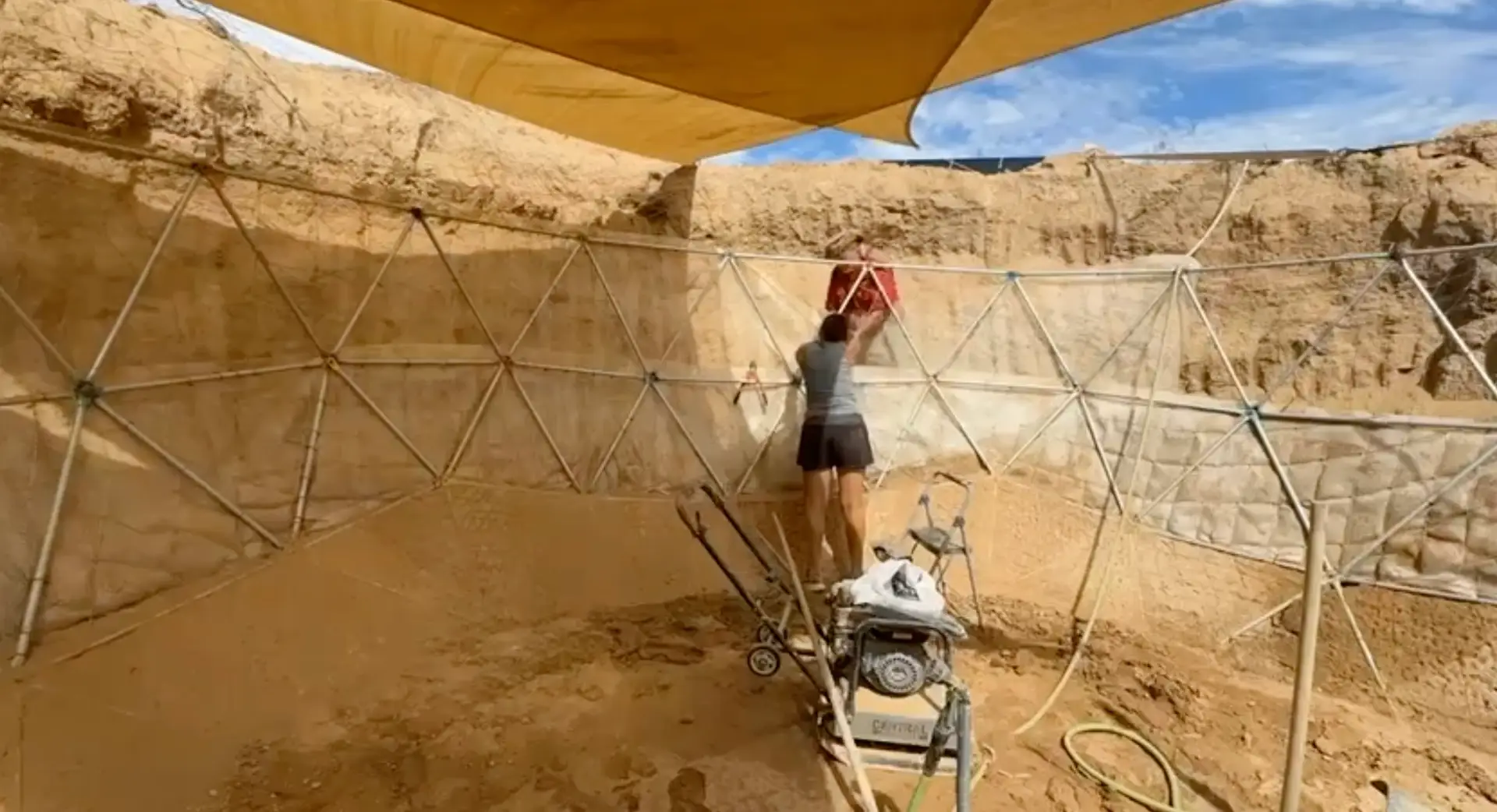
Welcome to Occupy the Land. This week we keep chipping away at the 20ft geodesic root cellar. Donna wires the hog fence and we stitch the fiberglass mesh layers together with a homemade curved needle so the next backfill stay in place. Soil goes in with the tractor, gets wetted daily so it reconstitutes into hard caliche, and the floor is now at the height we want. Next we assemble the top half of the sphere, set it with the tractor, wrap the remaining fence over it, and lock everything into one structure. After that: doorway mass, interior concrete, joists, and Lava Crete insulation on the upper half. Slow, hot, daily progress toward usable food storage. Peace.
Transcript:
Welcome to occupy the land. Occupy the land. What we’re doing is the way we’ve done this to get in and thread that and everything. It’s going to be a lot easier if we just thread the two meshes together. And I used a leather curved needle, but we got to get this through the eye hole first. So maybe if we melted that.
So we got to make it thinner. So we’ll go ahead and work on this and need. I’m gonna need Donna’s hand. So we’ll get back to you after we are successful.
My foot way out in the field or something? Not here.
To occupy the land. Occupy the land while we’re making progress on the root cellar. I mean, we got a lot of other things going on, but we just keep chipping at this every day and get to the point where, man, she’s done well. The next thing that we’re doing now, we backfilled, I’ll show you this in a little bit how we’re going to be crafting the doorway and the entry and so on, doing the floor we got at the level that we want.
We’re going to start doing the concrete as it goes up into the walls, but we’re doing another run that we have here, one more level that we backfilled with the tractor and putting the soil back there and finishing up the next level of the mesh that goes on the fence that is wire tied to the struts. Now, as we’re back filling this, it became obvious that, you know, we need to put the the top part on first before it kind of deforms it or puts pressure on different areas.
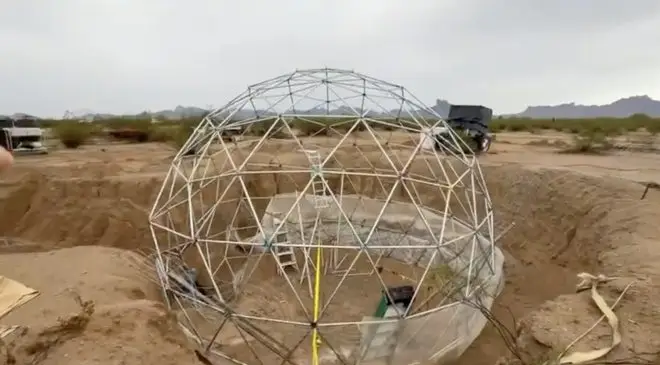
So we’re going to go ahead and have more hardware that’s coming Monday. And we’ll go ahead and build a dome that only takes about less than a day. Don and I can do that and just bolt the struts together and we take that. We’ll take the tractor, we’ll put it over the bottom part of the sphere, put it down and then connect it, and then it’ll go pretty fast.
Now I walk you around and see some of the things that we got to do and, and who are busy. And it’s hot. You know, we were thought and thought that it broke. It went below 100. Now it’s back up. So it’ll be another week or two before we get into a lot nicer weather starts to get here in Arizona.
So I’m going to go ahead and show you some of the things that we got to do. And and then you’ll see the next step. And here we go.
All right. Now as we dump the dirt in it goes down and it fills in behind here. That was the point. We have the struts that make up the sphere. Then we put the wire. The hinge cow fence is what they call it. And then the fiberglass panels. Now we do that. Now I had to kind of so it, you know, to connect these two and they just need to be held in place as we put the dirt in.
So that’s what was going on there. Now we had you know, these wire struts here that we use to wire tie everything. But to do that, we got a leather circle needle that we were using, and we had to make it out of one of these because I couldn’t get it through the I for all of the, the, the string that we did.
So we went ahead and made one. Donna came up with this idea and that worked really well. So we were able to, you know, kind of tie it together for when we put the dirt in. And we’re at the point now that we can start, you know, just using the ladder to go around and access the back, that makes that a lot easier and compact the soil.
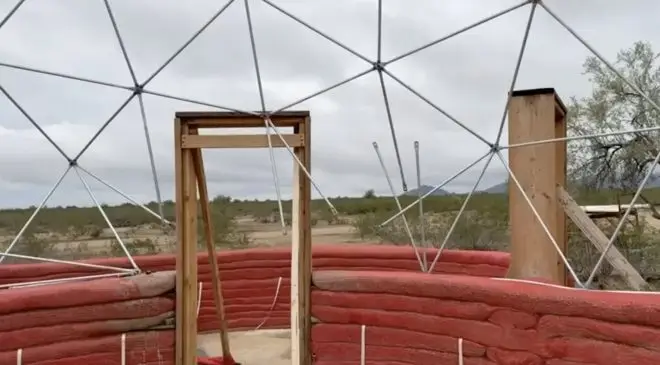
And we have what takes time is we have to keep it wet. So we’re wetting this, you know, daily and then coming in here and kind of hosing it down and so on. So this will return to the collection and be hard. Now this is the part that we got to do for the door. This isn’t done. So what we’re going to do is this always hit my head on that the so this wire that you see up here is the extra wire that we had that goes over.
Now you see over there we got it’s hard for me to see in the light here. But the we have those that will go over the entire sphere and bind it together. So we had to work around that. That’s been a pain to. But so we’ll go ahead and put the dome on then wrap that over and tie everything together.
So it’s one sphere. We got the floor level about where we want. So today and this weekend and so on. We’re build this fence. We’ll go to this wall here and it’ll go across here. And this will be built out and this will be the entrance. The door will go here, but we need to have the mass of the soil up around this, or we just lose all the, the coolness, you know, through this entryway here.
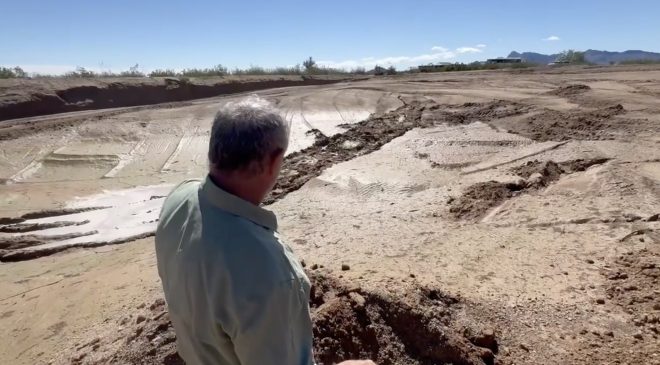
So we need to have a lot of mass up to about here. And when we do that, then we’ll keep the temperature down in here. And this is what we’re working on. So what I wanted to go ahead and show you is you’ll get an idea from the top of where we’re at and what we got to do.
And it’s it’s a thing, you know, it’s a lot of work. Now, this is the roles of the fiberglass that we have that we use. And they’re not really expensive. I mean, you know, we probably got less than $200 in mesh that we’re putting around it. This is the fence that we use to reinforce the sphere. And these are the shade that we have.
But we need to take the shade off to get access to the stuff that we need in the chickens. So what we’re going to go ahead and do.
Over the next few days. We’re going to go ahead and put this top part of the sphere together. Now, you see, we’ve been working around all this fence that is measured to go over the dome. So when we put that top part on this is going to wrap over it and then wire tie it down and it’ll be one big structure.
Now that’s what we’re doing is just loading in the dirt and then wetting it to make sure that it turns hard again. Now we do a lot with the tractor, but spreading it around is just getting down there with a shovel and the compactor tamper and tamping that down. Now the floor will blend into the wall. Now it looks like what we’re going to do is we’re going to pull from the top, the middle of this dome here, because the building for the bottom part is going to be different than the top part.
On the top part, we’ll put a coating of cement over it and kind of hold it together. And then we’re going to do Lava Crete. You know, that’s a project that we’re looking forward to and give it a lot of insulation, a lot of mass and a lot of thickness. So we’re going to go ahead and put that dome together, put it on top of here, wrap the fence over the top of it, bind it all together.
And then we have, you know, the doorway to do. And I need to be doing that doorway, you know, getting it ready now. But I’m probably going to finish it up after we put the top on. And it binds the shape. And I don’t want to build up the soil anymore because it kind of locks it in place and it kind of flexible.
So I’ll leave all the bolts loose on the dome as it comes down so it’ll, you know, conform to everything. And then when you start tightening everything down, it’ll get all round and hard and everything, and then we’ll start putting the rest of the soil in. And once we get the this fence wrapped over and the soil up so you can see it comes up about three, four feet above where it’s at now.
And as it goes, starts to go in, then it only has that soil that’s going to be on it, maybe like maybe two feet inside that that weight will be on there. It’s not much. That’s why we’re using Lava Crete. So there’s not going to be a lot of weight on this. And it’s going to be heavily supported from the underneath.
So that’s we’re getting there. We’re you know, over half done. You know, of all the real work that had to go into this. And it’s just we’re so busy with so many things. We just got to keep making progress every day a little bit. We’ll do an hour or three, Don and I on this, and then we’ll go to 50 gazillion other things that we got to do.
But that’s why we got this pulled back here that will go over all this meets over the dome. Now once we get the dome on, then we got to worry about the floor, then the joys that we make. I’m hoping to not have a center pillar. And to do that, to engineer it, you got to have. And it looks like it’s at least a 12 inch wide joist that goes across that to hold the floor and the the ceiling for the bottom.
Then we’re going to go ahead and start filling it all in, packing it down, getting the bottom done and having the concrete layer done on the inside. And then we start on the outside and we get to fashion windows and skylights and air circulation and the mini splits and electrical and all that. You know, that’s a thing. And then we have these two sets of electrical photovoltaics that feed and inverters that run, you know, all the Donna stuff back here.
And I might increase it. I think I’m going to put bigger panels out here to power the refrigerator and freezers and chests and all that kind of stuff that’s in the dome, because this is going to be one of the places we spend a lot of time when we’re on the land, and then we got to do the bridge that goes from Donna’s little garden area here, and it goes across there.
So the same engineering that we’re doing for the floor will be making for the bridge. Then that over there, that dome is going to come over here and be a greenhouse for Donna. We got winter of coming and we need to be getting food. And this is what slowed us down on everything else is working on this, because we knew at the end of last year it was going to be a food thing, and so we had to have a place to store it.
So that’s what we’re doing. And it’s just I mean, it’s nice out here and it’s getting nicer and you can see it greened up, you know, just one little bitty rain and it’s green. So that’s what we’re doing and we’re still at it. Donna is on another water run. Got to fill up everything we put. Got 12 1500 gallons in here just to keep this moist, to get it to solidify again, reconstitute.
So we’re at it all day, every day. And the foam may go out here in a minute because it gets hot and they don’t like it. So pace, see you next week.