Flash Flood Jackpot: Sand Pond Overflow & Green Explosion!
In this thrilling episode of Occupy the Land, a modest desert rain turns into a full-blown flash flood demonstration as water races across the property, filling our sand pond with an estimated 70–90,000 gallons in hours! We walk the washes to show how check dams and berms slow the flow, create instant mini-lakes, and soak the clay soil deep enough for trees and grasses to explode green. With capillary action pulling moisture upward and the desert already greening dramatically, we celebrate proof that water retention works. From sheeting runoff to overflowing channels, witness the power of simple earthworks turning moon dust into a thriving, water-rich homestead after just one good rain!
Transcript:
Here’s the west side of the property, and you can see that there’s little washes and channels come across the desert that make it over to our land. And we’re trying to manage this. So what happens? It flows across the road.
And it makes it into our wash system. But there’s a bunch of little ones natural that’s just across the land that this is where it starts to accumulate. And you can see it running over there. Now a lot of this is what we’re trying to capture. Eventually it goes into these main washes and, it doesn’t get more than a couple of inches soaked in the clay on the surface.
It just flows off into these washes. And then the washes do the same thing, and it just flows off the land. So that’s what we’re doing. We’re getting there. We’re stopping this up, backing it up, getting a little lake going, having the holes filled up and saturating the soil. Because what will happen is just all of this land, just sheets, and it flows in the washes and off the land.
So we’re stopping it. Within a few years, you’re going to see I’ve, you know, the desert for a long time. You add water, man. It just blows up. So that’s what we’re doing. It’s going to take probably three years and you will see a major difference. Now you can see where it’s coming across the land here. This will back up and then it will just start flowing into this wash.
And that’s why the fruit trees and stuff that you plant, you build up these berms on the side of the wash and that’s where you plant trees and different crossings. We’ll do bigger ones and so on. We’re still working on that. But this is what it does. It just shoots up. It pulls up. That’s where you get your grasses and stuff.
And then, it just goes into the wash. If we can control this, all of this is one big giant, you know, roof that we can collect the water in. And I’ll go ahead and walk you over the Sam pond. I haven’t been there yet this morning. Go see what’s up now, here’s where we would plant the trees.
We have these berms on the roads that hold this stuff back. That helps create the lake. Well, this is a good example of that, but, it just stays. And this is where we’ll be planting a lot of the trees and so on as well. We’re able to back up this water now. This continues. All right. I’ll just walk it over and go over there.
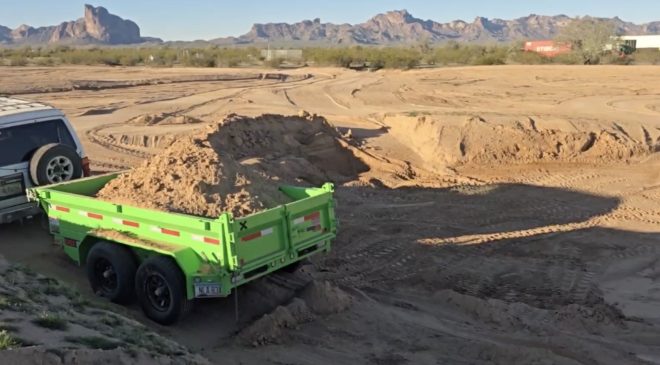
You can see what’s up. Doo doo doo doo doo doo doo. Now this area right here, Donna, between that green turquoise top and, truck over there is where the house pad is. Now, this is the area she wants to leave. Kind of urgent so you can walk it and so on. And it’s raining in here. It goes flooded.
I can’t walk in or near.
For now, I have another plan round one of the trees that I want to do, but we’ll do that. Oh, it’s getting ready to break. That hole’s down in in. There she goes. Boom!
Now, the water hasn’t made it up over the road yet, but when it does, you know, here it comes. It’s already starting to flow in. And you can see, you know, like these little things where it sheets. So it’s starting to sheet sheeting is when it just, you know, an even flow because the desert generally is pretty flat and it’ll build up into a sheet and then it wants to go somewhere and there it goes.
So this is, you know, like another area you can see it comes in.
And I’m not stepping in mud. Yeah. Let’s. Too bad okay. So this is the sample. This is where we’re getting all the soil.
Now eventually it all goes to the back here. This is where we’ll have a perforated tank. You know, a poly tank that will be in the corner down here. And that is what we wipe off the lens. And that is what the,
Where the water is going to be extracted from that tank as it goes into the air. And this will just keep expanding up here she goes.
You know, that’s probably only about a foot deep there, but the tank is about ten feet high, so up to there is about. Yeah. Getting close. So I dig this down another foot or two. We’ll put the tank in there, have it perforated, you know, drilled a bunch of holes, wrap it in ground cloth, put hardware cloth around it like a screen mesh kind of thing.
Then set it down some charcoal, you know, biochar, kind of whatever, help with the filtering bunch of gravel and rock. And then build that up with the gravel and rock as we process the dirt here. That’s why we need the trommel, because this is a lot of sand and gravel.
You just got to take the clay out. You use it for fill in other stuff. So that’s what’s going on. So, going to be done with this next week? Probably not. It’s going to take a while, but I got time. So good. So you can start to see it starting to sheet.
And the desert comes alive and you can see these low areas or even not so little areas. They just have a bunch of foliage. You know, grass grows up in other creosote I think these yellow or the creosote and yeah, it explodes. I’ve seen it many times. Just explode. One of the things is, one time we took, bunch of field of wildflowers, and I have professional photographers calling me wanting to know.
Not here is years ago in the desert. Call me where it was, because I guess they do calendars and watering. Oh, man. That’s. Oh, we got to get that one. You know, giant swirls of wildflowers all over. So they’re scanning the internet for people finding where they can get their next calendar shot. So this is a good example of what happens when it rains.
Now this is a little rain when it gets monsoon rain for days like this. And it’s all mine. That’s what we’re working on. He’s.
Of walking up there and here comes.
Now, this is a mini flash flood. Now it’s not raining, but I’m sure it is on the mountains up there. So here she goes. You see what I mean? It will overwhelm. Let’s get it.
And she’s full. I’m telling you, you know you can control this water. You have it forever. Why? Once you get it charged and it’s done. So here’s what I was talking about. It just overwhelms it.
There you’ll be in some canyon. Join yourself, and all of a sudden, here comes a wall of water. And hopefully somebody in an ATV screaming down the wash saying, you know, here comes flash flood, which happens quite a bit.
Well, that’s great that we got to see this.
Yes, I can help this one to where would I do it? Probably right about here.
See what I’m talking about? That’s what I’m talking about. Yeah.
And we’re done.
And it’ll start going over there.
Now, we’ll back this up.
And once it fills up, it’ll start overflowing. Probably right about here. And we’ll go down that way now from other drainage from the road and so on that we got, it still comes from all over the property. And we used, we didn’t want to fight the terrain, so we used the lower spots and the previous washes and everything to manage all this.
And this will start filling up to this. You get knee deep here directly all of a sudden insta river. The old. Yeah.
Now there’s a Czech dam, but one of the main washes, and it’s holding, and we put the berm. And this is where another Czech dam’s got to go, obviously. So we’re going to do that and they’ll help back that up. But we started building up the berm and so on where we’re going to be putting the Czech dam probably going to go right about there.
Now it’s going across the road.
And this is where you put, you know, bigger rocks and stuff. I put some gravel and stuff there. That’s why it’s not even back so fast. But you put some rocks and so on there because it’s on the backside where it really does a lot of the, eroding. Oh come on man. No, no. All right.
Now, we just walked this a little while ago.
There’s a house pad so you can see why we need to build it up. Because when this starts to back up, it would flood over there. So we have that built up. So it’s not doing that anymore. And it’s channel in here and at the wash on the other side of the building pad. I’m telling you one little rain and you could save if you’re ready.
You save the water for a year or two. Never.
Awesome. You got to see that.
Well, it rained even a little bit this morning, but, it’s already kind of dried on the land soaking in. But the Sam pond here, doing the calculations of this, it’s at least 70 to 90,000 gallons. So I’m, Damn, we won’t get a lot of water. And imagine all of this dirt area here. Well, potentially eventually be a pond.
Now, this is just a small rain. You get a monsoon season. You’re going to be able the way we got it set up. You can fill this entire thing from water off of these pristine mountains.
Oh, we got to dig a little bit for that one. All right, here we go.
So you go around having fun, right?
Yeah, I just ordered a lot of these. When it really gets rain, it overwhelms it. And it starts to create its own little channels on its own. And you got to help it a little bit. If you don’t do that, you know, kind of clear it. A lot of times I just drag the order across it and it kind of leaves an opening naturally for it to do this.
But yeah, I go around, play like a kid. But you can see these plants. They’ll turn green, green, green green, green. They get any water. And I had about a month ago. And then if it got really green and this is going to pop them, the desert’s going to be green green green here directly. Now what we want to do is we’re going to go around and chainsaw or whatever.
We’re going to take all this dead stuff and put it into, composting or chip it and so on. We got so many things to do, but it’ll take years. You know, I mean, look at all this stuff we got to do. But we do this and trim it up. It’ll look really nice. And we’ll have all that for composting and, yeah.
Okay, I’m digging a little trench for this to go in, but you can see that’s dry. You know, this little mound that only soaks down so much? That’s what we’re trying to do, is to get this water down deeper and it penetrate because it capillary action’s up as fast as it goes down. It just got to get it down there.
Now with enough rain I wouldn’t have to do anything. It would just start going in and create its own little waterfall. But we just had a little bit. So I’m helping it out a little bit.