



From Moon Dust to Green Oasis: Flash Floods & Water Retention Wins
In this episode of Occupy the Land, we walk the
In this episode of Occupy the Land, we tackle a long-overdue overhaul of the bus’s off-grid power system on our Arizona desert homestead! Ernie clears out outdated 24V inverters, charge controllers, and tangled wiring, replacing them with a powerful 48V inverter and high-capacity batteries for simplified, reliable 120/240V power. We remove failed rooftop flexible solar panels, prep for better connections, and organize tools for efficiency, ensuring no downtime during the swap with portable EcoFlow backups and a heat gun for shrink wrap. With family holidays approaching, this upgrade promises robust power for appliances and tools, marking a major step toward energy independence in our evolving off-grid setup!
Transcript:
Okay, we’re getting ready. We got everything all cleaned up and organized and the stuff out and ready to start disassembling. Now, while I’m busy doing this and I don’t need Donna’s direct help, she’s going to be, around just doing some maintenance stuff. Because one of the things we’re gonna, you know, grease all the fittings and everything on the tractor and, you know, some of the equipment, attachments and so on.
So I’ll show Donna how to do that. She’s seen me do it a bunch. But, you know, give her a full instruction so she can grease that while we’re, you know, working on this, and then I can call her over. Now, this is a fold out solar panel for the eco flow, and we rarely use this, you know, but, today’s the day because we can’t run out of power.
We got a couple of little batteries, but they don’t, you know, last out long or just little portable stuff. So what we’re going to do, we have the eco for for any power we need to charge batteries and so on, you know, there and for the tools. So we’re not out of power because that’ll suck. Because I need to do the shrink wrap with this heat gun.
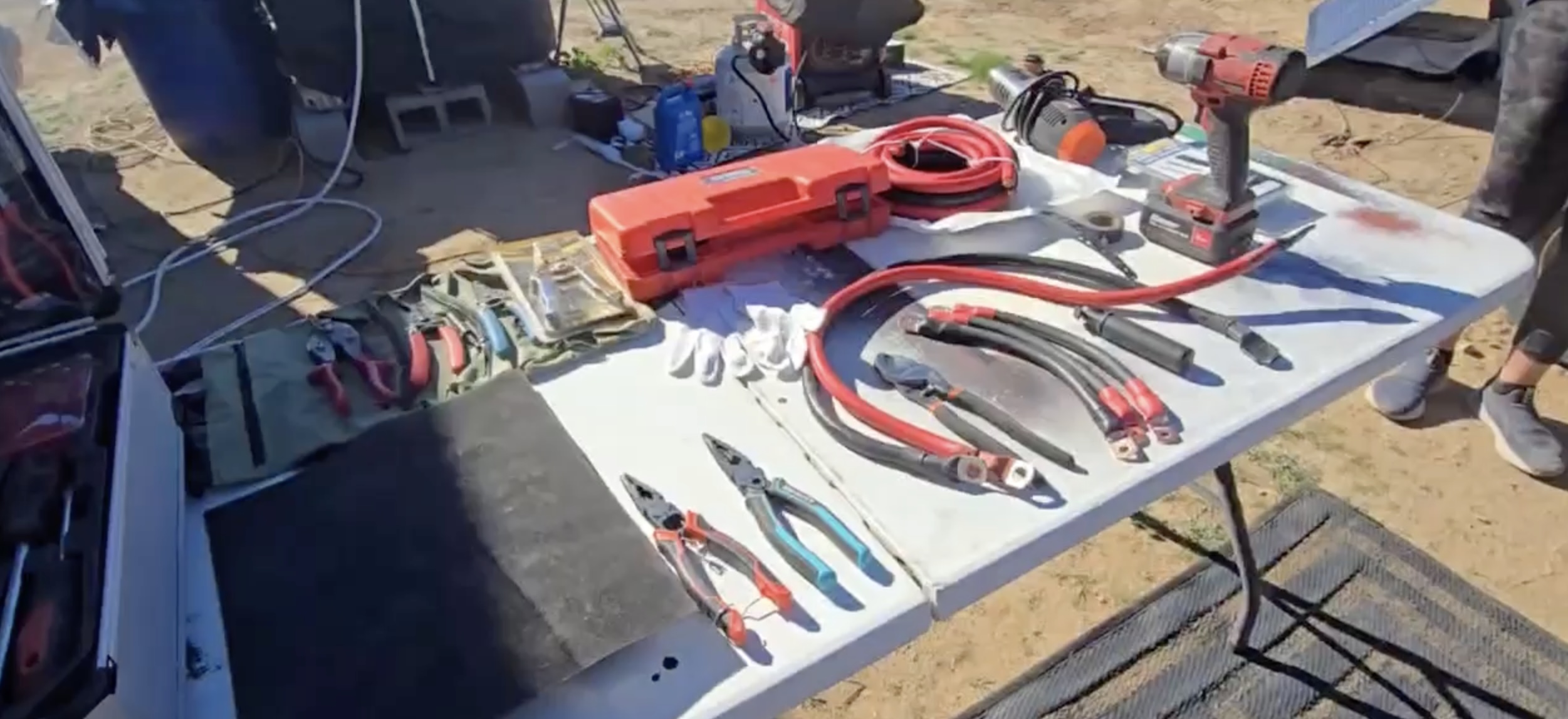
That’s 1500 watts. So if I don’t have power, that’s not going to work. So this is for fastening cables. I have the cables, you know, and stuff. And this is a this right here does the, ends, you know, this is, compression that does that in order to make these ends on there. So I have all that and, for ready now, this is, you know, cheapy from, you know, China or whatever.
I rarely use this, but when I do something like this, I don’t want to be hunting for tools. So it has a lot of tools that I’m going to need. And, you know, the screwdrivers. Ratchet set. The only thing is, this thing’s all metric. You know, I’m about half metric and half, you know, American imperial, whatever you call it.
But, so I needed this to be over here so that I didn’t have to go hunt for tools all the time. So that took us, like, an hour to get everything all situated but this table out here. So I got all my tools, the workstation for crimping electrical lines. Now, a lot of this is to hot. And, one of them, I think this one is, one I came has two cable here.
And, I think this is also has two arc cable. So this especially when you’re doing 48 volt, you’re doing big DC and so on, you’re going to need some cable. Now, one of the things when you’re doing 48 volt and you’re bringing it over or you do like 400V from on ten gauge wire, 8 or 10 that’s coming over from solar panels when you’re 48 volt or high 400 volt or something like that.
What’s amazing is the wires get smaller. The higher the voltage, the more it can bring in current. And what’s less, cause it has lower amps. So when you do 12 volt batteries and you’re trying to run a bunch of power through, you need bigger cables. They get hot. So just little time. Now on the top of the bus we have solar panels that came down to here and we were using them, but they’re not working and they haven’t for a long time.
So we’re just going to bypass all of this. Now, the generator we have shore power. When you go to like RV Park, you plug in there. And we disconnected that because we were working in, the generator and make it work. So that we had this, 30 amp to 20 that or 50 amp. And it is, for running welders and plasma cutters.
And so when we first got out here before we had the workshop, and that’s what all this stuff is. So we’re gonna not mess with a lot of this stuff. And, Bob Anderson, he’s in my electric guy, but he’s busy, and, but he’ll help me remotely if I got any questions. And we’re doing stuff. So most of our work is going to be over here.
I’m going to dismantle all of this. And this little 12 volt battery is what runs all the 12 volt stuff inside the bus. And it charges off of this system at 12V. Using this battery equalizer, different, you know, voltage kind of thing. So we’re going to go ahead and take that out. And I’ll put one of those Battleborn.
They don’t have a Battleborn that’s over on a 1.2 plus kilowatts. And it’s going to be powering another station or Donna’s chicken coop or something like that. Now these are 24V, and we’re going to be putting in two 48 volt packs. Now that charge controller and this one down here that we have because charge controllers in the inverters went out months ago.
And we’re just going to take all this stuff out so you can see the Christmas tree and freaking everything in there, all that’s going away. So we’re going to go ahead and take that out. And we have all these breakers and so on and connections. And you had something. So we’re going to go ahead and just bring all this out.
And when I take these inverters out we’re going to have this all cleaned up. And then we’re going to put in this bad boy. Now this is a 48 volt big giant. Oh my God system. Now this is 6000 watt I think it peaks at 12,000. So this one we’ve had for a while. It’s brand spanking. I just opened the box and going to leave that on there and, we’ll get that mounted in here and we just start reconnecting wires.
Now, hopefully I’ll be able to use almost all of these, you know. But I if I need to I’m going to go ahead and be making them now. It’s 1:00 in the afternoon and we got about four hours of good light and, you know, and then I have, you know, little lights and so on for me being able to see and battery and so on.
So in case it gets dark. But I hope not. I mean, we’re, we’re going to get her done. Now, what we did is we had an inverter. Yeah. This little 12 volt inverter 1500 watt here I think it’s 3000. And so that was a backup in case anything went out. We were able to still, you know, power refrigerators and all that kind of stuff.
And it was mounted up there where those screws are, and we would plug it into that 12 volt battery there, and then we just plug it in and there was a three outlet that it goes in up into the bus up there. So that was our emergency backup. And we could do that if we wanted. But we just there’s no way to really charge the batteries directly.
We could do the solar like with the ecoflow and everything, but it was time. I’ve been putting this off for so long, but now that I got, you know, this is the next stage we need to get everything kind of situate, situated for the holidays and, you know, family and friends come over and we don’t want to be, you know, poor of electricity.
So that’s what we’re working on. Here we go.
Okay. As we were going to get started on this, I haven’t gotten any for a long time. Power from the rooftop. Flexible panels. Now, these panels were about five years ago. You know, they were easy to put on here and they did pretty good, but they’re not creating any power anymore. I came up here to check, see if I wanted to incorporate these, and they’re crap.
You know, we’re going to put we have other panels that we may do that for. We go on trips, but you can see why, you know, they’re fried. And then the, all this cabling is good though. And then you can see the the sun has just destroyed these, you know, and the wiring is on, so this needs to be redone.
It wouldn’t be that big a deal, but, you know, to remove these, I put these on there, they’re going to be on there. And, we’re going to go ahead and bypass all this. We haven’t been using them for a long time anyway, but this is the wiring that we had for it. I was going to see if I could go ahead and get these working again, but that’s not worth the effort.
And it would, with all of this came in to a 24 volt and we put it down through the top here. But these are trash. You know, they they work well. For a few years. When we were traveling. But now we use those. So we’re going to go ahead and bypass this stuff. I’m just not going to, use the connections on these because they’re not they don’t produce that much anyway, you know, so we’re going to go ahead and upgrade.
Well, that’s our new or old. We’ve had a long time in the box inverter that we’re going to be switching out on the bus today. We had to clear out everything under the bus. It’s kind of my tool area there. One of them, there’s solar panels that slide out there, and we deploy them when we were out camping and so on.
And then, two compartments over there, and we just had a bunch of, you know, gun stuff and ammunition, you know, just stuff my gun room, everything in there and the inverter. So we’re just clearing all that out because we’ve got the shipping container now, and boom is filling up all that was in underneath. Now we need to get that over a shipping container.
And then we’re going to go ahead and set up a time lapse because we got to rock and roll and make hay while the sun shining. So we’re going to go ahead and install that inverter, take out all the other inverters and everything and start over with, more powerful batteries and, you know, get ready for the holidays and the family be comfortable and everything and be able to handle the high power here.
We’re having to split a lot of the panels and everything because the inverters were not powerful enough. And then we had to get new charge controllers. Screw it. We’re going to go ahead and wipe it and start over and do that all today.
Okay. Now this is the inverter that we’re going to be putting in. It’s a 48 volt. One 2240. And it didn’t do it. Everything we want by the time we get to the house, you know, it’ll be antiquated and obsolete. So we’re going to go ahead and use it on the bus and solve a whole bunch of problems.
And, we’re just going to start unboxing it. Now these are the batteries that go with it. We have six of these, and I only need to I mean, you know, it’s it’s like a thing. So we’re going to go ahead and get all of that in the battery compartment inverter area. All that out. Now the we started with four Battleborn.
That’s what we had. So we had like about you know five kW. Now we’re up almost 15. So we’re going to go ahead and take those out one of those 12V there and series to make 24. And these are two 24 volt batteries in parallel. If you go positive positive negative negative you maintain the same voltage but you just get a bigger battery bank.
Now if you put them positive to negative like you do in stacking, you know, five cell flashlight or something like that, then you increase the voltage. Well, these 224, if we did them in series would be 48, but we do them in parallel. So 24 these two 12 volt Battleborn, we put them in series so that, you know, positive or negative, positive or negative.
And then that is from 12 goes to 24. So that’s a 24 bank, that’s a 24 bank. And these are 24 volt inverters. Now they’re going. Now we lost the charge controllers. It just couldn’t keep up with what we’re doing. So we have that one for one battery and that one for another battery and a bunch of wires.
Oh my God. So what we’re doing is we’re just going to clear all this out and, yeah, you can see these bays just kind of go through. That box is for four solar panels. We had like 480. Watch as we’re doing Love Bus Liberty Tour around the country that we are boondocking it and totally off grid. We just put the solar panels out and we could charge it with the generator and so on.
So we were always been pretty comfortable. So what we’re going to go ahead and do is take these two out I don’t know. Yeah I might use them for something else or if they’re even usable. So we’re going to go ahead and take those out and put this one big one here. And and then that is going to hopefully go easy.
A lot of it’s just undoing and putting it back together is going to be a lot simpler I hope. Oh my god. So we’re going to get on this right now. Now we’re just getting set up. You know, I haven’t took a forklift to move the one of the work tables over here with those big heavy batteries. Didn’t feel like hauling them.
And, Donna set me up a nice little work area here. I got to go get all my tools and everything, and then you’re just going to get up Hyperlapse me. We’ll move the camera out a little bit. But, you know, I ain’t got time to be jerking around too much. But you can see there’s there’s so much crap.
Each one of these wires does something but, you know, don’t care and totally redo it and make it simpler.
Bus Power Overhaul: 48V Upgrade & Battery Cleanup! https://t.co/mnZDFTTDUx
— occupytheland (@occupy_the_land) January 3, 2026
In this episode of Occupy the Land, we walk the
In this episode of Occupy the Land, we push forward
In this episode of Occupy the Land, we finally complete