


Why the Desert Is Already Greener on This Side
Welcome to Occupy the Land. A rare multi-day light rain
Description:
Welcome to Occupy the Land. Donna crawls inside the vertical water tank so we can remove the broken bottom coupling for the sediment drain, then she plants another batch of potatoes in the cleared patch by the sand pond. Bob comes out to help set the first railroad-tie fence posts on the north line with the auger, laser and packer. We also catch the aggressive rooster, hold him down to establish dominance, and hope the “submit” method calms him. Tin Dog arrives with EMT conduit and we run the stamp press to make the struts for his 16-foot greenhouse dome. Peace.
Transcript:
All right, well, Donna’s got to crawl in there so that we can get the bottom attachment off to get a replacement. So this is entertainment.
Can’t move to the side, baby. That is what we got to remove. She’s got to go inside. I gotta go on the other side. So we’re going to do that.
All right. Grab it. Because you know it’s broke and we need to fix it.
I have to get a wrench. There’s a reverse thread. All right, we’ll get this off. Show you what happened.
It. Hold it up. Yeah. Disassembly is what we got to get a new one. So we’re going to town, do that, and then we’ll start doing the foundation. The pillars for the stand. And then muscling this up, that’s going to be a thing.
Okay on the bottom of this tank which is down there. This will come out of the tank as it sets up vertical, so that this will be the drain hose or pipe or whatever. And it was way out there about 15, 20ft. And it has a valve there that we can take the sediment that settles in the tank, and we just drain it and get rid of the sediment.
And then we’ll pull, you know, from about two feet up, you know, right about there. So. And what we’ll go ahead and do is be able to take the sediment out. But we got to go get this little coupling thing broke off. And we need a new one anyway. And we’ll go ahead and get this part, and then we’ll assemble it into the tank, and it’ll be ready to put up on the stand after we do that.
So that’s what we’re doing. And Donna’s going to go get it. Yes I am.
So what I was doing this afternoon was planting the other area of the potato patch. This one is over by the sand pond. A while ago, Ernie cleared a patch over here and I tilted and everything but the potatoes that I had to go in there weren’t very good. They didn’t have any eyes, I don’t know. So I had to reorder a bunch of potatoes and then let them grow the eyes and everything.
But they’re ready to plant now. So I’ve gone ahead and tilled this, planted the potatoes, watered it, and we’ll see what happens. This is a little different setup than the raised bed gardening, but we’ll see how it goes here. We need to know how to do these things anyway. So the other potatoes are doing really well. The ones that I, I planted in the grow beds are coming up really well, and I’ve held them up and covered them with straw.
And then just the other day, I planted the rest of the grow beds with some of these potatoes that I planted in the same types of potatoes that I planted in here. I planted over in those beds, and they’re starting to sprout already, so we’ll see how it goes. I’m excited to see what kind of crop we get or not.
Then. Then we’ll know.
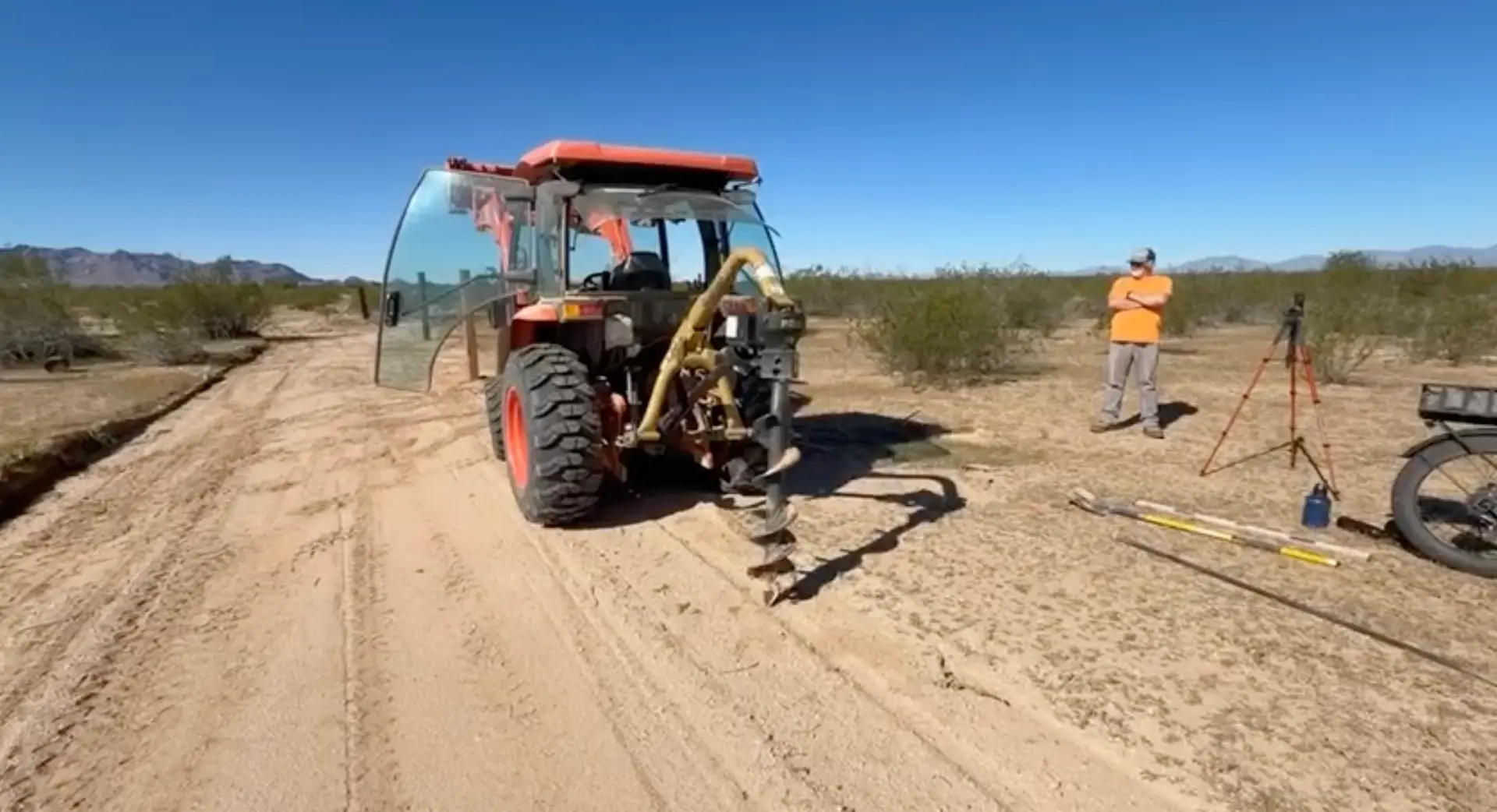
Welcome to occupy the land. Occupy the land.org. Now we’re out here doing fence posts for the north side of the short end of the property. Now, what we’re doing, you know, is my friend Bob is out of here. Need helping, making sure I do it right now. What we’re doing is we’re chaining up the post and have it ready to go down and hang to go in to the holes that we’re.
So we already have. Donna and I took the laser and we have you can see all the flags that go to the other corner of the property. And then where we have it, Mark, is where that has gone down. We took the the flag out, but we’re going to bobble hold it and make sure it’s vertical and we’re going to auger that down.
Then we back up to do the next one. And on the way over there we drop in the fence post. Then we take that compactor there. It’s a heavy rod with a wide bottom and you just pound, pound, pound, pound it down. We got know how deep we have to do it. So this is going to go pretty quick.
We just did this one here. Donna and I did that just as a test. And then Bob and I do that one. And we’re just going to rock and roll and whatnot. Now Donna is probably going to have a time lapse for us to see how long it takes us to do this. That’s going to be a while.
How many is that? That’s one, two, three, four, five, six, seven, eight, nine, ten. Yeah. It’s like over a dozen that we have to do just on this short end. So we’re getting to it. This is something Donna and I can do. But, you know, you you need a, you know, a man, you know, kind of make sure we get it, you know, all muscled in and ready to go.
And that’s what we’re going to be doing. So we get a process down. Maybe something Donald and I can do. But we’re going to be working on this today. Pace.
Now we’re over by the coop. We had to dispatch one of the hens. Weeks ago, it got injured and it couldn’t walk. And we took it inside, nursed it, put it back out, and they kept picking on it, pecking on it. It just wasn’t good. So we went ahead and Donna just put it. We took care of it.
Going to get in details but the but this rooster has been a pain in the butt. This it’s very aggressive. We got it about it was probably a couple of months older than the chicks. We knew we needed a rooster, but then we got two roosters out of the bunch. But this one, of course, was older, and it’s always attacking us, which I don’t mind, because then I get to boot it, you know?
So, you know. But Donna’s been doing research on it, on what to do. So tell me what you did. And, you know, if you let him go. Is he going to attack me? He may not attack you, but I don’t know what he’ll do when I let him go. I’m not really going to let him go because he’s still got some fight in them.
It’s all I can do just to keep him settled. But basically what you do when you have a rooster. Now he comes after me probably 90% of the time. It’s just random. I could be walking away. I could be 20ft away. And he’ll come running across and he, you know, he kind of jumps up and they have those claws on the back.
Not really a talon, but they, they’ve left some, they’ve drawn some blood and stuff. And so it’s, it’s very you know, I want to be nervous coming out here. I don’t want to have to worry about it. It should be a place of, like, all my coops before were just a place of kind of peace. The chickens had a good time, but this rooster is just making it difficult for me to even manage my own flock.
So basically, what you do is you. I had a hard time catching them, but you just have to commit and manhandle them down. And basically, I know if I let him go, he’s going to run off again. So I’m going to have to do this again. But basically what you do is you you put them down on the ground.
And you just got you got to hold them and then you just basically you hold them there for a minute and you just basically make him submit to you. Some of the videos I watched said it’s probably a good idea that the other hands are around, too. You basically want to embarrass the crap out of them.
Now, this doesn’t hurt them. It just it’s just holding his head there. I’m not like choking them or anything. You can’t squawk, you can’t move. It kind of like really. It must just really incapacitate them in some way. So I’m just going to hold them here for a little bit. And then when you’re, you’ve done that for about 30s to a minute.
He’s a pretty rooster. He’s very pretty. And I just I like to have a good relationship with him, but he’s just such a butthead to me. Every time I come out here and it’s it’s nerve wracking. So then you, you after you’re done with that and then you just pick him up. I wish I’d saw you catch him.
That would have been a thing. And you just pet him. You kind of. You just want them to relax. It’s like you want to let them know, hey, I’m the Alpha here, and I’m not here to hurt you, but I’m in charge. I’m not putting up with your crap, so we’ll see what happens. We’ll see if this works.
I mean, a lot of people swear by it. I’m just like this. Chicken psychology. I’ve never really had a rooster that gave me any problems. So this is kind of new to me. We’ll see if it works. We’ll let you. Yeah. We never had this problem. Usually the roosters came out of the, the I don’t know what do you call them, the clutch or something a group of young that we had.
And then we had a, a rooster that was really a neighbors. And when we left, we gave them all our chickens along with the rooster. Yeah. Used to live at our house. Yeah. He just came over and said, oh I see what’s up baby. All right. So I’ve had him for about five minutes and just kind of making them submit and and just trying to.
Well, how many times do you have to do this. Well they say until he stops being aggressive. Yeah. But most people say it’s like 2 or 3 times. So I’ve done it twice. If I let him go. We’ll see how he if he’s still got an attitude with me, we’ll see. He did not like my once he knew I was after him, he did not come after me.
He just ran. He ran. He did not, like, turn around and decide to face me or anything. He just all he could do to get away from me. So I cornered him in the coop. Had to do it a couple of times because he was pretty quick. But I just grabbed his tail and you know, you just with these things you have to commit with chickens, you can’t just sort of half, you know, half ass to commit it.
You know, our grandkids, we go you got to commit even their chicks there and they held them. So I’m going to let them go and we’ll see what happens. Well let me stand up and this thing comes after me. You know, I’m going to have to defend myself. Well, because I’ve, you know, when he comes after me, you know, I just kick them.
I just boot him. Yeah. He’s he’s starting to get a little. He was kind of relaxed. And now that you stood up. So, Yeah. I’ll get my foot cock.
Run away. We’ll see if this works long term. Well, I’m glad you committed and did it, because Donna’s been complaining about this rooster forever, and I. I just had to do the attitude that, You’re do me. You know, my attitude was just that, you know, I don’t want to be intimidated. I don’t want to. Oh, no, I’m not going to.
I don’t care. Okay, now I just while I’m talking, turn around the. Because what I do is I come in with the attitude because I got to work on the root cellar and stuff all around here. I come by any all of a sudden from out of the blue, he’s just like, attacking me. And I’m like, oh, you saw me.
So I just, you know, any way I can defend myself really is just kick them, you know? And sometimes I get a nice booting, you know, and send them up. And he doesn’t seem to hurt them and he doesn’t care. And he just keeps coming after me. But after a while, he’ll stop. So he’s less with me because I just don’t demonstrate fear or run away.
I, you know, don’t want to be intimidated, but but I don’t want to have to worry about them all the time either, because he can hurt you. I mean, you know, talons will get you. So, I just take, you know, for some reason, I haven’t got my right foot and really got into it, but, you know, whatever position, get my left foot and kind of shoe him away or kick him up or into the wall in the coop.
Or. It’s been about three times that I made good contact with them. Doesn’t mean anything. So I’m going, well, I got a gun. I mean, you know, really we got two other roosters. We don’t need this. But he is a beautiful rooster. And, so Donna did a lot of research you may see on our sites and so on.
She put up there. This technique, and it seems that’s pretty much the standard. You have to catch them, put them down, make them submit, then relax with them, kind of pet them. Them. Maybe you can make friends with them. But. And there’s one of the other roosters, you know, you can see that you get that kind of tail thing going on and it’s green and it’s, you know, they’re really pretty, they’re nice.
We’re starting to get a lot of eggs. So we just we have how many eggs now we’re backed up on. I have about two dozen. That’s over about a week. So two dozen. And they just started laying. Not all of them are probably laying, you know. So, it’s a food thing. And that’s why we did the chickens.
Because we’ve had chickens before. We never had this problem, but we had chickens before, and no muss, no fuss. I didn’t name them or anything because one, I had a favorite, another pretty hen and named it. And then a friend’s dog came and killed kind. And it was he goes, well, I’m sorry we my dog got one of your chickens.
I go, yeah, I don’t even know which one it is. Let’s just that, well, it’s that one that it got. So from then on I don’t even they’re just one of the brown ones. I mean, you know, I don’t care. So, but it is food and you don’t want to be stressed out when you’re making food and you want to have, you know, a relationship with them.
You’re not harvesting them. You’re not taking them out, except the one we had to dispatch today. And I will dwell on it, but we probably should have done it, you know, sooner. Yeah, a lot sooner because this has been suffering. We just thought it might get better or repair its hip or something, but, you know, so we had to do that.
So while we’re in the mood the roosters getting hit. So Donna props to Donna for chasing that sucker down. You you’re Rocky Balboa. You you catch your chickens, right?
Steel touches the flesh, right? We’d rather not do that. Cuts just like butter.
Okay, now we have this at zero degrees. And what we want to do have 15 to 18, about 16 degree angle on the ear. So this is what we’re going to do. Take this.
So a little bit more than that. We’re having a little bit too aggressive. So it’s about 14 degrees. That’s close enough. You get about 15 degrees or something and then you’re good. So we just kind of eyeball it you know. But we’re close enough.
All right. This is Tin Dog. You know, he watches Occupy the Land dog and keeps track of what we’re doing. Well, he’s coming out to help us build the trauma. Oh, my God, we’re going to get the trommel done. But, he’s a welder and so on, but he wanted to make a two phase geodesic dome for a greenhouse.
They want, since the property has up in show low. So, you know, how did you come to that idea? And what are you doing? And then you’re going to tell everybody about the deal you got on the EMT conduit? I just want to hear about that. That’s right. So what is it you’re doing here? Well, yeah, essentially, we’re putting together a greenhouse.
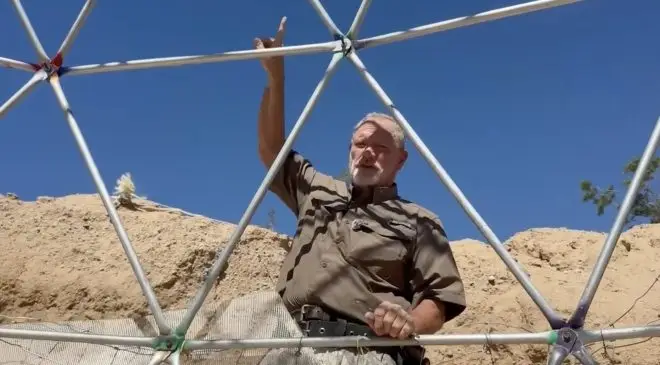
I want a fairly small one. We’re going to do about a 16ft diameter on it. And the overall concept is to try and keep it warm during the winter time. We’re up at elevation 6500ft. And we also want to be able to grow things in it without wind and rain and hail damaging everything. So this is all an experiment.
I’m a new to growing, so I just needed a platform to do so. Stumbled across Ernie’s website many years ago and saw his dome home building, and thought that was a clever idea of accomplishing what we’re looking for. So, So yeah. And then, I, I stopped by an electrical contractor, picked up the 35 sticks of three quarter inch EMT I needed for this project.
They also had a bargain bin discount of some EMT that they had that was laying outside, for a third of the price of what I paid for the new stuff. So I went ahead and had them load me up with that, another 50 sticks. And then after I got out here, I found out that they’re all like half an inch in short.
So we’re going to have to scale the the next one back just a little bit, chop the ends off, make them all even, and start from 118in instead of 120. So anyway, it’s still a deal. Yeah. It’s still a deal. Yeah, yeah. It’s like, you know, ten year ago prices, you know, like $3 a stick or something. So.
Right. I’m, I am on my way. So $10 out going to help in the big thing we have you know we’re working on doing the trauma and he has some experience and doing a lot of things. So he’s going to help out with that. So I’ll make sure he gets this all done right. And you know I went ahead while he was cutting those.
There’s the dice for punching out the ends. We have one of the ones with the ends, al. We’ll show you later. Oh, yeah. The, we are going to go ahead and grease this up. I had to clean it and everything, so we put it in to do this. So the ends of these, you know, get put in the stamp press and that dye makes this and you measure it from hold the hole.
And so the two phase just takes two different sizes because you just use it for greenhouse. So it’s really not that expensive. I remember it used to be a lot less. I could get a 16ft dome, three phase, you know, for $200 with the hardware. And now it’s like way more. Yeah. I searched around for a deal. Home depot was 15 bucks a stick.
I found an electrical contractor selling them for ten bucks a stick, which, you know, in the large grand scheme of things, 35 sticks. That’s $350. You got a covering. So for 500 bucks, you got a decent sized greenhouse. I think it worked out to, like, 175ft² of growing space. And the cool thing about using geodesic dome as greenhouse is doesn’t matter the angle of the sun.
You don’t get any shadows on the plants other than obviously the EMT con to it. That kind of holds the frame there. So you’ve got kind of a constant stream of, of of sunshine, the whole entire arc of the sun, regardless of whether it’s summer or winter. So, yeah, I really like this concept. Hopefully it’ll work out great and we’ll build with those 50 sticks I got on a special.
We’ll build a bigger one next time. So. Well this is we’re doing a 30ft that we’re bringing over. Matter of fact I have another 30ft over there. There’s a lot of things that you can do with it. I’m glad you’re inspired to do this. And we can help you out. Yeah. For sure. You help me get that trommel done, man.
Score. Yeah, yeah, we’ll get that done before I head out. But this stamp press here is going to be an absolute game changer. So you can do this all by hand. But my God, what a pain in the ass pain. That’s why we got this thing. We’ve had this probably got 15 years, you know. And this is held up.
It’s done. And so I mean you got to do maintenance on it and keep it all lubed and so on. So we’re going to put that together and I’ll show you that and we’ll put it on the stamp press. When he gets done doing all of his struts. He has like 65 and he’s almost done. And then we’ll go ahead and do it and fashion it.
And you’ll see we’ve been at it. What. Our hour and a half something you know. Well that included us figuring out that the, the, the sticks were an inch short. So I had to swap them out with the, with the other ones. So anyway, so if you have everything ready yet it all done, everything, you can do the whole thing a couple hours.
I mean for sure, you know fastest goes right. Well we’ll show you.
All right. So we got our three quarter inch EMT cut to length. Basically I worked at backwards from a ten foot stick. Tried to eliminate as much waste as possible. And by doing so, I was able to actually eliminate one cut as well. So these are 60.5in I think is oh I’m sorry, 61.45 actually. Plus an inch at each end because the stamping mill is going to lop off an inch.
You know, in the process of stamping. So anyway, we’ve got the A’s cut and we’ve got the bees cut, and, basically we’re going to run it through the stamp mill. Now slice an inch off of each end. By the time it’s all stamped and by the time it’s all done. I should have enough for a I think it’s 16.5ft dome.
That will end up taking in, reassembling and put our plants inside of it and see what we can do. But what we went ahead and did is the dye needs servicing. You always got, you know, grease the stamp press and you have the, the dye for it and so on. So I’m just going to put this together and put it on.
So we just went ahead and greased it up and put this together and make sure I get it right. Goes this way. And this thing literally light ways like half the time. Yeah. No, it’s it’s not light. So do you want a hand? Yeah, I got it. I’m not sure I get it on the right place.
You gotta get right.
So this goes. And we’ll show you that here in a bit.
Thank you.
Okay, so this is clamped on. And when we turn this on here spin.
And then we put them in a chunk. So go ahead and do one for ten dog.
I’ve not done this before. So right there. Okay. Make sure you get it straight. Got it in all the way to the back. Okay. Go ahead and do it. Go ahead. So that does that. Then you put it in all the way straight. Chunk. That’s it. Now we do about a 15 degree bend. You know about like that because it’s going around in a dome.
So that makes it a lot easier to put it together. Then we turn around to the other side and what we have to do to make sure it’s parallel. We set this out here to make sure you get it on the same plane.
Like that down here. So you get it on the same plane.
That’s probably how raise this did in straight up.
Oh.
Where’s the hammer?
Take two. No.
Fixed it.
Yeah, we just need that a little bit higher. That’s why it kind of didn’t go on the on the thing. So there.
That’s it. But then you take this, you put it together with these, you get a double pegs.
Oh, forgot my bench. About 15%. Okay. Tell me when. Degrees. Yeah. About that. There. Okay. That look right. Yeah. That’s right. All right. Nice. One more, one more. Done. Bunch of times. 35 to go. No, you got 60. Well, yes, 65 to go. Times two. No, it’s 65 sticks. Times two is 130. Right. So you got to do that 100 times but won’t really take you that long.
So it goes this fast? Sure. Yeah. Once you get the system down.
That’s it. Easy enough. Ten. Doggone it. I’m taking his own dome. He’s done everything himself. Dominant.
So if anybody has an idea, they want you. You buy your own conduit, you come and do something. You know, ten dogs got skills. So we’re going to be designing, working on the the trommel and exchange using my machine, which saves a shitload of time and effort and is far more precise than trying to do it by hand.
Yep.
Bitchute: https://www.bitchute.com/video/VIvekE9yMoYe/
Aggressive Rooster Submit Technique + Fence Progresshttps://t.co/X82CdF8pho
— occupytheland (@occupy_the_land) November 20, 2026
Welcome to Occupy the Land. A rare multi-day light rain
Welcome to Occupy the Land. Donna hills the potato plants
Welcome to Occupy the Land. We tighten all the bolts