


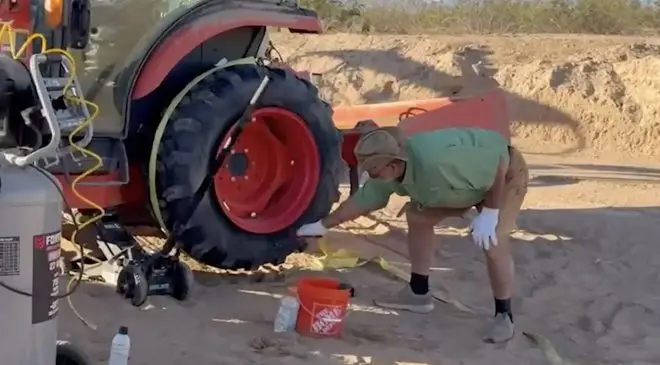
Potato Hilling + How We Reseat a Tubeless Tractor Tire
Welcome to Occupy the Land. Donna hills the potato plants
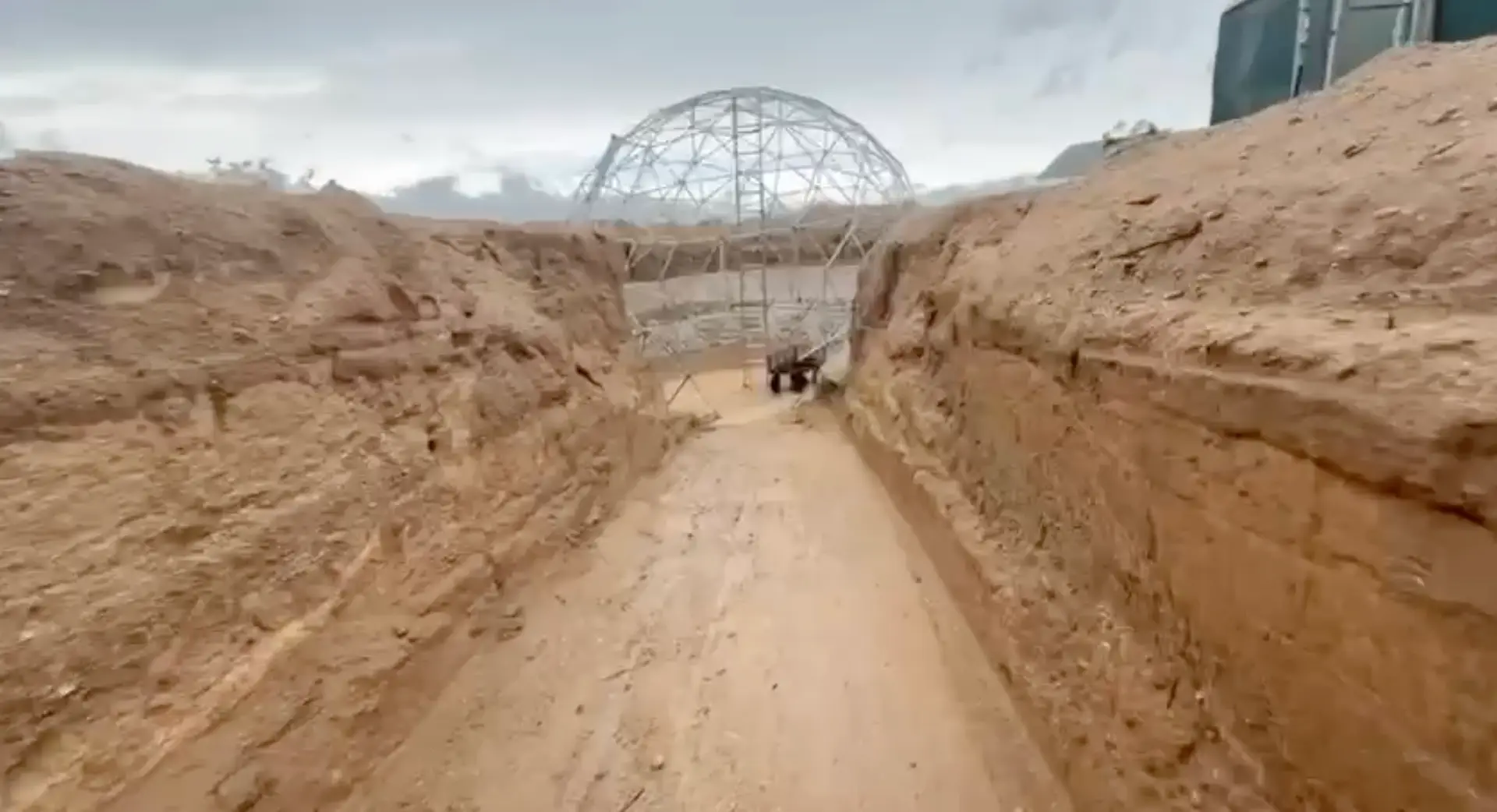
Welcome to Occupy the Land. A rare multi-day light rain has saturated the soil instead of just sheeting off. We walk the property showing how the penetration holes, dikes, settling areas and check dams are working, why the plants on the managed side of the runway are already twice as big, and how the root cellar walls held up under standing water. The sand pond is graded and ready for the thick pond liners, creosote piles are staged for biochar, and we test a Zuni bowl for future indigenous trees. Steady rain is exactly what the system was built for. Peace.
Translate:
Welcome to occupy the land, occupy the land.org. Now, rarely do we get steady light rain for days. Usually it’s a monsoon storm of. Oh my God. Now this is saturating the soil and we have it set up for that. So that’s very cool. But this is the cover on the pool. You can see. I mean that’s a lot of water that’s deep.
Now we have, the rain gauge here. What are we looking at? You know, and we already dumped out a little bit, so it’s like a been an inch over the last couple of days. But the steady rain, you know, gives us it starts to sheet a little bit when the ground gets saturated and, you know, see, it’s not flowing yet but it’s saturated.
So when we get a heavy downfall downpour, it’s just gonna freaking go right to the washes and go. Now this is why I do the ordering. Now that goes in, goes down about 4 or 5ft, these holes, and it saturates the clay and the soil underneath. And I have these all over the land, even in the washes, but especially on the up.
Yeah. That one collapsed in, you know. Yep.
So the it’s saturating the soil. This is exactly what we need, but it doesn’t have a super high flow sheets and going, you know, gangbusters into the sand pond yet. So yeah. See this is going to be a green postage stamp. I’m just saying, man, you know, people aren’t going to see what’s going to happen until after like a year or two of this stored water.
And all the plants just grow. Now on the other side of the runway here, over there, the plants, we haven’t done a lot of the backup or check dams or any of that stuff. So this is the plants are a lot smaller. You know, they just don’t, you know, get their green, but they’re not as big as over here.
You know, on this side the plants are like twice the size already. Just been here for a couple of years of us doing that. And you can tell. So it’s going to be a few years and it’ll be damn or any. What the hell did you do, manage the water. That’s what we did. So when we do the back blade, I try and even out the road as much as possible so it doesn’t do the rivets and eating away and cutting into.
And every time I come out, I go out and I, level it out, try and get the low spots filled in, the high spots cut down and it’ll be like, you know, days or week after the rain stop that I’ll be able to do that now, like here, you know, it’s accumulated. I’m going to have to add some more soil here.
I mean, it’s only a couple of inches or something, but as time goes on, it gets better and better and it washes away all of the clay and silt, and you’re left with this nice gravel and sand, and you don’t sink, because if you go out into the raw desert here without this being coated, once you break the surface, it’ll go up to the axle and you’re in mud or dust.
When it’s dry, it’s just, you know, you’re you’re not going anywhere. And that’s why it took me so long to dress up all of these roads. So I didn’t have to worry about that. The saturated soil, I’m just drive on it and don’t have to worry about getting stuck. I mean, it’s kind of slippery and slick and not perfect, but I’m really satisfied with how this has come out.
This is working well. And then, you know, you do get some accumulation. You know, it is kind of muddy, slippery a little bit. But, the washes here have not started to run yet because it needs a, you know, kind of a more sudden downpour. You start getting flash flood kind of thing. So here’s a we got some of our wheel covers blue.
You know, I pick those up, but you can see even in the washes it won’t go down that far. I mean the it’ll saturate like an inch or two and then it just keeps flowing. But if I can do this and create these, penetrations into the soil, you know, and it fills them up, that one. C it didn’t get enough yet.
All right. That’ll create a little canyon over here. Help it out.
All right. Get that to go in there and get a little bit more water. But you can see the green the desert greens up. You know, as soon as it hits, it gets some water. This is going to be green for months. And especially by allowing it to soak in, it’s going to change it a great deal. Now this try to get as flat as I can.
This is the main house build where it’s going. So I keep building this up and I needed to get saturated in wet. So it compacts and then it turns into that stuff. And it’s hard, hard, hard makes a good foundation. Now we’re going to go over to the, the root cellar and see how much that flooded overnight.
Yeah. But you know, the, Cal Creek that and a little bit 5% Portland has really held up. It doesn’t matter if it gets under water or flood. It’s just holding really well. I was hoping this weekend I have just a, I don’t know, probably a couple hours worth of work to finish this, to put the mesh on so that we can start to do, concrete and covenant when the guys come to help.
All right. So I kind of put up a little berm there to keep it from going, but it’s still, you know, of course it’s it’s raining. So let’s see how much flooding I got down here.
I’ll slip. Yeah. It’s not too bad. It’s level, you know, it’s, you can see how deep it is on the tires on that. So hopefully a couple days it won’t be more than it’ll take probably, I don’t know, three days for that to soak down. But I needed this to get wet back here, you know. So that settles and solidifies behind the mesh there.
That was something we were going to have to use a bunch of water from water tanks to do. And I go, oh, it’s raining it, let it do it. It’s all good. Now you can see that we got the mesh almost all done. And then this here will be a catchment. And then right there we’ll go a sump pump in a 40 gallon barrel that’ll be down there.
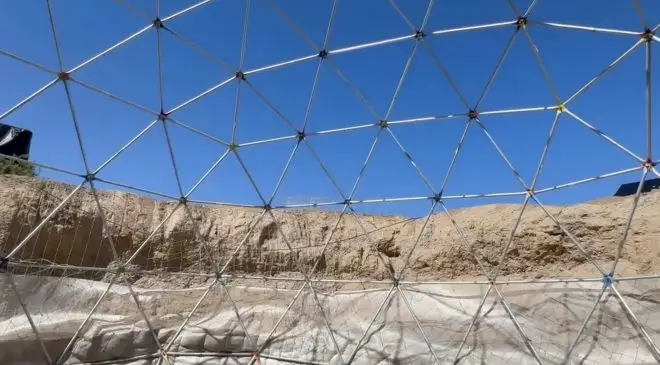
So when there is any water that comes down it just pumps it out. But this is going to be covered. You know we’re going to have like a covered bridge here and this fencing that’s coming over from the bottom to the top. It starts down here, goes up and around and then here. And this one will go integrate into this dome, into a covered bridge part that will go here.
So in here will be underground, you know, this will be like concreted and we’ll have that work area and so on as we go down into the root cellar. So there’s a big plan and it’s, you know, it’s coming together. We’re working at. But, it’s not really that muddy right here. I stepped there because when you get this sand and gravel and you get, washed out the soil and clay and so on, it’s really, you know, pretty sturdy.
It doesn’t, come too much of a pain in the butt. Now, we’re going to go over to the sand pond here and see how much is accumulated there. And now this is one of the what I try and do, especially after I get a rain like this. You can see that there’s little high areas on the inside of a turn, or needs a little bit more social over there to make it even, because you want it to be as even as possible.
When the water comes through that it’s flat, like it is over there. When it comes in flat like that, it doesn’t create a lot of rivets or, you know, starts a ditch or, you know, erodes away everything. So maybe after this rain or maybe a couple of more, I really got it pretty level. I’m just really messed with it probably more than I need to, but you can see if it’s low over here, it’ll start when it gets a big flood.
It’ll just create a big rut there. And I don’t want that. I want to slow the water down and have it more even as it goes, because then it washes away the soil, the light soil, the silt and the clay and leaves, the wash sand and gravel and it kind of self filters. So by the time it comes out, going through all of that, after a year or two or however many storms, it washes all the silt away, then the water is not silty, you know, it doesn’t get all cloudy brown.
You got to filter out a bunch of stuff and everything. So, you know, that works out well. Now here we have this is a good example on the trenches. You know, we’re starting to put in, you know, the brush the creosote. Now this is one thing a lot of people when we were saying we’re taking these creosote bushes and when we clear to, you know, make roads and stuff like that, that we’re taking and putting these in these ditches and burn them and they go, oh, man, it’s called Hugo Mounds, man.
Why aren’t you putting the soil in? Let it decompose now, which normally would be the way, but it was brought to my attention on the telegram site by some people saying, look, that creosote has some toxins for plants, that kind of whatever is why you don’t have a lot of other plants growing around them, because they put off some kind of toxin to weather the plants, and it’s not competing for resources with other plants.
So it’s not the best for doing who mounds, which is just, you know, plant matter and logs and stuff and dirt and mounds. Well, but it is good. You can burn it and make biochar. And that improves the soil and changes and a bunch of other stuff. So that’s what we’re doing. We just take we got piles, you know, over there that yet to have to go in and get distributed.
And it dries out a little bit and then we’ll, you know, set them on fire. So that’s why we’re burning. It is because it doesn’t really make good, you know, Hulu mound material. So that’s what we’re doing there. And then, you know, of course the water and this is just light rain and it’s just, you know, going in and charging these.
So this entire area here with the orchard is, is just clay. Instead of that running off, it’s saturating it. It’s just like a big giant mud pie. And I got lots of water, gazillions of gallons of it. And we have all these different washes. There’s one there, there, there, another one way down there, a couple up up there.
So we have a lot of the whole land feeds into here now. So you hopefully you can understand what’s going on here. This main one goes into the main storage of the sand pond. Now we have it built up here. Kind of a road, a berm there. Then I have another one there and it goes around the back.
So this is not connected to the main sand pond. This is a settling pond. The water will cumulate here. First I need to bring it down a little bit more. And then this dike separates the upper part where the orchard is from the water that goes down here. This is a settling area also. And then right there, you know, it’s like another little dike I got, you know, building up there.
So this is lower here and it gets over this hump. Now this is where I would put some filters. I’d have Adobe bags filled with sand or so on. So when it finally breaches the settling ponds out here to where most of the light material kind of goes down, or it gets all the dust and clay and dirt out, then it starts to flow down.
Now it doesn’t look like it’s been a lot different, but, you know, it was a lot steeper. And if I take a foot down from here and go all the way down there than here and there, it’s a lot of soil. I mean, it’s just been, you know, a lot of work. It’s been tanks and tanks and hundreds of dollars of diesel fuel.
So now that we got this kind of nice and graded and even that is the sand pond liner. So that is the first one that goes. And I have two more coming. So we’re going to go ahead and put that down. Now I’m going to have to wait until after this dries up and this will fill up. I mean if it’s a hard rain it’ll, you know, hundreds of thousands of gallons.
So when that goes down, I have it all nice and smooth and big rocks out and everything. And it’s not going to, you know, perforate the liner because it’s a 40 mil, which is freaking thick as heck. Puzzle will be an inner tube. And we put that down. I have two others going that’s a 80ft by 30. I have 240 by 40 coming, or probably already I gotta go get them.
And then, so this whole area will be lined. And then as the soil, as the water comes in around the perimeter will have kind of filtered a little bit. Then the, perforated water tank that goes in the bottom right at the very bottom down there, and we have the liner, there’s some sand and, you know, some sand to make it kind of cushiony.
And then it’s perforated. You have a bunch of holes in it, drill it and whatever I need it to leak, really. And then you wrap it and ground cloth. Then hardware cloth was like a screen and it holds it. Then we process the dirt and we get all of the sand and gravel during the trauma that we’re building, and that will be put back up against the tank.
So as the water accumulates in here, it’s a man made aquifer. It goes into that tank. Then we pump it out and it goes up over there to where we’re going to be having that tank. Now, the concave bottom of that, any sediment that does make it into there, it’s up on a stand and we just open the valve and flush out whatever that.
And then from the bottom, about three feet up or two feet, where the water is clear, is where we take and go to the filtration system and the pressure pumps and all that and distribute water for whatever we want. But main thing that I’m doing is I’m making sure as the water comes from the top of the land, up there, down this way, that it goes to where I want and I don’t have to pump it back up there.
So that’s why we’re spending so much time, you know, on this. This is, you know, a little dike for the settling pond. And then this is the main dike that separates this Sam Pond area, this accumulation for that storage down here, orchard up here. And there’s no sense in me having to go down there and then pump it back up here.
So I have it go here first, and then the excess goes down there. Now we have a lot of piping that I may, you know, put a certain height that I wanted to get to and then it feed, you know, under the road that way. And so and that’s yet to be all engineered and exact of whatever. But it is awesome out here.
And this all this rain flows from these mountains and comes this way is mine, mine, mine, mine, mine. Now, if I just have just a 18 acres, you know, that’s still like, you know, an inch of rain and still like, you know, hundreds of thousands of gallons. I mean, it’s, you know, fine. But this is the first time we’ve had this kind of rain to where it’s just steady for days and it will soak in.
It goes down when you have regular rain or you have it standing water. It penetrates the clay at about a foot every 24 hours. So three days of this, that means that we get like three feet of moisture going down and I’m like, hell yeah, it’s time to go ahead and light these up. You know, this week we have some guys coming through this next weekend and the weekend after, we’ll go and have some fun bonfire or whatever.
With that, we’ll put some of the amendments that we have different chemicals. So under bring down the p h on this because it’s really high here in the Sonoran Desert. It’s kind of like 8.4. And a lot of the crops and everything, you know, you need like five or 4 or 3. I mean, you know, bring it down.
So that’s what we’re doing. Donna’s potato patch on the other side of that. You know, brush pile there though there is it always has water that kind of floods that I’m not I’m kind of worried it might be too much water for doing root crops, but that’s what we’re going to do it anyway and test it. And then she has them in her garden area over there testing a lot of different things.
Now, this here is kind of, you know, I don’t have a plan for this part because this is acreage that we could do something. I don’t know what, but this is where we continued the dike over here on the west side of the sand pond and then cut it back there. So that’s the back road on the other side of that little dike.
So this is going to get super, super green. Now we could have a nice, you know, area. We could do a house. We could do, you know whatever. But this really be a growing place for a lot of stuff. But I want to do indigenous plants because this will be a lot of water and it’ll love it long time.
So a lot of, you know, palo verde trees and mesquite or whatever. And we had the auger and we done some fence post, like there’s that one over there we did as a test. And then we have the back blade on the tractor at the beginning of the heads of the washes coming on the property way up over there.
You do a circle and you create what’s called a Zuni bowl. And what that is, is an indentation that all water go in, has a berm around it, and in the middle you put trees. Well, the trees I want to do indigenous trees because I don’t want to have to worry about water and everything. And that’s going to be way more than that, you know, for them.
So that’ll be cool. So that’s all I’m doing today because, you know, we got rain. There’s not really a whole lot that can do while it’s raining other than just go evaluate stuff and we’ll go take a look at some more stuff. But you get the idea. And this is going to soak this property and we’ll be a green postage stamp from space.
And already on this side of the runway just after, I don’t know, the year year and a half or something. And when we actually got it all, managed the water. These plants have exploded. Their got they get really green, you know, they flower lots of bees everywhere and they’re like twice the size of what’s on the other side of the runway, like on the other side of that tree.
So you can see it and you saw it piece. I want you to show you the Zuni Bowl thing I was talking about. Now, this is the West side, long lengthways of the, the property. And a lot of the, water comes down this and then it hits these washes as they go on to the property and they get managed and go down to the sand pond.
Now, here is a place where it would flood over there to where I have the workshop. And, what I did is I, there’s another dike that I, I put along there, you know, I can show you, but the point was, is that this is where the water would come in this low area right here or high area, whatever, it would go in and start flooding that.
And I’m going, you know what we need there, a Sunni Bowl. And what it is, is I’ll just take the tractor and I’ll just go around in a circle and kind of dig it down. You know, when it does flood this and how I get it engineered and get it leveled and so on, that this little round area would get a lot of extra water for a tree that would go right there.
Now, a lot of times you don’t want like these plants, they’re up. You know, it’ll kind of each one of these plants are up a little bit and the water flows around them because you don’t want to get root rot or whatever. They don’t like it. But, we put the, a lot of these indigenous trees here.
These are ironwood, mesquite, palo verde, whatever. And if you craft them a little bit and you trim them and everything, you can get them, do whatever you want. And they’re really nice. And certainly for shade or having, you know, the picnic table or whatever you want to do. So this is what I’ll be doing a lot more of probably in the next few weeks as we finished in some other projects.
I’ll come out and make these, and this was just a test. I just want to see how much you know, how tight I could make it with the tractor and all that. And so this will be a big circle that will accumulate a lot of water, put, you know, kind of a berm around the back so it doesn’t flood, you know, my workshop area and so on.
And we’ll plant trees here and it’ll be all up and down. This line is the first ones that will do. And then there’s other places all throughout here where we’ll be doing that for other indigenous trees. Now throughout here you’ll see all of these holes that I’ve done, you know, and I don’t think they’ve gotten enough. Yeah. No, they don’t have enough, flowing water to fill these woo.
But slippery and, Yeah. So they haven’t filled up, you know, yet, but, you can see that this is kind of a low area that will eventually become a wash and so on. That’s why we put these holes here. So with all of these here, like this is a high area and I need the low areas and we have a lot of them around.
So you can see where I’ve had the tractor going around. We made a lot of these penetration holes. Well these holes as what will saturate all this soil up here. So this side of this road, on this side of the housing pad, there is pretty much being left alone. And this is just going to be all zero scaping, you know, indigenous planting and stuff just to show what will happen.
I just like the desert plants and this is just be a cool place to go. Hey, I’m telling you, man, it’s beautiful up here. All right? That’s all I want to show you this week. You kind of get an idea of how we manage the the water, but you got to spend months and months and years and whatever getting it ready for when it does this.
Because over 300 and something days of freaking totally blue skies in Arizona. I mean, you have water. It grows because it’s got a lot of sun. But when you do get the water, here it comes and you got to be able to manage it. So that’s what’s been taken up. So much of my time is crafting the land and the soil in preparation for the future.
You gotta, you know, think more than 2020. You know, hindsight, you know, no more than 20 miles away or 20 minutes into the future and it’s not really doing any good. You got to think long term and that’s what we’re doing.
Bitchute: https://www.bitchute.com/video/SIbHptrB0RzX
Why the Desert Is Already Greener on This Sidehttps://t.co/KFghIgs5q6
— occupytheland (@occupy_the_land) November 14, 2026
Welcome to Occupy the Land. Donna hills the potato plants
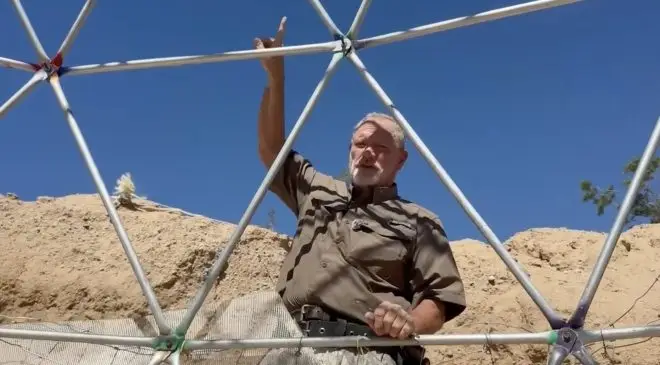
Welcome to Occupy the Land. We tighten all the bolts
Description: Transcript: Saw these two birds perching on top of