Homestead Update: Sphere Assembly, Chicken Water Tank & Sand Pond Dig
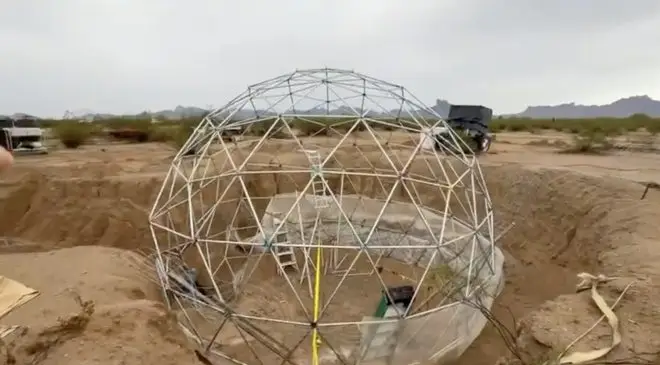
In this episode of Occupy the Land we make solid progress on the 20ft geodesic sphere root cellar! We lay hog fence reinforcement under the bottom struts, wire-tie it securely, and prepare to start mudding/embedding with caliche (Khaleesi) soil pulled from the sand pond. We also build and stabilize a gravel platform for a black poly water tank on a 55-gallon drum base, complete with gravity-feed siphon and float valve to supply the chicken nipples inside the coop. Additional updates include acidifying garden beds for potatoes, deeper sand pond digging (still holding moisture after 8+ months), building water-retention dikes, and notes on the approaching monsoon. Steady, practical advancement on food storage, animal care, and water systems in the Arizona desert heat! Peace.
Transcript:
So what he’s doing now is going to be a platform to put this water tank on its barrel. That we had is going to sit here, we’re going to fill it up and then it’s going to gravity feed on the other side. On the inside is the little water cup system for the chickens.
So they’ll come in to this bucket and a feed line will go here. We’ll put that up on the wall and then he’ll be able to just drink the water from there.
With the gravel going on the top of this down here, it’s going to pack it in as much as we can. Try to stabilize it.
Spreading all this gravel over this.
Mound here to stabilize it. When we put the water tank on there.
So now we’ve spread out the gravel and we’re wetting this down, and we’ll tamp it down and pack it really good. Put the barrel on top and fill it up. And then we’ll have to drill a hole through the back of the coupe and run the hose from the barrel to the bucket that’s in there.
Okay. Now here. What we did. I just piled up a bunch of dirt, and then I put water on it, tamped it down, put some gravel on it, and everything really stabilized this because we went for a couple of days, family and so on. And you worry about the chickens because you want to make sure they got enough water, five gallon bucket.
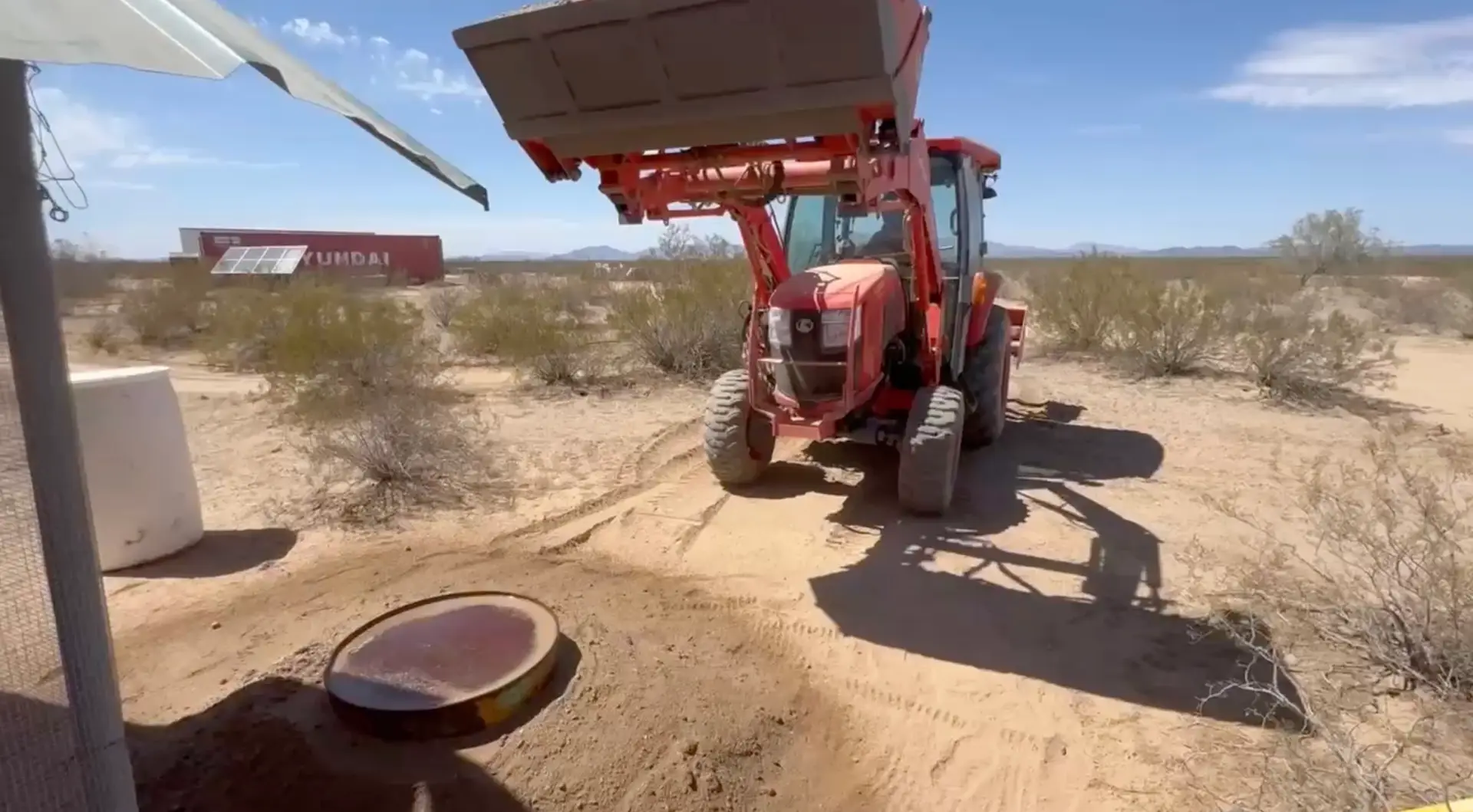
They’re going to do it. So we have this poly tank and we painted it black so it doesn’t get algae and so on. And we used a bottom third of a 55 gallon drum and just, you know, sledge it in to there and got it level to put this water tank on. Now we could do some rain harvesting or whatever to fill it, but we can just fill it up and that will last forever.
And I’ll show you inside of what this just siphons into, to keep the watering mechanism for the chickens. So I’ll show you that.
This is siphons in. And as this float here goes down, the water comes in and then it stops. So that’s the water source for that. And then that goes in to these little red things that they can get water from. And chickens, they’re just, they’re dumb because I mean, they’ll go and sit underneath one of these red things, and then they flap their wings to make it leak and dump water on them so they can nuzzle down into the ground.
You’ll see. They’ll just get there and take a nap, you know. And only we had Donna had to grab a couple of them and show them that water was in there, and a few of them do it, and the others will learn. We got bigger feeding thing and.
Having all this water here so we can leave for a few days and not have to worry about them. Look how big you’re getting. I mean, this has only been a few weeks and they just they just get really big because all they do is he let me leave this open. Now, they can kind of come out here, they’ll come out and do stuff.
But that’s what we need to do. We need to get the water thing done. And it’s and it’s hot. You know, I mean, it was up to 120 or earlier, you know, and they can’t. But as long as they got water or. Good.
So here I am, back in the garden again today, prepping the other grow bed for potatoes. This one has pretty much been prepped, but I’m trying to get the soil more acid. And I’ve added this soil acidic fire here, and it’s mainly sulfur and gypsum, so it takes a while to work it in. And and Arizona it’s got a lot of pain is really high out here, a lot of alkaline soil.
And I don’t really have a lot of that soil in here. Most of this is just the rabbit compost. And then I have peat moss to put in here. But the water is also very has it’s very hard. So it makes the the soil more alkaline. But we just keep working in this soil acidifying over time water and it working it in throwing coffee grounds and other things in here that will make it acid.
And eventually in maybe a couple of months, we’ll be able to plant the potatoes will be a little cooler and that we’ll be able to get that going.
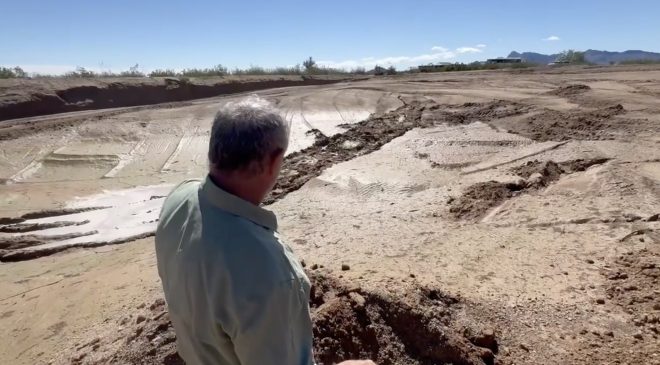
When it gets really hot in the middle of the day, I’ll get my air conditioned tractor and start digging out the sand pond more. And what you’ll see is it’s wet. You know, I went down just a couple of scoops and we start finding moisture. Now, there hasn’t been rain since October. And what is it? Almost July. So that’s seven, eight, nine months of no rain and certainly not any that soak this down here.
So this is retained in the clay for like ever. Now you see all this calcium. That is what makes this stuff really hard. You’ll see the blade almost doesn’t even go into it. And what we’re doing is this is the material that we need to make the mud for the root cellar and sealing that in. So we have a bunch over there of this, and then we have the dikes that we’re doing around the properties, the flood it.
So when it gets hot in the middle of the day, you know, I’ll come out here and do this stuff until it starts to cool off, and then I’ll start putting more struts on and and doing that. But I just wanted to show you that that’s why we want to back this water up and the ordered holes and so on.
Because once the water is slowed down and seeps into here and it goes about 12in every 24 hours, and if you can flood this and you can hold the water, it’ll just go and soak up like a sponge. And that’s how cactus survive go a year because they have the moisture down here. It’s just how it works. Then oh there’s a dust devil.
You know it’s going to go get Donna.
See that? And they’re always constantly coming through. And if they, you know, you got anything out that’s not. And just to that tree over there, we got a ten by 12 shed from my daughter. And I just waited it and scrapped it down and everything. If I hadn’t done that it’d be all over the desert. So you always count on dust devils?
Okay. Now this is where I take this load of the key from the Sam pond and building this dike so that we build it up here. There’s a wash their and this and all that up to where you see the trailer over there is going to be a lake, you know, it gets where it soaks in. But I wanted to show you how much sand and gravel is in this.
This is just makes like concrete. You get it wet and you compact it. Boom.
We still got a lot of struts to put together. And then here we got some sand and gravel for some concrete work that we need to do. But one roll of this fence is going to take care of the reinforcement for this. And as you can see, that’s the reinforcement for it. So that’s coming together.
And we’re starting to get clouds. Monsoon is going to be here soon.
Now this is the soil that is at the collegiate level in the sand pond. You get this wet and put it in there, and then it’ll dry and reconstitute into that hard stuff. So this is what we’re going to be making mud out of to embed everything. But we’re getting to that point where we’re going to have to start doing the bottom.
And I have to measure out ten feet, five feet from the center each side. And I may go I may go 12ft, you know, the level out the floor. So we’ll start working on that. And, you know, it doesn’t really make a lot of sense now until I really start getting into building the floor. And then you’ll start seeing what’s going to happen here.
Because once we get this fear done, then this just building the inside of it. So we’re getting close.
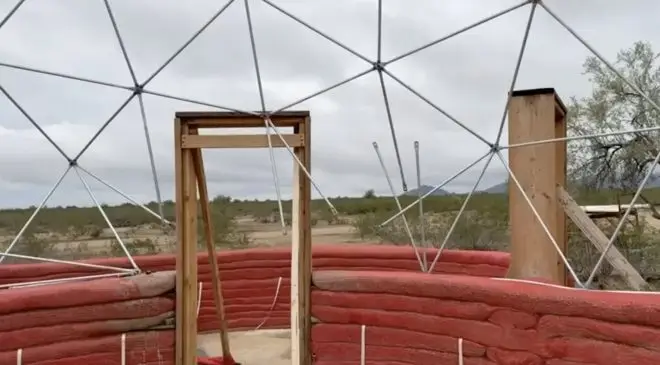
Okay. We have the dome constructed enough that we need to start putting the wire underneath, and then we’ll start wire tying everything. I got this kind of set to where I want it to be to get the door open and so on, but now is the time to start putting the wire in there, and it’ll start wire tying it down, and then we’ll start mudding it in.
So we needed to get the wire underneath this. That was a thing. We had to pull it with a tractor and so on. So that was easier than we thought it might be. And you can see that we’ll go ahead and take this and start mudding in. After we wire tie it down to the and attach it to the bottom of the dome.
And that’ll be the reinforcement for it. I’m going to go up probably another two runs and get the half of the sphere done, and then we’ll start packing this in. So that’s what this is about. Now the reason we have this so much longer is that it’s going to wrap up over the dome. And when we do the top half that’ll be a whole different technique.
But it’s going you know, we’re doing okay. I’ll spend some more time on it tomorrow and you’ll see where it’s going by then.
Well, the top of that point there is the halfway mark. You know, half green ones that go all the way around. So then we’ll start mudding this in and wire tying the fence. So this as far as we’ve gotten this week and it’s lay hot man. It’s like 110 degrees here. And it’s work on it in the morning and then the afternoon.
And we’ll have started muttered it in by next week. Stay tuned.