



Undeveloped Side vs Managed Side — Same Rain, Different Result
Welcome to Occupy the Land. After the rain we walk
In this episode of Occupy the Land, we walk the property to show the lasting results of an earlier flash flood that filled our sand pond with an estimated 70–90,000 gallons, proving our check dams, berms, and augered holes effectively slow runoff, create temporary lakes, and deeply saturate the clay soil. Months later, the desert remains noticeably greener than surrounding areas—grasses, creosote, and foliage thriving thanks to capillary action pulling moisture upward. We explain plans for perforated tanks, biochar/sand filtration, upper-terrace fruit-tree planting, and continued soil processing with the upcoming trommel. Current work includes raising pads between shipping containers for the future 30×60 building, prepping the workshop for dome strut fabrication, and enjoying peaceful mornings while balancing infrastructure with the homestead’s long-term vision of self-sufficiency and food production. Peace.
Transcript: Good morning. Welcome to occupy the land. Occupy the landlord. What we’re doing here. I wanted to, This is, when the shadows are longer, it’s easier to show. This right here is a dike. A build up between this. A couple of acres of clearing that we’ve done that is going to be up here is going to be the orchards, you know, the tree planting, the food bearing fruit and so on.
Now, as the water comes from these mountains, there’s like 4 or 5 washes that feed into this area. And it’s first going to go up here on the higher terrace. And you can see I don’t know if you can tell, you know, it has a divider here. So this will flood first up here. And then the overflow will go into the storage area which is down here.
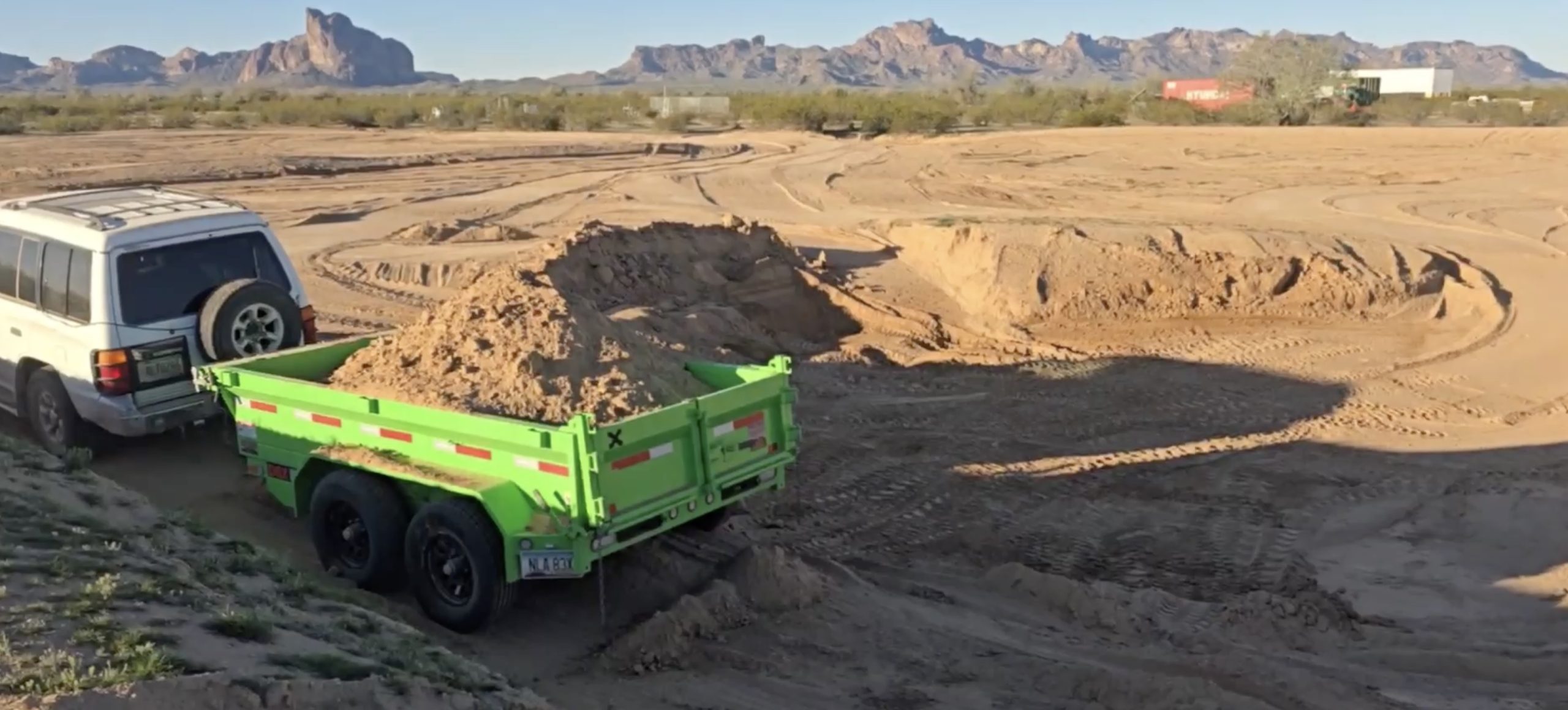
Now I’ve been spending a lot of time removing, soil from here that I need to build up between. I’ll go show you between the shipping containers to raise that up as a floor. And I have the tractor. These montero’s. I have had four of these. I still have three of them. You know, they’re in various different stages of it.
Needs something, you know, fuel pump on one and another. The engine where I just couldn’t get rid of them because they’re so goatee. They just freaking good. This particular model is a 97, 98 or something. And it wandered the car desert race like seven years in a row or something. I mean, it was just. And I could see why don’t it gets mad at me?
Whenever we get a new vehicle, I test it. You know, you got to hit the brakes hard. Do you kind of do fast little lane changing and little four wheel drive. And if it’s a four wheel and so on, and then you go get the it aligned and stuff. But I want to know the capabilities. And this thing has never got stuck.
It’s just amazing. So I keep these around. I don’t even think this one’s registered. I think we just keep it on the land to do this kind of work. And you can fill this sucker up. Well, I been keep digging this down. You can kind of get an idea. It’s starting to get, you know, low. But this will fill just right here.
This corner area is. Oh, man. You can get up to, you know, 100,000 gallons. We can already, support. So what? We’re going to go ahead and do is keep taking that wall back and using it. Fortunately, I need this soil. We need a lot to raise another foot on the house pad, which is, you know, over there and, between the shipping containers, the workshops there in the trailer, we have, area where a big building is going to go and we need to raise it up so that it doesn’t flood.
And it’s already raised on pads that I’ve created over there. But this is, you know, the rim around this is the corner of the property right here. And the overflow will just continue, you know, on its merry way. But this is where we’re going to be putting the water tank now. It’s going to be buried under stand. And then we wrap it with hardware cloth and have it perforated.
And then, you know, some activated charcoal and sand, whatever. And then we just fill it with sand that we process out of this wood trommel that I got a build which I need to have the workshop done. It’s all electrified. I got the, Yeah, I was going to take you. It had to be too much of a thing, but we’ll show you where we’ve been dumping it.
Now, what we’ll do is we got to build up the soil in different places so it doesn’t flood. Now, the problem is, is that all the sand and gravel is in here. And I need a trommel. It’s a spinning barrel that will separate the soil. And I can use it for everything. Now, fortunately, the way the desert is, is I have a lot of places that I can go.
There’s already the, regular erosion has separated it for me. I have down in, riverbed, which is way down there because this flows down to the bottom of the valley. There is a river, and it has really fine sand for mortar and stuff like that. Then you have the wash sand that is, wash sand. So it’s, you know, tiny gravel and so on.
Then you have the gravel and there’s really no rocks. I mean, every now and then you’ll get a rock. Look, I have a rock, but, generally it’s alluvial floodplain, which is just erosion from these mountains. And it’s pretty easy to dig. And you can see, you know, gets a lot of foliage. It’ll start to dry out here after a while.
But, You can see even under these creosote, which is, you know, supposed to be poisonous to other wildlife, I mean, plants and so on. And, they find they adapt. But, you don’t want to be using creosote, motion. You know, that’s one thing we’re learning. You don’t want to mulch that up, you know, use it to burn or, you know, you can put it in compost.
Piles kind of separate, but the even the branches are saying is not good. But, we have a lot of other trees via the foliage and so on that we do compost and woodchip. Now, this is what I’m building now. We got our solar panels up. We got the electrical, I got electrical run over there. I can do 220 and 110, all my equipment and everything.
But this is what we’re building up now. You can see now it’s got the gap here. And I’m building this up to be at the bottom level like here. Now what we putting in concrete here. And I need a pad of be probably like a square or a semicircle round here. Depends on how I want to do it.
But just to get started on a floor that will be in here, this is a floor that’s raised up to put that red. There’s two red boxes there. Have a building in there, 30 by 60. Yeah I think it’s 30 by 60 by 20 to be high. It’s big. So it’ll be where I can put all the attachments for the tractor and so on and the tractor and get it out of the sun and, you know, the weather, but you know, so I have a lot to bring over here.
I don’t know how much you can tell from, you know, the camera here, but this is what I’ve been doing for the last week and just bringing over soil. So I need that sand dam over there to be able to have the soil to breathe. That’s a lot. You know, I’ll probably do that. I have no idea, you know, 15, 60 loads.
And then we build it up here. And the reason we did this is I didn’t want this to flood into the shipping container. So I raised him up about, you know, foot and a half or something. And then I got to fill in the soil between them and we could use this. Now I have other things being stored at friends and family and some of our vehicles that I want to have.
It’s going to be Ernie. They call it lay down yard, you know, scrap yard, junk yard, whatever. Three sources. So they, these other montero’s that I have work, I just need to do some work on them and so on. I just don’t need them right now. So we’re going to go ahead and get them. And we have a, 2500 Dodge pickup that had the engine go.
So we, you know, need that for Donna’s other, big truck. We could use that for a lot of spare parts and so on to get it going and running. But these are projects that get in the way of building, man. You know, I we’ll do that later. So this is what we’re working on is mainly the, workshop area and everything because I need it.
I need all my welders and plasma cutters and fabrications and whatever doing that. But as we showed you before, you know, here’s our power station. You know, we have the inverters and, just give you a quick look, but they, Those that batteries, inverter, charge controller. Now, this charge controller, I got up there because we got a windmill and, it’s a power windmill.
Generates that a little bit. Just a when it blows out here and the wind gets going, it’s frustrating as heck and blowing stuff around and so on. But when you got a windmill, I’m not so bad. Here is we can power. Cool. And then it makes power at night as well. So I have these posts. We were going to put the panels were going over there, but that building was going to come out and I had to move them anyway.
So I took the post out and we can put up some more panels for done, over here. Now she’s kind of the mine yesterday. She. Yeah. Do that. Make me power station. Make it go were that. Show me which button to push I go no no no no no no no no no. You’re going to half of all the electrical power.
She doesn’t really understand what each component is or and don’t want to know. I mean, I explain it to her, but it just, you know, she’s not retaining it. So I go, nope. Yeah, we have all this stuff. We’ll put it on the workbench, we’ll go through it. I’ll show you how to do it, and then she will know because she needs to know.
So we’re going to go ahead and do that. And then she’ll have a power station out here because I have the panels, I have charge controllers, I have the, inverter, you know, that’s made it so she’d get all the power. She wants to run her water and be able to, you know, pump water here at her sink that we got.
And that hasn’t been set up yet. So we’re going to go ahead and when. But we both got time to go over and power this. We’re going to go ahead and do that. And she gets an education. No she’s rather I just do it. But you know it’s necessary that you understand how this stuff works to be able to, you know, survive and what’s going on around the country.
We’re in this big polar vortex, freeze your butt off stuff. And my oldest daughter with her family, they have a fifth wheel with gazillion pop outs in their F-350. You know, they’re pulling around here in Texas now, and they’re like, damn, it is getting just, you know, rain and sleet and subzero temperatures. And you wake up with everything ice skating rink and cars just sit there and wait until it’s done.
So they’re in the middle of it and, I know a lot of people around the country are in here. We’re I mean, I wake up, it’s cold, man. It’s it’s like. It’s like going to be down in the 60s today. It’s just so nice here, you know, and enjoy living in Arizona. Now this is the pad where the house is going to go, the main build.
And I have to keep when I get done with all the soil around the workshop and everything, I got to do a gazillion loads here. I’ve already, raised it about, oh, almost a foot probably, mom, if you can see the ridge there. But, this is where the water comes this way. So I needed to go around the house.
Pat. So there is a wash over here, and then another one on the other side of that between the house pad and Donna’s garden area. And this is where the water will go around. It is towards the sand pond. Now I’ve only had like one and a half good rains to be able to determine what how. But it works.
I mean, we had the laser level when we get it out and we kind of had a bead on it, so there wasn’t really a lot I had to do, you know, like, you know, it comes down this.
It goes through and, and there’s a, it’s a ten from a shack that’s back there. Old timers living back in. Yeah. These homes are they got you know, it’s like 40s 50s kind of stuff. I mean it was a long time ago. They were out in the boonies doing open range. And this is the tractor we were able to get this kind of backed up and then it broke free here, which it has overflow.
It needs to continue on the go down, do its thing in other places. But this is where the, you can see I kind of got it raised here. You know, when I got time, I always put a load here a little bit more, block this off and so on. But this is exactly how it’s supposed to work.
The check dams go here in front of these washes. Backs out all up, fills in the auger holes that we have in it. We put sand in it to keep them open, and then it just charges the soil. And it soaks up so much of it that, you know, you can go months, year, you know, with, enough water to keep certainly the indigenous plants alive.
And that’s why we decided that down there as part of the, upper terrace for the sand dam area up there, that’s where the orange all the water will go there and flood that first. So the check dams go here to hold this back, and then, of course, it’ll fill up. And, you know, a good storm will fill up like ten minutes.
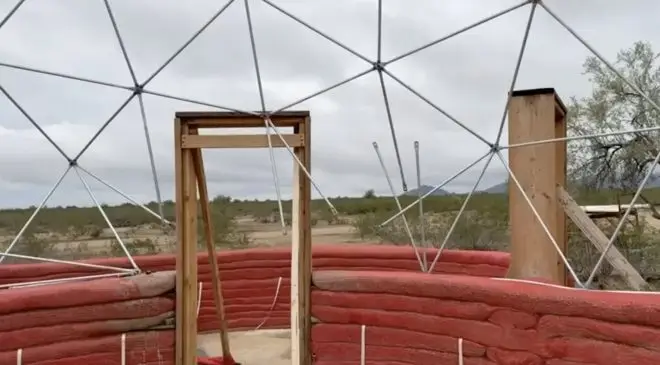
And then it overflows and it’ll go across the road here. Now we’ve experimented. One of the first things we did, we started with the hyper Adobe Earth bags, and we stacked them here. And then we, coated them with a stucco mix of basalt and fiberglass, reinforcement fibers and put it and this is held up great. I don’t have any cracks or I mean, it’s this is kind of how the exterior of the domes are going to be, at least until we find something better.
But just work it out. Well, so this is one of the, probably about five main washes. Yeah, three of the bigger ones. And we can, can you use them to control the water to flood all this? That is the goal. And it’s all these different things are in parallel, you know, it’s like here’s, you know, I started piling up, you know, some dirt and the, some get a big berm here that will interface with that little flood back there.
And I got to do it along the right side of the road. There. So it’s all part of a, a plan, you know, and we’re and we’re doing it. So I wanted to go ahead and just kind of show you where we’re at now. You got a whole bunch of little video and so on. Different Thetas, Donna’s car, her enclave.
It didn’t like the desert, but it’s doing okay. We we’re going to get rid of that and trade that in. It looks like I have a, a really nice big collating copier underneath there. I got to get that. And one of the doors, it’s going to be a project here in the next week or two. And then we have the backhoe come attachment to the tractor.
And this is Donna’s, you know, from our monster truck. And, we have another one that we can use first, but we need to get the running boards off of it and everything. There’s my, you know, you know, tool around truck, and I don’t get to drive hers. I don’t want to because I get blamed for everything. So I just I got my pick up.
I’m good. So we eventually get back to this. But we’re at the stage now of integrating the dome onto the top of that. We got to go three more layers to do what we want to do, and then we integrate that into the windows and doors. We got to start doing a lot of stuff, but I need the workshop.
So I’ve been focusing. Everything we’ve been doing is on getting that workshop done so that we can do all the stuff that we need to and fabricate and struts on the dome, stamp, press, welding, plasma, blah, blah, blah, blah, blah. So that’s what’s going on. So in the meantime, we just enjoy it out here every day we get up.
There’s plenty to do. You know, it’s getting to the point where there’s a lot of maintenance. You know, there’s things like you gotta tend the garden every day. I gotta, you know, keep building more solar powered stuff. You know, the plumbing is not that bad. You know, you get a windstorm, you got to clean up, you know, whatever.
Now, what we did is that dish used to be on top right there. But you walk around the bus and it would move the dish and break communication with the relay that’s on that mountain right there. So what we’ve done is I put a railroad tie in and let it get all solidified and so on. And, so that got solid.
And then I took and put a aluminum tubing that I got a bunch of and, and, this stuff is awesome. And we’ll run out of that one day, and that’s not going to be good. But, go ahead and screwed that in there. But the dish had to go to that mountain and we’re just going to test it today.
Johnson sneezing from the economic truth is coming on the show today. And he is the one that’s created Outernet which is a mesh network that’s been kicking butt. They came out and installed, here. And we went on top of that mountain to put the relay. I was, saying, so that is you go look at the videos.
That was last March in 25. And, it’s been almost a year, and we’re upgrading it because they took the once they realized we could go 200 down and 100 up on speed. Whoa. We can really get some stuff. Okay, well, you guys work on it. Well, I get other stuff done, so we’re going to be talking about that today.
And actually, making use of the the mesh network. We’ve tested it and we use it and it doing its thing. But we need to, you know, get it to where actually neighbors can start using it. Now this is where we’re going to put test a, potato garden. You know, we’re just going to put a bunch of potatoes here because it stays moist, you know, long time when you scrape down the, soil, you can see that it’s charged and only go down until six inches or so, and it’s just wet ground.
This is, we got to separate out the creosote. We don’t want to put that in there. We just use that for burn pile. But there’s a lot of wood. You know, we have, you know, for making decorative things, branches that we would use for, post and integration into the build and so on. So kind of separate that out and then the rest of it, you know, this is I think this is Ironwood here.
And, you know, a lot of this stuff is just firewood that we have plenty. And we got so much more to to do. But the creosote. Yeah. You know, we got warned about that. You shouldn’t be, you know, using that and, composting and so on. So we generally just build, burn it and, yeah, it’s I think what we’re going to go ahead and do is, you know, we have grandkids.
They want to get paid for something. Can we go out and get paid? Yes you can. And what they could do and they have an endless supply of it is all just dead branches and stuff around these. And that’s what makes your tires flat and you go up against, you know, these branches go right through tires so you can see all that dead stuff around these branches.
We trim that off with hedge trimmers and chainsaws and whatever. We’ll get them out here and we’ve already done it. And you can craft these into like, hedges. You know, you trim them back and then kind of keep them low and let them flow. They’ll turn into a ball. You know, it’s a I’ve seen guys that are showing me that.
I said, oh okay, we can do that. But where, you know, a lot of it around where we spend a lot of our time, like that building pad, that is where the home is going. And we get that view and the other views around. It’s going to be awesome. It took a long time, you know, for us to select exactly where we wanted it to go.
And it just kind of develops organically. And I’ve I’m liking that. You know, you really spend some time on the land and where you want it to be and how the roads naturally kind of develop and so on, and it becomes a thing. Then you go here, here, here, here, and it makes sense and, and it works. Now on the other side over there is the, the runway.
You know, that kind of go around, walk over there and then we’ll end it. But
I added it, I wanted to have the runway because I wanted to do exploring here. I used to fly ultra lights back. God, 35 years ago or something. And I really liked it. And, you know, Donna is a parachutist. You know, she’s now my grandma goes parachuting, you know, and we have the kids go out there for solos and all that kind of stuff.
So every now and then she’ll go parachute just to get her adrenaline up. And, it changed her. I mean, she’d be a lot more confident than you first. I’m. I’m good. I’ve done a tandem once before. There, I did it. Get off my butt. But, you know, I always wanted that. So I used to fly, sail planes too.
And I was young. I was like 13, 14. I learned to fly sail planes. My dad was a pilot, and I just always wanted to do that. But it’s not quiet. And, you know, ultralight start quiet parachuting in and quiet, hot air balloons. That’s the only time you ever get some quiet. You just. You do bubbles and you just big soap bubbles.
You just kind of float with them. They don’t go anywhere. It’s like you’re a bubble with it. That was the experience I was looking for. So I’m like, cool, got that under my belt. But I like going up and down, be a mobile and see from the air ultra lights. So that’s what this is for. This is for us.
And we’ll get it all trim back where we need to and everything. And got plenty of room for landing. My son has, does paragliding, you know, the big, you know, like a parachute parasail, whatever they call it. And, he’s always eyeballing courthouse Rock there. He’s. Oh, I could go off of that, but he has a winch on his truck, and his brother comes out with them, and they kind of go out here and have some fun.
Then, this road here, it kind of veers off to the left. That was the first road on the land. That’s when we, you know, kind of dodging creosote and just kind of naturally evolved. And this where this dome is, you know, the panel between that and that enclave vehicle, is it the center of the property? That is the center.
Now, this side we haven’t developed at all other than that road and then the border roads that, you know, perimeter of the property. Now there are some other trees you know, around and we’re going to be planning more and they grow. You give them more water, they grow really fast. So we have a lot of other areas that we could have, you know, just nice picnic areas.
Isolated another home. My, sisters may retire out here. We have, other family. You know, my mom might need some help, and, I got, I don’t know, probably at least seven acres all over here that’s undeveloped, that we can do whatever. So we’re focusing on this half on this other side. This runway here is where we’re doing a lot of the infrastructure and the building and getting all our goodies.
So we had our first holidays here. It looks like the family and we couldn’t drag them out here. And now they’re, you know, think about Easter. You got the extended family coming. It’s not it’s not as bad as they thought, but you know, the wind. We got to make sure you’re able to block the wind because in, you know, February to April around in there’s about six weeks and it’s really windy, which is one reason why I have a windmill.
You don’t complain about it as much. Now, this year, all the drainage comes this way. It’s all set up to go to that corner of the property and not go off the land till it hits that corner. Now, this right here is one of the main washes that comes through the property.
And we kind of back it up here. So it’ll do this.
You know it starts to fill in these holes and so on. Foot charges the ground. So then it flows here and around camp here. And then it makes it on the other side of the solar panels over there around the bus. It goes in the sand part. Eventually everything goes to the sand part. And from the runway it comes through here and it goes that way.
So I, I captured all 18 acres of, of water. I really need that. They could isolate it and put a wall around the property and everything. And just the water. I get on 18 acres, seven inches over 18 acres is like a year’s a lot, whole lot. Especially when we got it to where we want it to, saturate up there anyway without having to pump it from here.
And then it goes into that upper terrace, and that’s where we want the water for the fruit trees and everything anyway. So I’m really not seeing a big giant power demand of distributing water around, because that’s why we do these IBC totes. We just go around with the trailer and fill those up. And this is the construction, water that we have.
We just fill that up and we move it around where we’re never during construction. We need that for, like, the concrete and so on. Now in there, that’s a, a table saw that’s in there and that’s a chop saw. And we got some stuff and tools and stuff up here, and we’re going to get back to it.
Now we have over here, these three wagons or what we’re going to use to,
Separate all of the soil in the trommel. I have to build it for these because I want to be able to, you know, just, you know, it’s processing and, you just pull the wagon out, dump it in a big pile, and you just keep doing that. You don’t have to move the tram around all the time. And, and these bikes are awesome.
You know, we we scored on that. They wouldn’t deliver or couldn’t or lost it. And we got refunded for two of the bikes. And then he said, well, if they come you can keep them. So we got those free. And then we had to buy, you know, they’re cheaper ones. But these are pep, you know, we got two of these and it’s just so convenient.
Just to go tooling around now. Donna, we decided we were going to empty it. But everybody’s like why? You know? So we put a cover on it and then we got like 3500 gallons, you know, here or more that, we got as backup and we just, checked the water and chemicals and everything on it, a couple days ago, and it was fine.
Great. Clear. So as long as you keep it covered, don’t get light in there. You’re doing pretty good. This is just so nice. I mean, this is where we come out. That is, if you take the top off and it’s a fire pit, and, we got no fireplace over there. We put the chairs around it and so on, you know, and just enjoy ourselves.
We’re really liking Arizona is outdoor living. You know, it’s really about that now this comes off so, you know, it’s got a little fireplace. So yeah it doesn’t throw a lot of heat. So what we do is we get those little propane Mr. buddies and put around people’s feet because it was it was cold a couple of nights, you know.
And we still like it out here. Well, this is what we’re doing, you know, this is, you know, how we’re living and, you know, it’s it’s it doesn’t suck. It’s just not that bad. Now, one thing we call it, it’s called a fuel keg. And, we need to just make sure the fuel, buddy, we always want that.
It’ll be comfortable. So it’s a lot cheaper than buying these canisters. They gone up. Oh, my God, or the stupid. But, you refill them, we get for those little tanks, and we just refill it, and it takes a minute, and and we’re good. So this and then we put up this shading if we need it, you know.
And Donna wants shade over her outdoor kitchen is very entertaining and so on. So life does not suck while everybody’s freezing their butt off around the country. And, you know, a lot of, economic problems are coming. Silver and gold spike is just a sign of, you know, abandonment of the fiat system is kind of what we were doing this for in preparation for more self-sustainability individual liberty, self-responsibility.
Taking care of yourself two is one. One is none kind of thing. And it’s just been a really good experience. And I encourage you guys to keep track of us. Occupy the land.org.
From Moon Dust to Green Oasis: Flash Floods & Water Retention Winshttps://t.co/6Atxqdw2eT pic.twitter.com/erVomKIJzk
— occupytheland (@occupy_the_land) February 21, 2026
Welcome to Occupy the Land. After the rain we walk
Welcome to Occupy the Land. We finish the top half
Welcome to Occupy the Land. Donna and I assemble the